
 English
WDM
WDM (Wavelength Division Multiplexing) is an advanced optical fiber communication technology. Its principle involves combining optical signals of different wavelengths and rates through a multiplexer, coupling them into different optical channels within the same fiber for transmission. The core function of this technology lies in significantly increasing fiber capacity and efficiently utilizing fiber resources.
CWDM
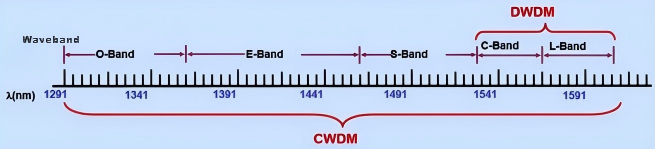
CWDM (Coarse Wavelength Division Multiplexing) operates with a 20nm wavelength spacing, covering 1270nm to 1610nm across 18 bands. However, due to pronounced attenuation in the 1270–1470nm range for legacy fibers, this band is typically used for short-distance transmission (<40 km), while the 1470–1610nm band is applied for longer distances (>40 km).
DWDM
DWDM (Dense Wavelength Division Multiplexing) offers finer wavelength spacing options (e.g., 1.6nm, 0.8nm, 0.4nm, and 0.2nm), supporting up to 40, 80, 160, or even 192 channels. Typical DWDM operating wavelengths include the C-band (1525nm to 1565nm) and L-band (1570nm to 1610nm).
MWDM
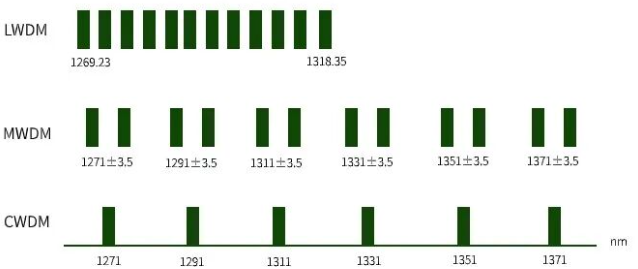
MWDM (Metro Wavelength Division Multiplexing) expands capacity by reusing the first 6 CWDM bands. Its key innovation compresses the original 20nm CWDM spacing to 7nm and employs semiconductor cooler-based temperature control to split each original wavelength into two (offset by ±3.5nm). This approach increases capacity while conserving fiber resources. The wavelength conversion details are as follows:
| Original CWDM Wavelength | MWDM Left-Shifted Wavelength (λ − 3.5nm) | MWDM Right-Shifted Wavelength (λ + 3.5nm) |
|---|---|---|
| 1271nm | 1267.5nm | 1274.5nm |
| 1291nm | 1287.5nm | 1294.5nm |
| 1311nm | 1307.5nm | 1314.5nm |
| 1331nm | 1327.5nm | 1334.5nm |
| 1351nm | 1347.5nm | 1354.5nm |
| 1371nm | 1367.5nm | 1374.5nm |
LWDM
LWDM (LAN Wavelength Division Multiplexing), also known as fine wavelength division multiplexing, is primarily designed for Ethernet applications. It features channel spacings of 200–800GHz, positioned between DWDM (100GHz/50GHz) and CWDM (~3THz). LWDM typically operates in the O-band (1260nm–1360nm), specifically utilizing 12 precise wavelengths from 1269nm to 1332nm with ~4nm spacing. A key advantage of this technology is its stable signal transmission performance near the zero-dispersion wavelength.
FWDM
FWDM (Filter Wavelength Division Multiplexing) leverages mature thin-film filter technology. These devices efficiently multiplex or demultiplex optical signals across broad wavelength ranges, making them widely applicable in erbium-doped amplifiers, Raman amplifiers, and various WDM fiber networks.


