
 English
I. What is POTN?
Packet Optical Transport Network (POTN) is an integrated transport network that deeply converges packet transport and optical transport technologies.
Built on a unified packet-switching platform, POTN simultaneously supports Layer 2 switching (Ethernet/MPLS) and Layer 1 switching (OTN/SDH). This architecture enables flexible feature customization for diverse deployment scenarios, offering superior network flexibility and scalability to meet multi-service bearing requirements.
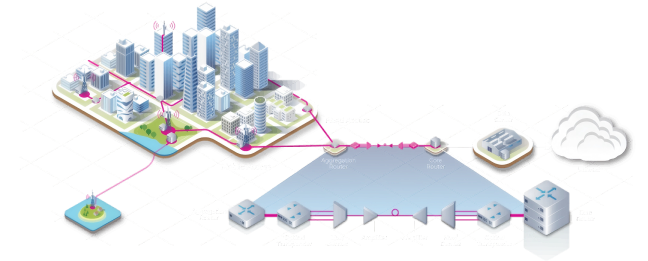
II. POTN Evolution Paths
Primarily deployed at aggregation/core layers, POTN's unified platform allows flexible combination of packet § and optical transport (O) functions according to demand. Two evolution pathways exist:
-
Path 1: PTN → POTN
Starting point: Existing Packet Transport Network (PTN)Evolution: Gradual integration of optical (O) capabilities
-
Path 2: OTN → POTN
Starting point: Optical Transport Network (OTN)Evolution: Incremental addition of packet § features
Since access layers typically employ PTN, the PTN→POTN path is more logical and natural from an end-to-end unified management perspective.
III. Application Scenarios of POTN
In the era of full-service operations, POTN's core objective is unified multi-service bearing. By integrating multiple transmission networks (e.g., MPLS-TP, PTN, WDM, OTN) into a single platform, POTN combines the functionalities of PTN, OTN, and traditional SDH.
This unified architecture enables "independent shared-network" development for LTE backhaul, enterprise clients, and residential services—significantly simplifying network layers, reducing O&M complexity, and cutting deployment costs, space, and power consumption.
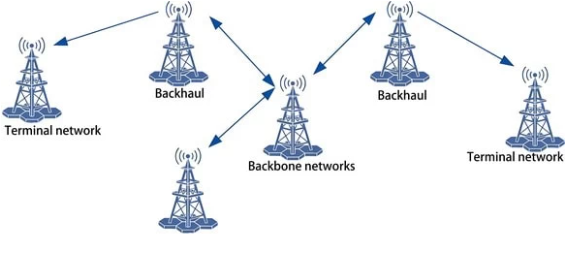
3.1 Base Station Backhaul Services
3.2 Enterprise Services
Enterprise services exhibit distinct trends of high profitability, rapid growth, packetization, and broadbandization. Early services relied on E1/STM-1/FE connections with point-to-point traffic flows. Current services feature significantly increased bandwidth, emerging dedicated line demands, and evolving traffic patterns toward point-to-multipoint and multipoint-to-multipoint configurations.
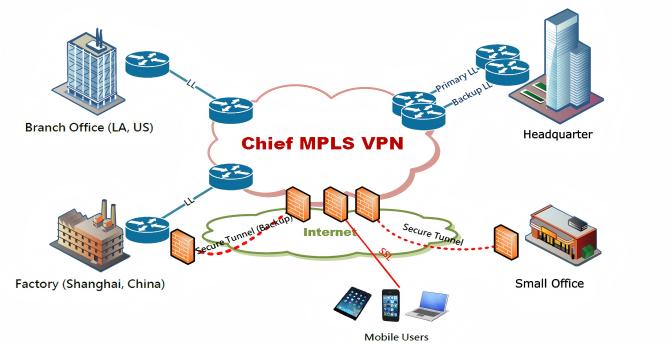
POTN can support dedicated line and private network services for large customers. It can rapidly support either OTN for CBR (Constant Bit Rate) services or packet switching based on MPLS-TP according to customer requirements.
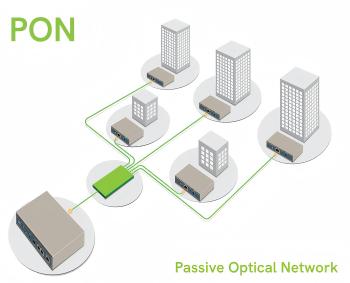
3.3 Residential Services
For OLT uplink traffic, POTN supports three transport modes:
- MPLS-TP over OTN: Uses MPLS-TP encapsulation with LSP 1:1 protection and shared ring protection, offering statistical multiplexing and flexible traffic forwarding.
- Native Ethernet over OTN: Employs Ethernet encapsulation with statistical multiplexing and Ethernet Ring protection.
- ODUk Transparent Transmission: Direct ODUk mapping enables ultra-low latency via rigid point-to-point pipes, though without traffic aggregation capabilities.
IV. Advantages of POTN
4.1 Cell Switching and Hybrid Line Card Technology
- Technology Convergence: While PTN excels at packet switching but lacks coarse-grained channel scheduling, and OTN specializes in channel scheduling but lacks packet switching, POTN integrates both strengths at the switching layer.
- Unified Cell Switching: Unified cell switching technology achieves seamless integration of small-granularity packet switching with large-granularity channel scheduling.
- Hybrid Line Cards: Traditional PTN/OTN combinations may cause internal fiber jumps and service delays. POTN's hybrid line cards support flexible pipelines, enabling concurrent bearing of both packet-switched and framed (e.g., SDH/OTN) services.
4.2 Multi-Layer OAM Mechanism
POTN adopts a hierarchical OAM (Operation, Administration, and Maintenance) design. Both OTN and packet technologies follow transmission models, and their multi-layer OAM processing mechanisms enable flexible insertion and extraction of optical signals with varying granularities across different optical layers.
4.3 Coordinated Multi-Layer Protection Mechanism
As a fusion of two transmission technologies, POTN requires channel protection across multiple network layers. Through coordinated mechanisms, it achieves synergy between different protection layers, establishing a multi-layer protection framework aimed at end-to-end service protection. This effectively combines PTN and OTN protection schemes, optimizing both multi-point failure resilience and bandwidth efficiency.
V. How to Upgrade from PTN to POTN
Currently, PTN (MPLS-TP) networks are widely deployed across access, aggregation, and metro core layers. With continuous growth in service bandwidth, operators increasingly require PTN network upgrades:
- Option 1: Add DWDM interfaces to existing PTN equipment to enable high-capacity, long-distance wavelength transmission.
- Option 2: Introduce ODUk switching alongside PTN packet switching, allowing non-terminated traffic to bypass via ODUk scheduling while flexibly aggregating/dividing terminated traffic between packet and ODUk pipelines.
PTN devices based on unified packet-switching platforms can achieve seamless upgrades by simply adding OTN/POTN line cards or P-O conversion cards. Alternatively, carriers may choose to directly deploy new POTN networks at aggregation or metro core layers to meet future demands for higher bandwidth and intelligent scheduling.
VI. Conclusion
As a deep convergence of PTN and OTN technologies, POTN inherits PTN's flexible packet-switching capabilities while incorporating OTN's high reliability and coarse-grained transmission features. It demonstrates clear advantages in unified multi-service bearing, simplified network architecture, improved resource utilization, and intelligent O&M.
Looking ahead, as 5G, cloud computing, video services, and enterprise private lines continue to grow, traditional PTN networks will face bottlenecks in capacity and flexibility. POTN will emerge as critical infrastructure for converged multi-service networks. Its robust multi-layer protection coordination and intelligent scheduling capabilities will empower operators to achieve "high-bandwidth, low-latency, intelligent" transport network evolution, positioning POTN as the core direction for next-generation optical transport networks.


