
 English
With the explosive growth of the global artificial intelligence (AI) industry, the demand for high-speed optical communication in AI servers has surged exponentially. 800G optical modules, with their ultra-high bandwidth and efficient interconnection capabilities, have become the core carrier of data center computing power networks and a critical infrastructure supporting next-generation ultra-large-scale data centers, high-performance computing (HPC), and cloud services. This article will comprehensively analyse the technical details and industrial value of 800G optical modules from the perspectives of technical classification, form factor differences, and core applications.
800G Optical Modules: Single-Mode vs. Multimode – Technical Differences & Application Scenarios
Based on transmission media and distance requirements, 800G optical modules are mainly divided into two categories: single-mode 800G optical transceiver modules and multimode 800G optical transceiver modules. These two types of 800G transceivers differ significantly in technical architecture, transmission performance, and applicable scenarios, catering to the interconnection needs of different levels within data centers.
Single-Mode 800G Optical Modules: Ideal Choice for Long-Distance Transmission
Single-mode optical modules use single-mode optical fibers as the transmission medium. Leveraging their narrower beam diameter and lower signal attenuation, they can achieve long-distance transmission ranging from hundreds of meters to over ten kilometers. They are primarily suitable for scenarios such as data center campus interconnection and interconnection between core switches and remote server clusters. Currently, mainstream single-mode 800G optical modules include seven standards: DR8, PSM8, 2xDR4, 2xFR4, 2xLR4, FR4, and FR8. Each standard has distinct characteristics in terms of transmission distance, fiber requirements, and technical architecture:
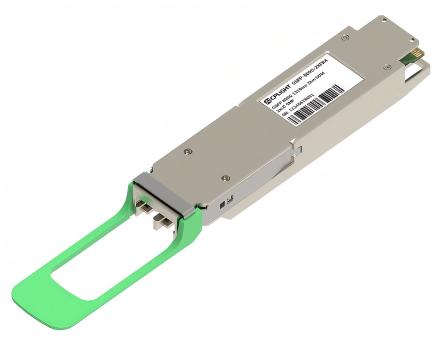
| Module Type | Core Technology | Transmission Distance | Fiber Requirement | Typical Application Scenarios |
|---|---|---|---|---|
| 800G DR8 | 100G PAM4 modulation, 8-channel single-mode parallel technology | 500m | 16 single-mode fibers (8 transmit, 8 receive) | Core layer interconnection within data centers, such as direct connection of 800G-800G switches and compatible interconnection between 800G and 400G/100G server nodes |
| 800G PSM8 | CWDM (Coarse Wavelength Division Multiplexing) technology, 8-channel parallel transmission | 100m | 16 single-mode fibers | Long-distance interconnection at the data center aggregation layer, suitable for fiber resource sharing scenarios to reduce fiber deployment costs for multi-device interconnection |
| 800G 2xDR4 | Integrated with two 400G-DR4 interfaces, dual MPO-12 connectors | 500m | No fiber breakout cables required; a single module supports two 400G links | Data center upgrade scenarios, enabling smooth transition from 800G to 400G devices and compatibility with existing 400G DR4 optical modules |
| 800G 2xFR4 | 4-wavelength CWDM4 (1271/1291/1311/1331nm), Mux multiplexing technology | 2km | 4 single-mode fibers (62.5% reduction in fiber usage) | Data Center Interconnection (DCI), interconnection of core devices across buildings, balancing transmission distance and fiber costs |
| 800G 2xLR4 | 4-wavelength CWDM4, enhanced signal amplification technology | 10km | 4 single-mode fibers | Long-distance campus interconnection, metropolitan area data center interconnection, adapting to cross-regional computing power scheduling needs |
| 800G FR4 | 4-wavelength PAM4 modulation, 200Gbps per channel | 2km | 2 single-mode fibers | HPC cluster interconnection, high-speed data transmission in Storage Area Networks (SAN), balancing bandwidth and distance |
| 800G FR8 | 8-wavelength parallel transmission, 100Gbps per channel | 2km | 2 single-mode fibers | High-density interconnection at the core layer of ultra-large-scale data centers, providing higher transmission capacity redundancy |
A core technical feature shared by single-mode 800G optical modules is the adoption of the PAM4 modulation format. By transmitting 4-level signals within a single symbol period (compared to 2 levels in traditional NRZ), PAM4 doubles the bandwidth without increasing the symbol rate, enabling a per-channel transmission capacity of 100Gbps. Additionally, most single-mode modules utilize a combined parallel channel and wavelength division multiplexing technology to reduce fiber usage while further improving transmission efficiency and distance.
Multimode 800G Optical Modules: Cost-Effective Choice for Short-Distance High-Density Interconnection
Multimode 800G optical modules use multimode optical fibers as the transmission medium and are mainly suitable for short-distance (≤100m) high-density interconnection scenarios within data centers, such as rack-to-rack and server-to-switch connections. They offer advantages of low deployment costs. Currently, there are only two mainstream standards for multimode 800G optical modules, each designed for different fiber resource requirements:
800G SR8: Moving Beyond 400G SR4 with Doubled Bandwidth
The 800G SR8 optical module is a direct evolution of the 400G SR4, with core technical features including:
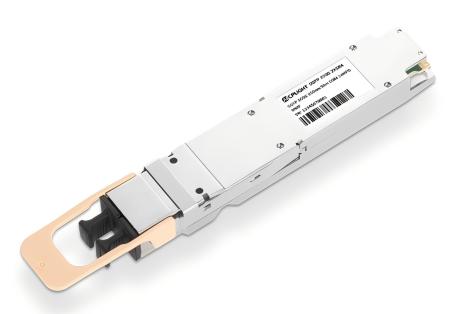
VCSEL Laser Technology: Adopts 850nm wavelength VCSEL lasers, offering low cost and high reliability, and is compatible with the transmission characteristics of multimode fibers.
Channel Expansion Design: Continues the parallel transmission architecture, increasing the number of channels from 4 (in 400G SR4) to 8, with a per-channel rate maintained at 100Gbps PAM4, achieving a total bandwidth of 800Gbps.
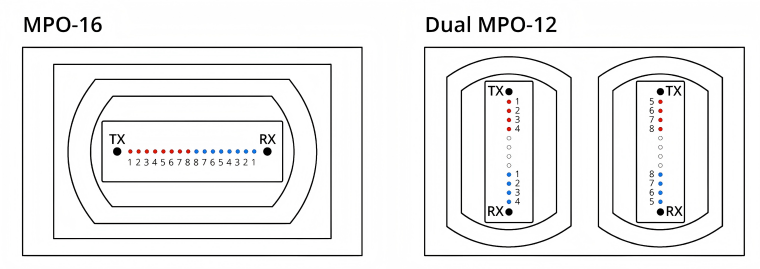
Fiber and Interface Requirements: Requires 16 multimode fibers (8 transmit, 8 receive) and uses MPO-16 or dual MPO-12 interfaces, compatible with existing multimode fiber infrastructure.
Application Scenarios: Interconnection between Top-of-Rack (ToR) switches and server nodes in data centers, short-distance storage cluster interconnection, especially suitable for scenarios requiring high bandwidth but short transmission distances.
800G SR4.2: An Innovation for Saving Fiber Resources
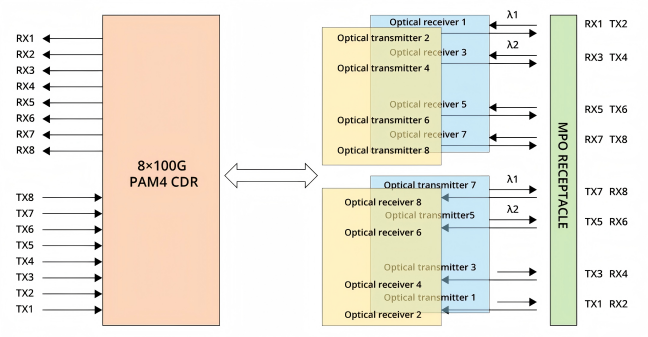
The 800G SR4.2 is an optimized solution designed for fiber resource-constrained scenarios, with its core breakthrough lying in bidirectional transmission over a single fiber. Specific technical details are as follows:
Dual-Wavelength Bidirectional Transmission: Uses two wavelengths (850nm and 910nm) for transmit and receive signals respectively, enabling simultaneous bidirectional data transmission over a single fiber.
DeMux Wavelength Separation Component: Incorporates a built-in wavelength demultiplexer (DeMux) that can accurately separate signals of the two wavelengths to avoid mutual interference.
50% Reduction in Fiber Usage: Requires only 8 multimode fibers (compared to 16 for SR8), significantly reducing fiber deployment costs and wiring complexity inside cabinets.
Application Scenarios: Interconnection of high-density server clusters (e.g., AI training server racks), interconnection of devices inside high-density cabinets in data centers, enabling high-bandwidth transmission in limited spaces.
800G Optical Module Form Factor Technology: Differences Between QSFP-DD and OSFP
Form factor technology serves as the physical carrier of 800G optical modules, directly determining the module's size, power consumption, heat dissipation capacity, and port density. Currently, the mainstream form factors are QSFP-DD and OSFP. These two form factors have distinct design concepts and cater to the needs of different scenarios.
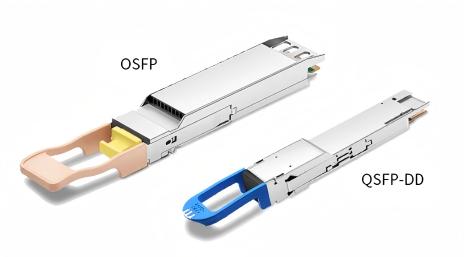
Core Parameters Comparison of the Two Form Factors
| Form Factor | Power Consumption | Port Density | Compatibility | Heat Dissipation Capacity | Typical Application Scenarios |
|---|---|---|---|---|---|
| QSFP-DD | ≤15W | High (more ports can be deployed on the same panel) | Fully compatible with previous generation form factors such as QSFP56, QSFP28, and QSFP+ | Moderate (relies on external heat dissipation or small heat sinks) | High-density servers, leaf switches (ToR), edge computing devices |
| OSFP | ≤20W | Medium (larger size than QSFP-DD, fewer ports) | Incompatible with previous generation form factors | Strong (larger housing volume + built-in heat dissipation structure, supporting high-power modules) | Core switches, backbone network devices, long-distance high-power optical modules |
Key Factors for Form Factor Selection
Port Density Requirements: For devices (such as leaf switches and AI servers) that need to deploy a large number of ports (e.g., 48 ports, 64 ports) in limited panel space, the small size of QSFP-DD provides a clear advantage, enabling higher port density. In contrast, core switches have lower port density requirements and prioritize high power and heat dissipation stability, making OSFP the more suitable choice.
Power Consumption and Heat Dissipation Conditions: Long-distance single-mode modules (e.g., 800G 2xLR4) integrate signal amplification components, resulting in higher power consumption (typically 15-20W) and requiring the strong heat dissipation capability of OSFP. Short-distance multimode modules (e.g., 800G SR8) have lower power consumption (≤12W), so the heat dissipation design of QSFP-DD is sufficient.
Compatibility with Existing Equipment: If a data center has already deployed a large number of QSFP-series modules (e.g., 100G QSFP28, 200G QSFP56), choosing the QSFP-DD form factor enables a smooth upgrade without replacing device interfaces. For newly built data centers, form factors can be flexibly selected based on core requirements.
Interoperability Logic: It is important to distinguish between physical form factor and protocol compatibility — OSFP and QSFP-DD modules cannot be physically interchanged (due to different interface sizes). However, as long as they support the same Ethernet media type (e.g., both are 800G DR8), they can achieve logical interoperability through fiber links without affecting data transmission.

Full-Scenario Applications of 800G Optical Modules
The application scenarios of 800G optical modules have expanded from traditional data centers to AI computing power interconnection, HPC, cloud services, and telecommunications backbone networks, becoming a key cornerstone supporting the development of the digital economy. Different scenarios have distinct technical requirements for 800G fiber transceiver modules.
Ultra-Large-Scale Data Centers: The Core Nerves of Computing Power Interconnection
Data centers are the core application scenario for 800G optical modules, covering a three-tier interconnection architecture of server - switch and switch - switch:
Access Layer (Server - ToR Switch): Multimode 800G SR8/SR4.2 modules are used to achieve short-distance high-density interconnection between AI servers (e.g., GPU servers) and ToR switches, meeting the massive data interaction needs during AI training (e.g., a single GPU server requires 800G bandwidth to support data parallel computing).
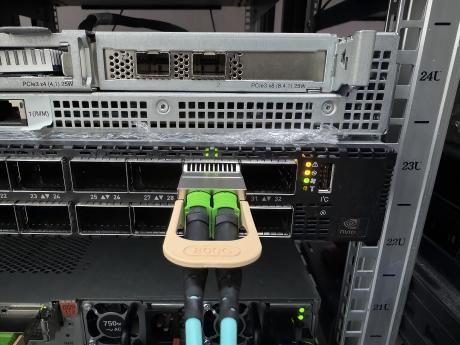
Aggregation Layer (ToR Switch - Aggregation Switch): Single-mode 800G DR8/2xDR4 modules are adopted for medium-distance interconnection (≤500m) across racks and regions, adapting to computing power scheduling within data centers.
Core Layer (Aggregation Switch - Core Switch): Single-mode 800G 2xFR4/FR4 modules are used for long-distance interconnection (2km) across buildings and campuses, supporting global computing power collaboration in ultra-large-scale data centers.
AI and High-Performance Computing (HPC): The Transmission Accelerator for Massive Data
The demand for bandwidth in AI training and HPC scenarios has experienced explosive growth — take GPT-4 training as an example, which requires millions of GPUs for collaborative computing, with single-cluster data interaction reaching the PB level. 800G optical modules have become the key link connecting GPU clusters.
AI Training Clusters: 800G SR4.2 modules are used to achieve direct interconnection between GPU servers. The bidirectional transmission over a single fiber technology reduces fiber wiring complexity, while the 800G bandwidth meets the requirement of hundreds of GB of training data transmission per node per second, avoiding reduced training efficiency caused by bandwidth bottlenecks.
HPC Supercomputing Centers: 800G FR8/2xLR4 modules are used to build high-speed links between computing nodes - storage nodes and computing nodes - scheduling nodes, supporting long-distance transmission of 2-10km. This adapts to the distributed physical architecture of supercomputing centers, and the 100G PAM4 modulation technology ensures low-latency data transmission (≤10μs).
Cloud Services and Enterprise-Level Applications: Solution for High-Bandwidth Requirements
With the popularization of high-bandwidth applications such as cloud gaming, 4K/8K video streaming, and VR/AR, the demand for network bandwidth from cloud service providers and large enterprises continues to rise. 800G optical modules are mainly applied in the following areas:
Cloud Service Provider Backbone Networks:
800G 2xLR4 modules are used to build cross-metropolitan backbone transmission links (10km), enabling traffic scheduling between different data centers and supporting the cloud - edge - end integrated architecture.
Enterprise-Level Storage Networks:
800G FR4 modules are adopted to build Storage Area Networks (SAN), enabling high-speed backup and access to enterprise core data (e.g., financial transaction data, medical imaging data). The transmission rate is 100% higher than that of 400G modules, and the 2km transmission distance adapts to enterprise multi-building deployment scenarios.
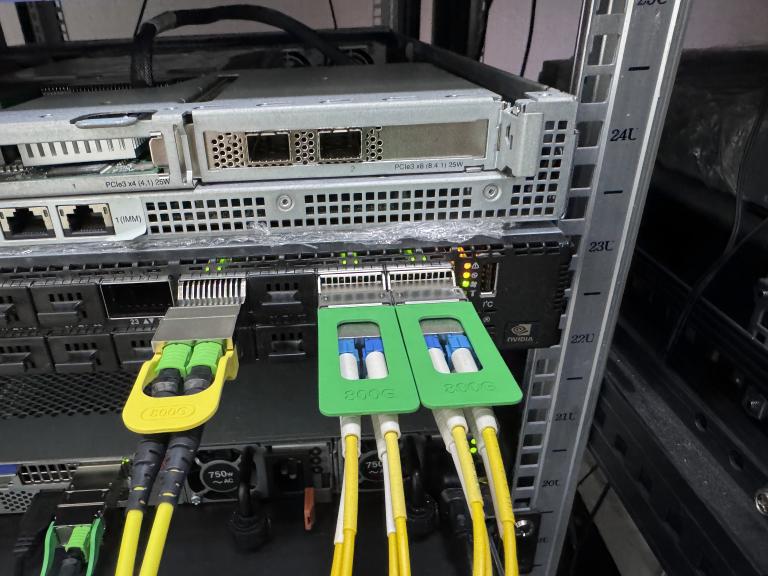
AICPLIGHT 800G Optical Modules
AICPLIGHT is a leading innovator in network infrastructure solutions. Backed by over 15 years of industry expertise, we deliver high-performance, scalable, and cost-efficient network solutions tailored to modern demands. Our AICPLIGHT 800G optical modules stand out by covering both InfiniBand and Ethernet networking scenarios — seamlessly matching diverse high-speed connectivity needs.
800G Optical Modules for InfiniBand Networking
AICPLIGHT 800G OSFP InfiniBand transceivers primarily cover the following types:
| P/N | Form Factor | Wavelength | Max Cable Distance | Connector | Max Power Consumption | Highlights |
|---|---|---|---|---|---|---|
| OSFP-800G-2SR4 | Twin-port OSFP Finned Top | 850nm | 30m@OM3; 50m@OM4 | Dual MTP/MPO-12 APC | 16W | ✅ Qualified for InfiniBand NDR End-to-end Systems. ✅ Built-in Marvell 6nm DSP Chip. ✅ Finned-Top OSFP Used in Quantum-2 Air-Cooled Switches. ✅ Support 800G-to-Two 400G ConnectX-7 Links or 800G-to-Four 200G ConnectX-7 Links. ✅ 8x 100G-PAM4 Electrical to Dual 4x 100G-PAM4 Optical Parallel. |
| OSFP-800G-2DR4 | Twin-port OSFP Finned Top | 1310nm | 100m | Dual MTP/MPO-12 APC | 17W | ✅ Qualified for InfiniBand NDR End-to-End Systems. ✅ Built-in Broadcom 7nm DSP Chip. ✅ Finned-Top OSFP Used in Quantum-2 Air-Cooled Switches. ✅ Support 800G-to-Two 400G ConnectX-7 Links or 800G-to-Four 200G ConnectX-7 links. ✅ 8x 100G-PAM4 Electrical to Dual 4x 100G-PAM4 Optical Parallel. |
| OSFP-800G-2FR4 | Twin-port OSFP Finned Top | 1271nm, 1291nm, 1311nm, 1331nm | 2km | Dual Duplex LC/UPC | 16.5W | ✅ Qualified for InfiniBand NDR End-to-End Systems. ✅ Built-in Broadcom 7nm DSP Chip. ✅ Finned-Top OSFP Used in Quantum-2 Air-Cooled Switches. ✅ Support 800G-to-Two 400G ConnectX-7 Links. ✅ 8x 100G-PAM4 Electrical to Dual 4x 100G-PAM4 Optical Multiplexed. |
| OSFP-800G-DR4 | Single-port OSFP Flat Top | 1310nm | 500m | MPO-12 APC | 16W | ✅ Qualified for InfiniBand XDR End-to-End Systems. ✅ Built-in Broadcom DSP Chip. ✅ Flat-Top OSFP224 for ConnectX-8 Adapter. ✅ Support 1.6T-to-Two 800G Links for Switch-to-Adapter. ✅ 4x 200G-PAM4 Electrical to 4x 200G-PAM4 Optical Parallel. |
800G Optical Modules for Ethernet Networking
For Ethernet networking, AICPLIGHT 800G OSFP transceivers primarily cover the following types:
| P/N | Form Factor | Wavelength | Max Cable Distance | Connector | Max Power Consumption | Highlights |
|---|---|---|---|---|---|---|
| OSFP-800G-2xSR4 | Twin-port OSFP Finned Top | 850nm | 30m@OM3 50m@OM4 | Dual MTP/MPO-12 APC | 16W | ✅ Built-in Marvell 6nm DSP Chip. ✅ Support 2x 400G or 4x 200G Breakout. ✅ Modulation (Electrical): 8x100G-PAM4. ✅ Modulation (Optical): Dual 4x100G-PAM4. ✅ Compatible Brands: Cisco, Juniper, Arista, NVIDIA/Mellanox, etc. |
| OSFP-800G-2xDR4 | Twin-port OSFP Finned Top | 1310nm | 500m | Dual MTP/MPO-12 APC | 16.5W | ✅ Connect New 800G Sites to Legacy 400G Sites via 2x400G Breakout. ✅ Built-in Broadcom 7nm DSP Chip. ✅ Support 2x 400G, 4x 200G or 8x 100G Breakout. ✅ Modulation (Electrical): 8x100G-PAM4. ✅ Modulation (Optical): Dual 4x100G-PAM4. ✅ Compatible Brands: Cisco, Juniper, Arista, NVIDIA/Mellanox, etc. |
| OSFP-800G-2xFR4 | Twin-port OSFP Finned Top | 1271nm, 1291nm, 1311nm, 1331nm | 2km | Dual Duplex LC/UPC | 16.5W | ✅ Built-in Broadcom 7nm DSP Chip. ✅ Support 2x 400G Breakout. ✅ Modulation (Electrical): 8x100G-PAM4. ✅ Modulation (Optical): Dual 4x100G-PAM4. ✅ Compatible Brands: Cisco, Juniper, Arista, NVIDIA/Mellanox, etc. |
Conclusion
800G optical modules are not only the core carrier of data center computing power interconnection but also a critical infrastructure supporting the development of core areas of the digital economy such as AI, HPC, and cloud services. The differentiated design of 800G single-mode and multimode transceivers meets the full-scenario needs from short-distance high-density interconnection to long-distance backbone transmission, while the complementarity of QSFP-DD and OSFP form factors provides equipment manufacturers with flexible selection options. In the future, with continuous technological iteration and cost reduction, 800G optical modules will further penetrate into more industries and become an accelerator for the high-quality development of the digital economy.


