
 English
When it comes to networking, five fundamental concepts must be mentioned: IP addresses, subnet masks, gateways, DHCP services, and PPPoE dial-up. These terms frequently appear when configuring computers or routers, yet while many recognize them as strings of numbers, few truly understand their meanings and functions. Below we'll explain these five core networking concepts in detail.
What is an IP address?
An IP address (Internet Protocol Address) is a standardized addressing format provided by the IP protocol, assigning logical addresses to every network and device on the internet. This abstraction masks physical address variations to enable network communication.
Analogy:
Imagine people in a sealed room without names, how would you quickly find a specific person? Numbering each person allows clear identification when calling "Number 1." Similarly, every networked device requires such an identifier: its IP address.
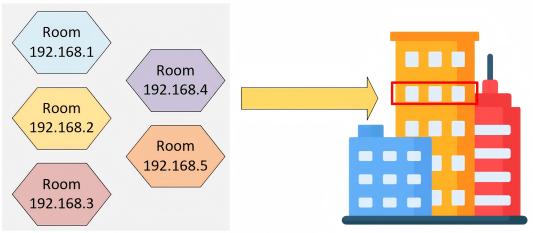
Extending the analogy: A building with multiple sealed rooms, each containing many people. To locate a specific individual, you'd need a "room number + personal number" system. For example, "1.10" would indicate the 10th person in Room 1.
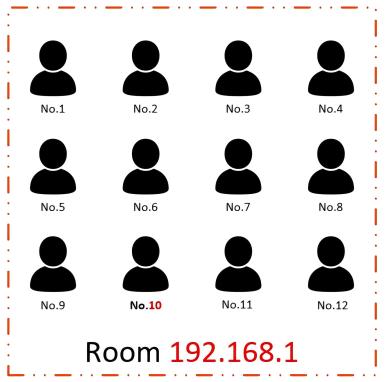
IP addresses typically consist of four sets of numbers. For example, the common address 192.168.1.10 can be understood as "person number 10 in room 192.168.1."
Note that if two people in a room share the same number, confusion arises when someone is called. The same principle applies online: no two identical IP addresses can exist within the same local area network, or IP conflicts occur. Therefore, IP addresses must be unique.
What is a Subnet Mask?
Using the previous example of 192.168.1.10, we could interpret "192.168.1" as the room number (network segment) and "10" as the individual identifier (host address). Alternatively, we might consider "192.168" as the room number and "1.10" as the identifier.
To ensure all devices consistently determine which portion represents the network segment and which represents the host address, a fixed rule is required—this is the role of the subnet mask.
A subnet mask consists of four numerical segments, just like an IP address. Through logical operations with the IP address, it explicitly defines which bits correspond to the network segment and which identify the host ID.
| IP Address | Subnet Mask | Meaning |
|---|---|---|
| 192.168.1.10 | 255.255.255.0 | Network: 192.168.1 Host: 10 |
| 192.168.1.10 | 255.255.0.0 | Network: 192.168 Host: 1.10 |
What is a Gateway?
Analogy:In our analogy where each person in a room has a unique number, the room itself remains sealed. For communication between different rooms, a "wall-penetrating" messenger is needed—someone to carry messages out and bring external messages in. This role with "cross-boundary capability" represents the gateway in networking.
A gateway (Gateway) is a device that facilitates communication between different networks. It enables data forwarding and processing across networks using different protocols or residing in different segments, allowing devices to communicate beyond their immediate network.
What is DHCP Service?
Analogy:We've established the importance of unique numbering. While a few people in a room might self-select numbers without issue, hundreds doing so would inevitably cause duplicates and conflicts. This necessitates an "authoritative figure" to centrally assign numbers—a service analogous to DHCP.
DHCP (Dynamic Host Configuration Protocol) is a critical network protocol that automatically assigns IP addresses, subnet masks, default gateways, and other parameters to devices joining a network. Without DHCP, network administrators would need to manually configure each device—a near-impossible task in large networks. DHCP dramatically enhances network automation efficiency.
What is PPPoE?
Analogy:In our analogy, while each room has its "super-powered communicator" (the gateway) for external connections, coordinating communication across an entire building or between different buildings requires a higher-level entity—the internet service provider (ISP). The ISP manages all broadband networks and routes data to any destination on the internet.
To establish communication with the ISP, a dedicated and encrypted channel must be created. The method for setting up this channel is PPPoE.
PPPoE (Point-to-Point Protocol over Ethernet) is the most widely used protocol for broadband access. In the early days of the internet, dial-up connections over telephone lines used the PPP protocol, requiring username and password authentication. PPPoE encapsulates this traditional PPP (which handles authentication and management) within Ethernet frames, enabling broadband networks to support authentication, authorization, and billing functions.


