
 English
In the field of optical communications, the SFP family has become one of the most common optical module form factors in data centers, enterprise networks, and carrier networks due to its flexibility, compact size, and hot-swappable features. With continuously increasing service rates, the SFP series has evolved into various specifications such as SFP, SFP+, SFP28, SFP56, SFP-DD, DSFP, and SFP112. This article systematically outlines the characteristics and differences of various SFP modules in chronological and technological order, helping you quickly understand their practical applications in different network scenarios.
1.SFP
SFP stands for Small Form Factor Pluggable. Developed based on the SFP Multi-Source Agreement (MSA), this transceiver is a compact, hot-swappable module capable of data transmission via fiber optic cables, Ethernet cables, or copper cables. Introduced in 2002 as an upgrade version of GBIC, SFP is significantly smaller in size and is also known as mini-GBIC.
Optical modules with rates ranging from 10Mbps to 8Gbps can be classified as SFP. Multimode SFP can transmit up to 550m, while single-mode SFP can achieve unrepeated transmission up to 200km. They are commonly paired with connectors like LC or SC, but due to their compact size, the vast majority of SFP modules utilize the smaller LC connector.
2.CSFP
CSFP stands for Compact Small Form-factor Pluggable. It applies BIDI technology to SFP by integrating components of two 1G BIDI SFPs into a single SFP housing, achieving a rate of 2G. Typically, BIDI SFP uses a simplex LC interface, whereas CSFP employs a duplex LC interface. It is often deployed alongside BIDI SFP, enabling one CSFP to connect with two BIDI SFPs.
3.SFP+
SFP+ stands for Small Form Factor Pluggable Plus. While maintaining the same dimensions as SFP, SFP+ increases the rate to 8Gbps–16Gbps. Like SFP, it commonly uses LC connectors, with a maximum transmission distance of 300m in multimode environments and up to 160km in single-mode environments.
4.SFP28
SFP28 (Small Form Factor Pluggable 28) derives its name from its maximum rate of 28Gbps, representing the single-lane limit under NRZ modulation. Introduced later than 40G QSFP+, it belongs to the same technical framework as QSFP28, sharing identical per-lane rates.
SFP28 typically employs LC connectors, with maximum distances of 100m (multimode) and 40km (single-mode). As data center speeds continue to rise, SFP28 is gradually phased out from primary service links, now more commonly used in management networks or enterprise uplinks.
5. SFP56
SFP56 (Small Form Factor Pluggable 56) achieves a 56Gbps rate using 50G PAM4 modulation, doubling SFP28's capacity. However, its adoption remains limited—many users skip 50G and directly migrate to 100GE, where QSFP28 dominates. Consequently, SFP56 occupies a somewhat awkward market position.
6. SFP-DD
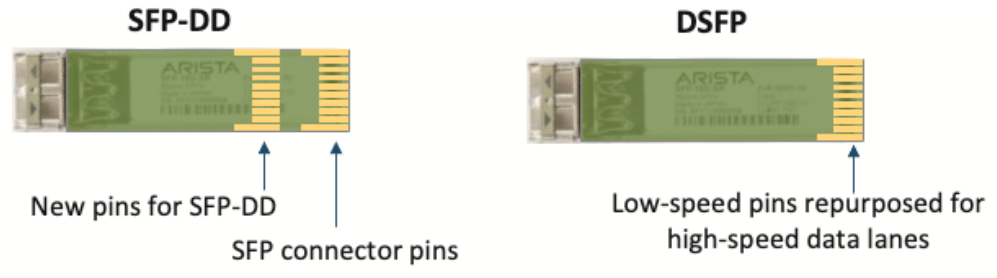
SFP-DD (Small Form Factor Pluggable – Double Density) doubles the electrical interface pins to enable 2×50G lanes, also referred to as SFP56-DD. Its width and height match standard SFP modules, but its length is slightly extended, with a longer gold finger section to accommodate the additional pins.
7.DSFP
DSFP stands for Dual Small Form Factor Pluggable. It achieves a single-port rate of 100Gbps by aggregating two 50G PAM4 signals. Unlike SFP-DD, DSFP doesn't increase the number of electrical interfaces but relies on dual-channel optical aggregation to reach 100G speeds.
8.SFP112
SFP112 stands for Small Form Factor Pluggable 112, indicating its maximum rate of 112Gbps. Based on 100G PAM4 technology, it achieves 100G through a single channel without requiring parallel optical paths. This represents one of the most advanced technologies in the optical module industry and has become the most popular SFP specification in recent years.
SFP-DD, DSFP and SFP112 all belong to the 100G-class SFP module series, each with unique advantages particularly suited for data center scenarios requiring extremely high port density. Compared to 100G QSFP28, they offer greater potential: on a 1U panel, a switch can accommodate about 40 QSFP cages versus approximately 60 SFP cages. This means the SFP series can provide an additional 2000G total capacity in the same space.


