
 English
DAC
DAC (Direct Attach Cable), commonly referred to direct-attach copper cable, is a fixed-length cable assembly with pre-attached connectors on both ends. It is a cable assembly procured in fixed lengths with fixed connectors at both ends, where the module head is inseparable from the copper cable. The copper core inside the DAC is directly soldered to the PCB board, which contains only basic functional circuits and lacks complex electronic components for signal processing.
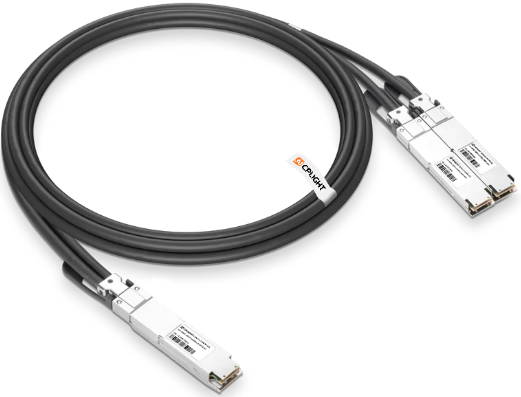
With notable advantages like high cost-effectiveness, low power consumption, low latency, and high data rates, high-speed cables are gaining increasing popularity among users and occupying a significant position in high-speed data communication solutions.
ACC
ACC (Active Copper Cable) shares similarities with DAC, featuring industry-standard connectors on both ends, but it can be considered an "upgraded" version of DAC. By integrating a Redriver (signal equalizer) chip at the receiving end, ACC employs signal equalization and reshaping technology.
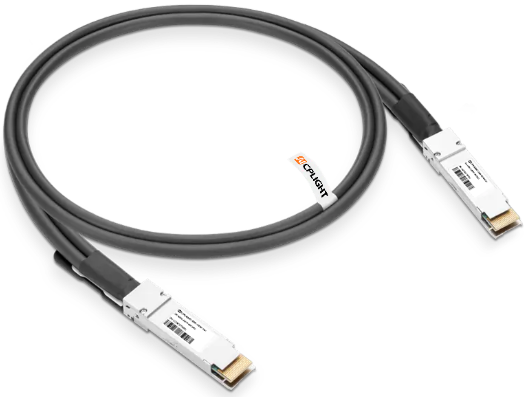
Unlike passive DAC cables, ACC uses an active chip to compensate for high-frequency signal loss, enabling longer-distance transmission by amplifying analog signals. However, the Redriver amplifies noise alongside the valid signal, which impacts data transmission quality. Consequently, the gain in transmission distance is relatively limited. For example:
- 10G SFP+ DAC: Max distance 7m
- 10G SFP+ ACC: Max distance 10m
AEC
AEC (Active Electrical Cable) is a cable manufactured using narrow-gauge copper wires, equipped with standard connectors on both ends. Unlike traditional copper cables, AEC integrates signal restoration and amplification components—such as Retimers, Gearboxes, and FEC (Forward Error Correction) circuits—on its internal PCB, elements typically found only in optical modules.
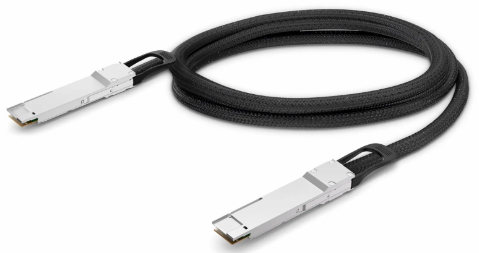
Thanks to its robust signal-recovery capability, AEC can transmit high-quality electrical signals without relying on thick copper cores. Compared to ACC and DAC, AEC features a thinner diameter, lighter weight, and longer transmission distances. However, due to its integrated electronics, it consumes more power than ACC/DAC (though still less than optical modules). AEC is primarily used in ultra-high-speed applications like 800G and 1.6T deployments.
AOC
AOC (Active Optical Cable) is a fiber-optic cable assembly with pre-attached connectors. Fundamentally distinct from copper solutions (DAC/ACC/AEC), AOC uses fiber optics as its transmission medium, essentially functioning as an integrated unit combining a multimode optical module with an optical fiber patch cord.
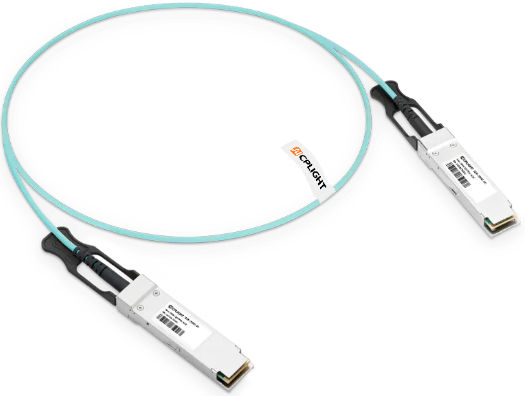
The optical transceivers at both ends of AOC handle electro-optical conversion. Since they incorporate core functionalities of optical modules, AOCs can be categorized as optical transceiver devices. Consequently, AOCs are more expensive than copper cables but outperform electrical solutions in signal stability, anti-interference capability, and transmission efficiency.


