
 English
Overview
A leading low-voltage engineering company in Spain undertook a comprehensive network construction project for a local hospital. The project required seamless integration and unified management of wired and wireless networks. As a service provider with extensive experience in foundational network construction, this client had maintained a deep partnership with AICPLIGHT for over a year, consistently procuring optical modules (ranging from 1G to 100G), fiber patch cords, and integrated cabling accessories. AICPLIGHT's exceptional product quality and competitive pricing have solidified its position as a trusted supply chain partner.
Issue
During the critical final acceptance phase of the project, on-site personnel reported an urgent technical failure. The Cisco/Huawei dual-compatible SFP-25G-SR optical modules purchased from AICPLIGHT failed to establish link connection (Link up). The hospital's technical lead attributed the issue to the use of third-party compatible modules, putting the client at risk of reputational damage and project delay.
Solution
1.Immediate Response
Upon receiving the feedback at 23:00 local time, despite being off-duty, AICPLIGHT's sales representative promptly activated the emergency protocol, coordinating with the Southern Europe regional technical lead for intervention.
2.Thorough Investigation
By 23:30, AICPLIGHT's technical team held a video conference with the client. It was revealed that even Cisco and Huawei original modules retrieved from the warehouse failed to establish a connection on-site. Given that OEM technical support (Case) response cycles typically take up to 8 hours, this could not meet the on-site urgency requirements.
3.Simulated Environment Setup
AICPLIGHT engineers quickly matched the on-site equipment models (Cisco Nexus 9000 C93240YC-FX2 running OS 10.2(4) and Huawei CE6865-48S8CQ-EI on V200R005C00*) with equivalent lab devices (Cisco N9K-C93180YC-EX and Huawei CE6860-48S8CQ-EI), synchronizing firmware versions to ensure consistency.
4.Experimental Verification
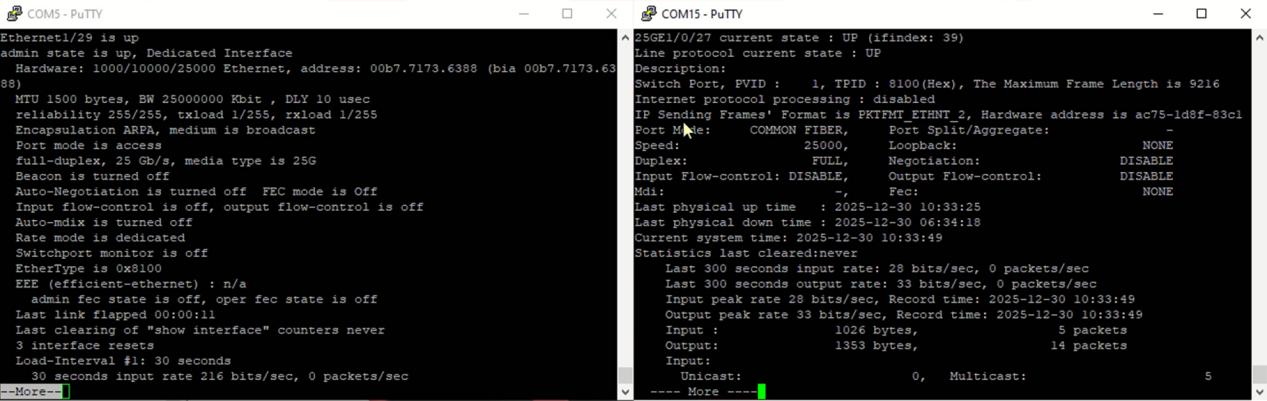
Technicians programmed test modules with the same dual-compatible coding as the ordered batch. Loopback tests confirmed the modules functioned flawlessly on both Cisco and Huawei devices, proving the issue stemmed from network configuration—not hardware quality.
5.Resolution
Further analysis identified discrepancies in default 25G SFP28 port configurations between the Cisco and Huawei switch firmware versions. With client authorization, AICPLIGHT guided remote adjustments to align port settings, successfully restoring link connectivity.
Our Value
1. Multi-Brand Compatibility Encoding Capability
- Cost Efficiency: OEM optical modules are often prohibitively expensive and typically guarantee 100% compatibility only with their own brand's equipment. AICPLIGHT's dual-compatibility coding enables a single module to operate seamlessly across two different brands (e.g., Cisco and Huawei).
- Beyond Dual Compatibility: AICPLIGHT supports multi-brand compatible encoding, enabling "one code for multiple brands." Clients no longer need to purchase separate modules for different brands, significantly reducing project costs and inventory complexity.
2. Emergency Support Mechanism
- 30-Minute Rapid Response: From the initial client report, AICPLIGHT mobilized a technical team within 30 minutes, initiating video diagnostics to pinpoint issues.
- 4-Hour Resolution: The entire process—troubleshooting, replication, and solution deployment—was completed in 4 hours, far outpacing OEM support cycles (typically 8+ hours). This ensured zero delays in project deadlines.
3. Extensive Lab Infrastructure
- 300+ Network Devices: AICPLIGHT's lab replicates 95% of mainstream brands (Cisco, Huawei, Juniper, etc.) and firmware versions, enabling accurate environment simulation.
- Reproducible means Solvable: By mirroring client setups (e.g., matching Cisco Nexus 9000 and Huawei CE6865 configurations), AICPLIGHT delivers more predictable technical support to customers operating in complex, multi-vendor network environments.


