
 English
As data center bandwidth demands continue to rise, 200G networks have become a critical step between existing 100G deployments and future 400G/800G architectures. When designing or upgrading a 200G data center, selecting the right optical module form factor is essential, as it affects network performance, deployment cost, compatibility, and long-term scalability.
Currently, the two most widely used 200G optical transceiver form factors are QSFP56 and QSFP-DD. Although both support 200G transmission, they differ significantly in architecture, modulation methods, channel count, and upgrade potential. This article provides a clear, accurate, and practical comparison to help you make the right choice.
200G QSFP56 vs 200G QSFP-DD: Core Technical Differences
| Feature | 200G QSFP56 | 200G QSFP-DD |
|---|---|---|
| Packaging Design | Evolution of QSFP+, QSFP28 | "Double Density" version of QSFP |
| Electrical Interface Channels | 4 lanes | 8 lanes |
| Modulation | 4 × 50G PAM4 | 8 × 25G NRZ |
| Single Channel Rate | Single channel rate reaches 53.125 Gbps, achieving high-speed transmission through PAM4 technology | Maximum single channel rate is 25Gbps, relying on multi-channel aggregation to achieve the total rate |
| Total Transmission Rate | Total 212.5 Gbps | Total 212.5 Gbps |
| Scalability | Primarily supports 200G | Native support for 400G & 800G |
| Fiber/Link Cost | Only requires 4 channels, lower link loss and fiber cost | Requires 8 channels, relatively higher fiber cost |
| Compatibility | Directly compatible with QSFP/QSFP28 | QSFP-DD port supports QSFP/QSFP56 (device-dependent) |
- Modulation Technology
The 200G QSFP56 optical transceiver adopts PAM4 (Four-Level Pulse Amplitude Modulation), which transmits two bits per symbol using four distinct voltage levels—effectively doubling spectral efficiency compared to traditional NRZ. This higher bandwidth density allows QSFP56 module to achieve 200G using only four optical channels, reducing link complexity and overall deployment cost. As a result, PAM4-enabled QSFP56 modules offer an efficient, resource-optimized solution ideal for cost-sensitive 200G deployments that require high performance without additional channel overhead.
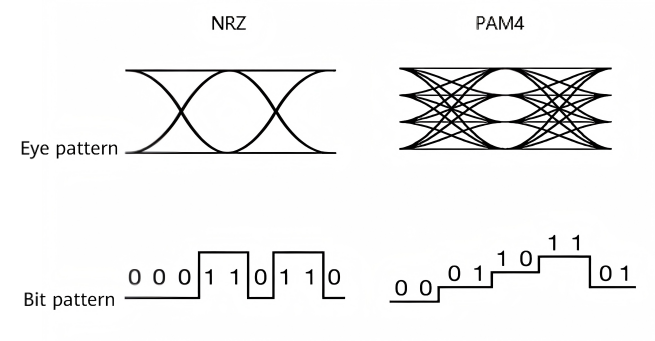
Figure 1: NRZ vs PAM4 Encoding
While 200G QSFP-DD modules, such as SR8 commonly adopt an 8×25G NRZ architecture. The lower per-lane complexity of NRZ offers notable advantages, including reduced power consumption, minimal signal processing latency, and enhanced overall signal stability. These characteristics make NRZ-based QSFP-DD modules particularly well suited for high-density, short-reach data center interconnections, where energy efficiency, real-time performance, and simplified deployment and maintenance are critical considerations.
- Packaging and Compatibility
Because QSFP56 preserves the familiar mechanical and electrical design of the QSFP family, it can be directly inserted into QSFP+ and QSFP28 ports, enabling a straightforward upgrade from 100G to 200G without requiring significant hardware modifications. This high degree of backward compatibility helps minimize equipment replacement costs and makes QSFP56 module an excellent choice for data centers aiming to expand to 200G with minimal disruption to their existing infrastructure.
The defining innovation of the 200G QSFP-DD (Quad Small Form Factor Pluggable Double Density) lies in its dual-row "Double Density" connector, which expands the electrical interface to eight lanes within the same overall footprint. This enhanced design not only maintains backward compatibility with QSFP, QSFP28, and QSFP56 modules—depending on the device cage and port support—but also provides forward compatibility, allowing seamless migration to 400G and beyond through simple module replacement or system upgrades. This scalability is one of the key advantages that sets QSFP-DD apart from QSFP56.
200G QSFP56 vs. 200G QSFP-DD: How to Choose?
- Considering Cost-Effectiveness and Immediate Needs
If your priority is cost-efficient 200G deployment and you do not anticipate upgrading to 400G within the next one to three years, 200G QSFP56 is the most practical option. These transceiver modules are generally more affordable and achieve 200G using only four channels, which reduces fiber requirements, simplifies optical link design, and minimizes link loss—ultimately lowering overall deployment costs. This makes QSFP56 modules particularly suitable for small to medium-sized data centers, campus networks, and environments seeking a budget-friendly 200G upgrade.
- Considering Future Scalability and Performance Requirements
If your data center has a clear roadmap for upgrading to 400G or higher within a few years, or if core applications demand exceptional power efficiency and low latency, 200G QSFP-DD is the preferred choice. Its native support for higher-density electrical lanes provides a direct upgrade path to 400G without costly infrastructure replacement, helping reduce long-term total cost of ownership (TCO). In addition, QSFP-DD modules offer strong signal stability and performance, making them ideal for high-density interconnects, large-scale cloud deployments, and high-performance computing clusters where reliability and scalability are paramount.
- Considering Equipment Compatibility
Equipment compatibility is a fundamental factor when choosing between QSFP56 and QSFP-DD. If your existing switches or routers primarily feature QSFP or QSFP56 ports, selecting QSFP-DD may lead to port incompatibility and force unnecessary hardware upgrades—ultimately increasing costs. In these cases, QSFP56 module ensures seamless integration and maximizes the value of your current infrastructure. Conversely, for new deployments or environments already equipped with QSFP-DD capable hardware, choosing QSFP-DD provides greater long-term flexibility and preserves the option for future 400G or 800G expansion.
AICPLIGHT 200G QSFP56 Optical Modules
The AICPLIGHT 200G QSFP56 SR4 is a short-reach optical transceiver designed for high-speed data center interconnects up to 70–100 meters using multimode fiber (MMF). It leverages 4×50G PAM4 technology and high-performance VCSEL lasers to deliver low power consumption, low latency, and superior signal integrity. Its 4-channel architecture simplifies cabling and is perfectly suited for high-density applications like ToR–spine and server access layers, ensuring reliable, cost-effective, and plug-and-play deployment in cloud computing and hyperscale clusters.

Figure 2: Arista Switch links:200G QSFP56 SR4 to 200G QSFP56 SR4
In contrast, the AICPLIGHT 200G QSFP56 FR4 offers a medium-to-long-distance solution, extending connectivity up to 2 kilometers over single-mode fiber (SMF). This module utilizes 4×50G PAM4 Wavelength Division Multiplexing (WDM) and high-reliability CWDM optics paired with advanced DSP algorithms to maintain excellent signal quality and a low bit error rate over extended links. The FR4 is the ideal choice for interconnections across racks, floors, and core switching nodes in applications such as spine–leaf architecture upgrades and enterprise campus backbones, providing a high-bandwidth, cost-effective, and robust mid-range optical solution.

Figure 3: Cisco Nexus Switch links:200G QSFP56 FR4 to 200G QSFP56 FR4
Summary
Choosing between 200G QSFP56 and QSFP-DD is not about determining which is better, but about selecting the form factor that best fits the deployment scenario. QSFP56 excels in cost control and broad compatibility, making it ideal for organizations focused on meeting current 200G requirements with maximum cost-efficiency. QSFP-DD, on the other hand, offers greater scalability and performance headroom, making it the preferred option for large or rapidly growing data centers planning for 400G and beyond. Before deciding, organizations should evaluate their business scale, budget roadmap, existing equipment, and 3-5 year network evolution plans to ensure the chosen optical module aligns with long-term infrastructure strategy and operational goals.


