
 English
The rapid expansion of AI, HPC, and cloud-scale workloads has elevated data center interconnect requirements to unprecedented levels. As InfiniBand XDR and NDR, along with 800G Ethernet architectures, become mainstream, optical transceivers must deliver higher bandwidth density, lower latency, and improved energy efficiency.
Within this context, two advanced 800G optical modules play critical but distinct roles: the 800G DR4 OSFP224 transceiver and the 800G 2xDR4 OSFP transceiver. Although both achieve an 800Gb/s aggregate data rate and support 500m single-mode transmission, their electrical architectures, modulation schemes, optical lane configurations, and deployment scenarios differ significantly. Understanding these differences is essential for designing high-performance, next-generation computing clusters.
What Is 800G DR4 OSFP224 Transceiver?
The 800G DR4 OSFP224 Transceiver is defined as an 800G single-mode optical transceiver. It is engineered to support the latest InfiniBand XDR 800G protocol and is optimized for high-density, intra-data center connectivity. The designation "224" refers to its 4 lanes of 200G electrical SerDes, enabling a total electrical throughput of 4 x 200G = 800G.
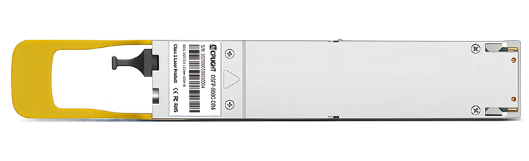
Figure 1: AICPLIGHT 800G DR4 OSFP224 Transceiver - OSFP-800G-DR4
Key Specifications and Design
In terms of form factor, the 800G DR4 OSFP224 module is a Single-port OSFP (Flat top) design. Its core technical specifications include:
- Data Rate: 800Gb/s via a single DR4 optical interface.
- Modulation: It employs four electrical channels, each running at 200Gb/s using 200G-PAM4 (Pulse Amplitude Modulation of 4-levels). This translates to a configuration of 4x 200G-PAM4 electrical-to-optical parallel lanes.
- Optical Interface: It utilizes a single MPO-12/APC optical connector.
- Reach and Media: It achieves a maximum reach of 500 meters over Single-Mode Fiber (SMF).
- Power Consumption: The module operates with a relatively low maximum power consumption of 16 Watts.
Primary Application: 1.6T-to-two 800G Switch-to-Server Link
The primary and most demanding application of the 800G DR4 OSFP224 transceiver is in high-bandwidth breakout scenarios. Specifically, it is the key component for the 1.6T-to-two 800G Links for Switch-to-Server connectivity.
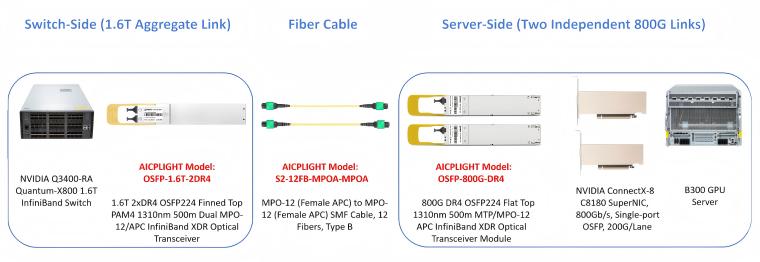
Figure 2: 1.6T-to-two 800G Switch-to-Server Link
Switch Side: An NVIDIA Q3400-RA Quantum-X800 1.6T InfiniBand Switch hosts a specialized 1.6T 2xDR4 OSFP224 Finned Top transceiver (e.g., AICPLIGHT OSFP-1.6T-2DR4). This twin-port module handles the 1.6T aggregate link and uses a Dual MPO-12/APC interface to launch two independent 800G channels.
Transmission: The two 800G channels are carried over two straight MPO-12/APC SMF cables up to 500 meters.
Server Side: The links terminate at a B300 GPU Server equipped with NVIDIA ConnectX-8 C8180 SuperNICs (800Gb/s). The two 800G links are received by two individual 800G DR4 OSFP224 Flat Top transceivers (e.g., AICPLIGHT OSFP-800G-DR4). This completes the high-density breakout connection essential for AI and HPC clustering. The OSFP-800G-DR4 is also suitable for interconnection between the same type of modules.
What Is 800G 2xDR4 OSFP Transceiver?
The 800G 2xDR4 OSFP transceiver—often called a twin-port OSFP (finned-top) module—is functionally two independent 400G DR4 modules integrated into one physical OSFP housing. It is qualified for use in InfiniBand NDR (2 x 400G) end-to-end systems and is featured with low latency, low power, and high reliability.

Figure 3: AICPLIGHT 800G 2xDR4 OSFP Transceiver - OSFP-800G-2DR4
Key Specifications and Design
The defining physical characteristic of this module is its Twin-port OSFP (Finned top) form factor, which is optimized for improved thermal management and is typically used in air-cooled switches.
- Data Rate: It supports 2x 400Gb/s links, resulting in an 800Gb/s aggregate rate.
- Modulation: The design is based on an 8-channel parallel single-mode configuration. It uses 100G-PAM4 modulation, translating to 8x 100G-PAM4 electrical to dual 4x 100G-PAM4 optical parallel lanes.
- Optical Interface: It requires a Dual MPO-12/APC optical connector.
- Reach and Media: It has a maximum reach of 500 meters using single-mode fibers.
- Power Consumption: It has a maximum power consumption of 17 Watts.
Primary Applications: Switch-to-Switch and Breakout Links
The versatility of the 800G 2xDR4 OSFP allows for flexible network deployment. It is primarily deployed in two key scenarios:
- 800G-to-800G Switch-to-Switch Link:
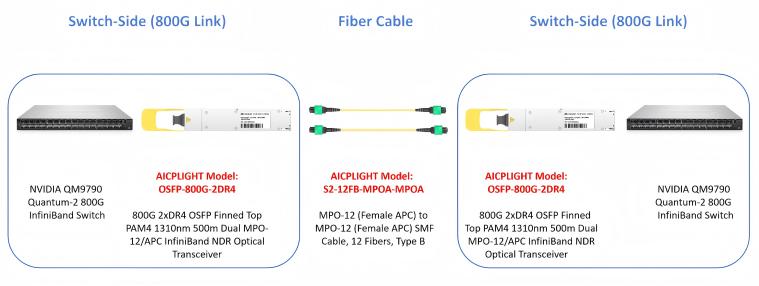
Figure 4: 800G-to-800G Switch-to-Switch Link
This configuration connects two NVIDIA QM9790 Quantum-2 800G InfiniBand Switches. AICPLIGHT OSFP-800G-2DR4 transceiver is used at both ends, establishing a direct, reliable 800G link over SMF. This application is crucial for linking upwards in spine-leaf architectures.
- 800G-to-two 400G Breakout Link
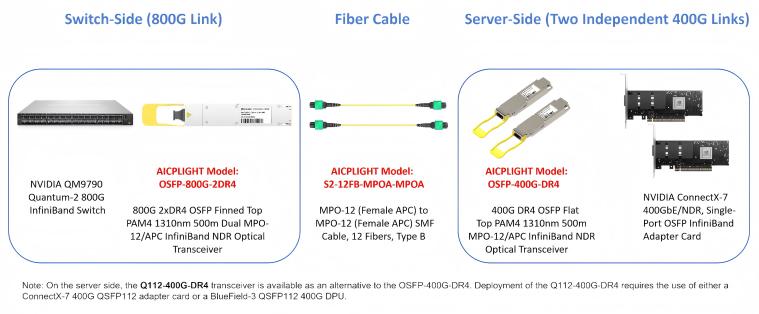
Figure 5: 800G-to-two 400G Breakout Link
This scenario utilizes the module's 2xDR4 nature to break out the 800G link into two independent 400G channels.
The QM9790 Switch hosting the OSFP-800G-2DR4 connects to two separate NVIDIA ConnectX-7 400GbE/NDR Single-Port Adapter Cards.
The server cards are populated with two 400G DR4 OSFP Flat Top transceivers (e.g., OSFP-400G-DR4) or two 400G DR4 QSFP112 transceivers (e.g., Q112-400G-DR4) to receive the individual 400G streams.
This connection is also ideal for linking downwards to Top-of-Rack switches, ConnectX Smart Network Adapters, and BlueField-3 DPUs in compute servers.
Technical Comparison: 800G DR4 OSFP224 Transceiver vs. 800G 2xDR4 OSFP Transceiver
While both modules achieve an aggregate 800Gb/s data rate and share the 500m SMF reach, their engineering differences dictate their specific usage:
| Feature | 800G DR4 OSFP224 | 800G 2xDR4 OSFP |
|---|---|---|
| Data Rate Structure | 1 × 800Gb/s DR4 | 2 × 400G DR4 (800G aggregate) |
| Form Factor | Single-port OSFP (Flat top) | Twin-port OSFP (Finned top) |
| Optical Connector | Single MPO-12/APC | Dual MPO-12/APC |
| Modulation/Lanes | 4x 200G-PAM4 Electrical to 4x 200G-PAM4 Optical Parallel (4 optical lanes) | 8x 100G-PAM4 Electrical to Dual 4x 100G-PAM4 Optical Parallel (8 optical lanes) |
| Max. Power Consumption | 16W | 17W |
| Matching Cables | SMF (Single-mode Fiber Cables) | SMF (Single-mode Fiber Cables) |
| Application | 1.6T-to-two 800G Links | 800G-to-800G Links, 800G-to-two 400G Links |
The most significant distinction lies in the modulation scheme: the 800G DR4 OSFP224 transceiver achieves its 800G over fewer, higher-rate lanes (4x 200G-PAM4), making it suitable for direct 800G links and the 1.6T breakout. Conversely, the 800G 2xDR4 OSFP transceiver uses eight lower-rate lanes (8x 100G-PAM4) to deliver two distinct 400G channels, lending itself perfectly to native 800G links between switches and 800G-to-400G breakout applications.
Conclusion
Both the 800G DR4 OSFP224 and the 800G 2xDR4 OSFP modules are foundational to the 800G ecosystem, but they serve distinct, non-overlapping roles dictated by their physical design and lane configuration. The 800G DR4 OSFP224 transceiver is the preferred single-port solution for achieving high-density, 1.6T-to-dual 800G breakouts relying on high-speed 200G-PAM4 lanes. Meanwhile, the 800G 2xDR4 OSFP transceiver stands out as the versatile twin-port module, excelling at switch-to-switch aggregation and 800G-to-400G breakouts by utilizing its dual-port, 100G-PAM4 structure. The strategic deployment of these specialized transceivers is crucial for maximizing throughput, optimizing power consumption, and maintaining the low-latency interconnects necessary to sustain the extreme demands of modern AI and HPC workloads.


