
 English
Driven by the surge in wireless terminals and the widespread adoption of high-definition video, cloud applications, and IoT devices, Wi-Fi technology is continues to evolve at an accelerated pace. The transition from Wi-Fi 6 to Wi-Fi 6E, and now to Wi-Fi 7, represents significant leaps in speed, frequency utilization, latency, and concurrency. Understanding these core technical distinctions is essential for both individual and enterprise users to make informed infrastructure decisions.
1. What is Wi-Fi 6
Wi-Fi 6 was officially released in 2019. By introducing OFDMA, power optimization mechanisms, and bidirectional MU-MIMO, it achieved significant improvements in performance and efficiency. Operating on the 2.4 GHz and 5 GHz bands, it delivers over a 30% increase in total throughput in high-density environments compared to its predecessor (Wi-Fi 5), while significantly improving connection stability and the ability to handle multiple simultaneous devices.
2. What is Wi-Fi 6E
As an extension of the Wi-Fi 6 standard, launched in 2020, Wi-Fi 6E's primary innovation is bringing all existing Wi-Fi 6 capabilities into the newly opened 6 GHz spectrum. By operating across three bands (2.4 GHz, 5 GHz, and 6 GHz), it offers lower latency and higher available bandwidth per unit area. This makes it particularly effective for highly congested wireless environments, leading to a growing trend among network vendors to deploy 6 GHz-capable hardware.
3. What is Wi-Fi 7
Development for Wi-Fi 7 began in 2021, introducing substantial upgrades in modulation and bandwidth.
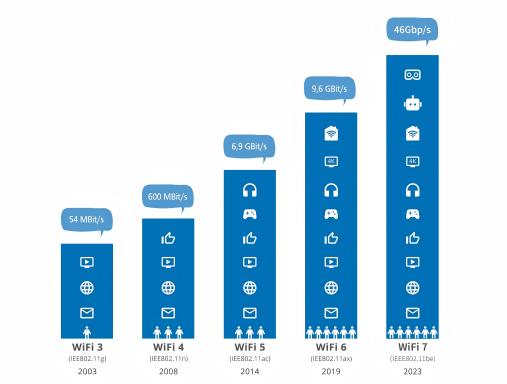
By increasing channel width to 320 MHz and implementing higher-order QAM modulation alongside more spatial streams, Wi-Fi 7 reaches a theoretical throughput of 30 Gbps. Supporting simultaneous operation across the 2.4 GHz, 5 GHz, and 6 GHz bands, it provides the technical foundation for the next generation of high-performance wireless applications.
4. Technical Differences
4.1 Speed
In terms of speed, both Wi-Fi 6 and Wi-Fi 6E offer a theoretical maximum throughput of 9.6 Gbps, representing a significant increase over Wi-Fi 5's 6.9 Gbps limit.
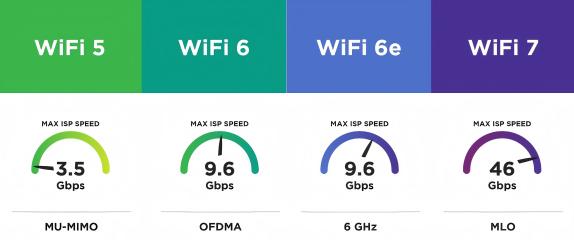
Wi-Fi 7 further elevates the theoretical speed to a maximum of 30 Gbps. Achieving this level of performance requires a new generation of high-performance terminals and IoT devices to fully exploit the advantages of multi-band parallel communication.
4.2 Frequency Bands
Wi-Fi 6 primarily operates on the 2.4 GHz and 5 GHz bands. As the number of wireless devices continues to grow, congestion in these two bands has become increasingly apparent.
Wi-Fi 6E mitigates interference and congestion issues by introducing the 6 GHz band, providing a cleaner wireless environment for high-speed, low-latency communication.
Wi-Fi 7 also operates across the 2.4 GHz, 5 GHz, and 6 GHz bands, while further improving spectral efficiency and multi-link capabilities.
4.3 Channel Width
While the second generation of 802.11ac began supporting 80 MHz channels, Wi-Fi 6 achieved a significant leap in throughput by introducing 160 MHz channels.
Wi-Fi 6E takes full advantage of the wider, more contiguous spectrum in the 6 GHz band, making the deployment of 160 MHz channels more flexible and achieving higher actual throughput.
Wi-Fi 7 further supports ultra-wide 320 MHz channels, providing the fundamental capacity for extremely high-bandwidth applications.
4.4 QAM Modulation
QAM modulation determines the encoding density of data on wireless frequencies. Higher modulation orders allow more data to be transmitted per unit of time.
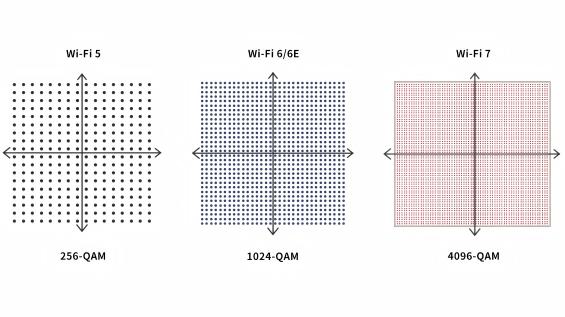
- Wi-Fi 5 uses 256-QAM, which is reaching its limits in scenarios like 4K video and AR/VR.
- Wi-Fi 6 and Wi-Fi 6E increased this to 1024-QAM, significantly improving transmission efficiency.
- Wi-Fi 7 further upgrades to 4096-QAM to achieve even higher throughput under ideal channel conditions.
4.5 Data Streams
Wi-Fi 6 pioneered the practical implementation of bidirectional MU-MIMO and increased the number of spatial streams to 8, greatly enhancing multi-device concurrency compared to Wi-Fi 5's 4x4 MU-MIMO.
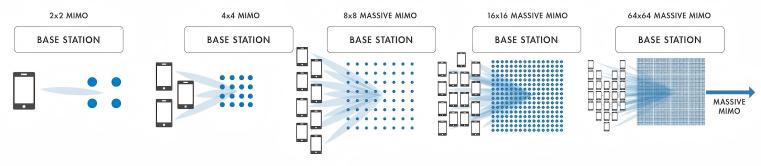
In Wi-Fi 6 and Wi-Fi 6E, client devices can only use one band (2.4, 5, or 6 GHz) at a time, relying on intelligent connection mechanisms to switch between them.
Wi-Fi 7 introduces Multi-Link Operation (MLO), which allows devices to send and receive data across multiple bands and channels simultaneously. This significantly reduces communication latency and brings the wireless experience closer to that of a wired network.
4.7 Encryption Standards
Wi-Fi 6 and Wi-Fi 6E fully adopt the WPA3 encryption standard. By utilizing protected management frames and an improved four-way handshake authentication mechanism, they effectively defend against the offline attack risks present in WPA2.
While early reports suggested that Wi-Fi 7 would introduce WPA4, this is inaccurate. Wi-Fi 7 does not launch a new WPA4 standard but instead further optimizes and enhances the existing WPA3 framework.
5. How to Choose the Right Wi-Fi?
5.1 Home Users
- Daily Browsing and Social Media: Wi-Fi 5 / Wi-Fi 6
- Home Theater and Gaming: Wi-Fi 6 / Wi-Fi 6E
- Smart Home and Multi-device Connectivity: Wi-Fi 6 / Wi-Fi 6E
- High-end E-sports and 8K Streaming: Wi-Fi 6E / Wi-Fi 7
- Long-term use (Next 5+ years): Wi-Fi 7
5.2 Enterprise Users
- Small and Medium-Sized Enterprises (SMEs): For environments with fewer than 200 terminals, dual-band Wi-Fi 6 APs are suitable. If there are high demands for video conferencing, tri-band Wi-Fi 6E APs should be prioritized.
- Large Enterprises: For environments with over 500 terminals and requirements for live streaming or high-bandwidth services, Wi-Fi 7 APs are recommended to meet future expansion needs.
6. Conclusion
Wi-Fi 6, Wi-Fi 6E, and Wi-Fi 7 are not simple generational replacements; they represent a progressive evolution tailored to different application scenarios.
Wi-Fi 6 focuses on efficiency and stability, Wi-Fi 6E addresses congestion through the 6 GHz band, and Wi-Fi 7 aims for ultra-high bandwidth, ultra-low latency, and multi-link communication for next-generation high-performance applications. To truly maximize the value of a wireless network, users should make a rational choice based on their actual usage scenarios, number of terminals, and budget.


