
 English
With the proliferation of cloud computing, high-definition video, remote work, and smart home applications, high-speed and stable network connectivity has become a fundamental utility of modern life, much like water and electricity. Behind everything from 4K Ultra-HD video to lag-free online gaming lies a key technology: FTTH. As the premier solution for the "last mile" of broadband access, how exactly does FTTH work? What are its core components and technical advantages? This article will take you deep into the technical world of FTTH.
1. What is FTTH?
FTTH stands for Fiber To The Home. It is a broadband access technology that transmits network signals directly to a user's residence via fiber optic media. Compared to traditional copper-based access, FTTH provides higher bandwidth, faster transmission rates, and longer signal transmission distances. Currently, FTTH has officially replaced copper cabling to become the mainstream choice for global broadband access.
2. FTTH Implementation Methods
Based on whether the Optical Distribution Network (ODN) contains electronic components, FTTH implementation is primarily divided into two types:
2.1 PON (Passive Optical Network)
The defining characteristic of PON is that the intermediate distribution stages do not require expensive active electronic equipment. Instead, it uses passive components like Optical Splitters. This method offers advantages such as simple maintenance, low cost, and strong anti-interference capabilities.
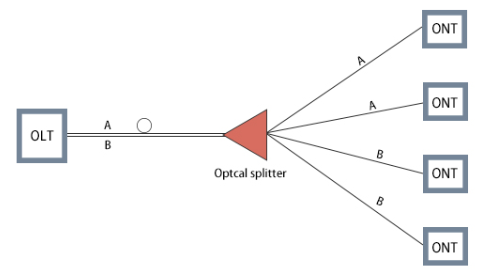
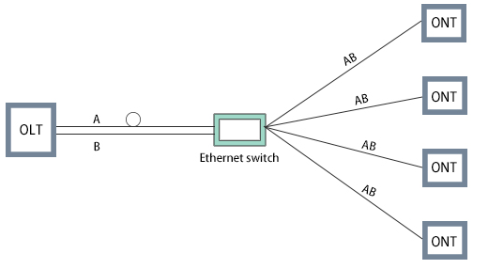
2.2 AON (Active Optical Network)
AON relies on active switching equipment or amplifiers in the middle to distribute and enhance signals. It is typically used in specialized scenarios involving extremely long transmission distances or highly complex bandwidth allocation.
3. FTTH Network Components
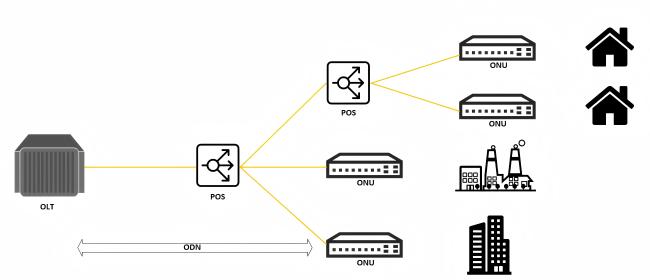
A complete FTTH network is mainly composed of three major parts: OLT, ODN, and ONU/ONT.
3.1 OLT (Optical Line Termination)
The OLT is the core equipment of the PON system, usually deployed at the service provider's central office. It acts as the interface between the core network and the access network, handling bidirectional data conversion.
3.2 ODN (Optical Distribution Network)
The ODN is the "backbone" and physical transmission channel of FTTH. It consists of feeder fiber cables, distribution fiber cables, drop cables, fiber interface boxes, distribution boxes, and the POS.
3.2.1 POS (Passive Optical Splitter)
POS is a critical component of the PON. It is responsible for physically distributing the optical signal from the OLT to multiple users. The splitting ratio (such as 1:32 or 1:64) determines the coverage range. Its advantage is that it requires no power supply and has a long lifespan, though splitting the light does cause signal power loss.
3.3 ONU (Optical Network Unit) / ONT (Optical Network Termination)
Deployed at the user end, the ONU and ONT are responsible for receiving optical signals from the OLT and converting them into electrical signals, while also converting the user's electrical signals back into optical signals for upload. The main difference lies in the application: an ONU is typically used to connect multiple user terminals, whereas an ONT is more commonly used for single-user or residential environments.
4. PON Technical Principles
Currently, the mainstream PON technologies are divided into two major standards: GPON and EPON.
4.1 GPON (Gigabit-capable PON)
GPON is based on the ITU-T G.984.x standard. It supports asymmetrical rates of 2.5 Gbps downstream and 1.25 Gbps upstream. It features stronger multi-service bearing capabilities and comprehensive QoS (Quality of Service) guarantees, making it suitable for commercial districts or mid-to-high-end residential areas with high bandwidth demands and diverse service types.
4.2 EPON (Ethernet PON)
EPON is based on the IEEE 802.3ah standard. It utilizes Ethernet encapsulation and supports symmetrical rates of 1.25 Gbps for both upstream and downstream. EPON offers the advantages of lower cost, simpler structure, and technological maturity, making it ideal for cost-sensitive residential or rural areas primarily focused on general internet data services.
5. FTTH Deployment Modes
Based on the actual conditions of residential communities or buildings, deployment is generally divided into three modes:
5.1 Dedicated Fiber Access
Each household receives a dedicated fiber optic cable connected directly to the central office with exclusive bandwidth. This is mainly used for high-end villas, enterprise private lines, or organizations with extremely high security requirements.
5.2 Splitter-Based Fiber Access
A single fiber is extended to 32 or 64 users through an optical splitter. This is currently the most cost-effective and widely applied deployment model.
5.3 Multi-User Access (FTTB + LAN)
Fiber reaches the building's weak current room, which is equipped with an ONU, and then accesses the interior via copper cabling. Although originally designed for retrofitting older buildings, this method is gradually being replaced by FTTH splitter models as user demand for Gigabit bandwidth grows.
6. Advantages of FTTH
6.1 Ultra-High Bandwidth
Fiber optics possess nearly unlimited potential bandwidth resources. FTTH completely breaks through the physical bottlenecks of copper wire, easily supporting connections of 1 Gbps or even 10 Gbps.
6.2 Multi-Service Access
With its powerful multi-service bearing capability, a single fiber can simultaneously transmit data, voice, and video, achieving a one-time construction for concurrent multi-service operation.
6.3 Stability and Ease of Maintenance
Fiber optics are minimally affected by ambient temperature. Furthermore, the passive components in a PON network greatly reduce potential points of failure, resulting in a simpler network structure with stronger anti-interference capabilities.
6.4 Security and Eco-Friendliness
Fiber is corrosion-resistant, lightning-proof, and free of electromagnetic radiation. It offers extremely high transmission confidentiality and is an environmentally friendly communication method with a physical lifespan significantly superior to traditional copper cables.
7. Conclusion
FTTH is not merely a change in access media; it is a qualitative leap in network communication. With PON technology as its cornerstone and the efficient coordination of OLT, ODN, and ONT, it delivers pure, high-speed optical signals directly to every household desktop.


