
 English
The data rate of optical modules has now reached 1.6 Tbps. However, as speeds continue to rise, the number of signal modulation components in traditional optical modules also increases, leading to higher power consumption. For example, a 100G QSFP28 module consumes 3.5W, while current 1.6T modules can draw up to 25W—equivalent to the power usage of a small desk fan.
Traditional optical modules typically rely on DSPs (Digital Signal Processors) to handle signal equalization, retiming, and compensation, mitigating attenuation and distortion during transmission. While DSPs excel at improving signal quality, their operational power consumption and latency have become major bottlenecks limiting module efficiency.
LPO
LPO (Linear-drive Pluggable Optics) is a concept first introduced by Macom and NVIDIA in 2022. By eliminating DSPs, it establishes a purely analog "linear-drive" optical link. In this architecture, the optical module only handles electro-optical conversion and signal transmission, while tasks like equalization, retiming, and compensation are offloaded to the switch.
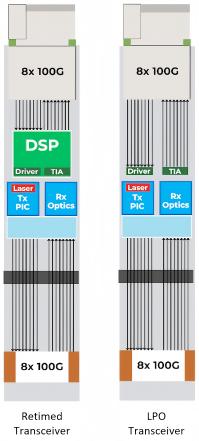
Advantages:
- Lower Power Consumption: By replacing DSP-based digital processing with linear-drive circuits for direct signal conversion, power consumption is reduced by over 30%.
- Reduced Latency: The elimination of DSP processing steps enables faster signal conversion, significantly cutting latency.
- Cost Efficiency: High-end DSPs account for 40% of total module costs. Removing them drastically lowers overall expenses.
NPO
NPO (Near-Packaged Optics) is a transitional technology bridging traditional pluggable modules and CPO. It integrates the optical engine and GPU chip side-by-side on the same high-performance PCB or organic substrate, connected via ultra-short high-speed circuits. This minimizes the distance between the switch chip and optical engine, ensuring high-quality signal transmission.
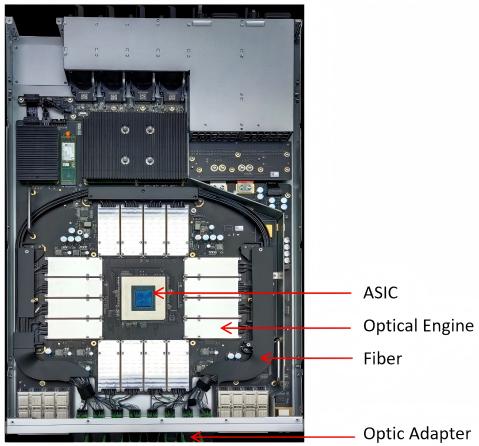
Advantages:
- Lower Latency: Independent packaging and on-substrate interconnects drastically reduce electrical path length.
- Easier Maintenance: The optical engine can be replaced separately from the ASIC without powering down or disassembling the device.
CPO
CPO (Co-packaged optics) integrates the optical engine responsible for electro-optical conversion with the ASIC chip handling data exchange within a single package. This achieves ultra-short electrical signal transmission distances, enabling high bandwidth, low power, and low-latency interconnects while reducing thermal demands.
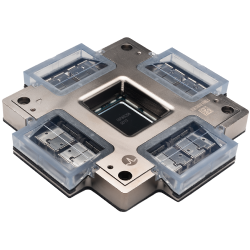
Advantages:
- Ultra-Low Latency: Minimized signal travel distance and fewer intermediate stages enhance response speed.
- High Space Efficiency: Compact integration increases port density, saving data center space.
- Reduced Power Consumption: Shorter electrical interconnects cut signal attenuation and energy loss.
- Improved Reliability: Fewer external interfaces and connectors lower failure rates.


