
 English
As digital technologies like AI, cloud computing, and big data continue to expand their application scope, generating massive amounts of data every day, data centers have an exponentially growing demand for network bandwidth. Optical modules are core components that enable the transmission and conversion of optical signals in data center networks. The speed of fiber transceiver technological iteration directly determines the efficiency and cost of data transmission. At present, the optical transceiver module industry is in a critical stage: from the large-scale commercial use of 400G transceiver modules, to the rapid growth of 800G transceiver modules, and the gradual implementation of 1.6T transceiver modules. Meanwhile, to solve the power consumption and heat dissipation problems caused by high bandwidth, LPO (Linear Pluggable Optics) technology has emerged and gradually been applied in industrialization, injecting new impetus into the efficient operation of data centers.
400G Transceivers: Mainstream for Short-Distance Data Center Interconnection
In the technological evolution path of optical modules, transceivers with different rates have always kept pace with the development needs of data centers. Currently, 400G optical transceiver modules have become the mainstream choice for short-distance interconnection in data centers and have been put into large-scale commercial use. Whether in large data centers of cloud computing providers or core networks of enterprise-level data centers, 400G optical transceivers undertake the important task of massive data transmission.
800G Transceivers: Demand Explodes Driven by AI Large Model Needs
However, with the rapid development of artificial intelligence technology, especially the higher requirements for computing power and bandwidth in the training and inference of large models, the market demand for 800G optical modules has witnessed explosive growth. According to a report released by LightCounting, an industry research institution, a single GPU requires more than 100Gbps of interconnection bandwidth during the training and inference of AI large models. This makes 800G optical modules, which can provide higher bandwidth, an inevitable choice.
1.6T Transceivers: Entering Early Stages to Meet Ultra-High-Speed Transmission Needs
While the demand for 800G optical modules is growing rapidly, 1.6T optical transceiver modules with higher rates have also entered the stage of technical verification and early commercialization. The emergence of 1.6T fiber transceiver modules is mainly to meet the demand for ultra-high-speed data transmission in future super-large AI data centers, supercomputing centers and the 5G Advanced (5.5G) era. As the parameter scale of large models continues to expand, the rise of multi-modal AI applications, and the increasing frequency of data interaction between edge computing and core clouds, 1.6T optical transceiver modules will gradually become a key technology to solve the bottleneck of ultra-large-scale data transmission, pushing data center networks into the T-level era.
LPO Technology: Lowering Power Consumption, Emerging as a Core Choice for High-Bandwidth Optics
As the rate of optical transceiver modules continues to increase, power consumption and heat dissipation have gradually become key bottlenecks restricting their development. In the traditional DPO (Digital Pluggable Optics) solution, digital signal processing (DSP) chips are integrated inside optical modules. While DSP chips realize functions such as signal equalization and error correction, they also consume a lot of electricity and generate considerable heat. For data centers, the high power consumption of a large number of optical modules not only increases the overall operating costs (including electricity fees, investment in heat dissipation equipment, etc.), but also affects the stability and service life of equipment due to excessive heat dissipation pressure. This problem becomes more prominent especially after the large-scale application of 800G and higher-rate optical modules.
Core Innovation of LPO Technology: Removing DSP to Optimize Performance
To solve this pain point, the industry has explored new technical paths. LRO (Linear Receive Optics) and LPO (Linear-drive Pluggable Optics) technologies are important directions among them. Compared with LRO, LPO technology has become the mainstream technical choice for current high-bandwidth optical modules due to its significant advantages in power consumption and performance improvement. The core innovation of LPO technology lies in removing the digital signal processing (DSP) function from pluggable optical modules. It transfers the signal processing tasks originally undertaken by optical modules to switch chips for integrated processing. At the same time, relying on the optimized design of the physical layer of short-distance links, it greatly simplifies the internal structure of optical modules while ensuring the quality of signal transmission.
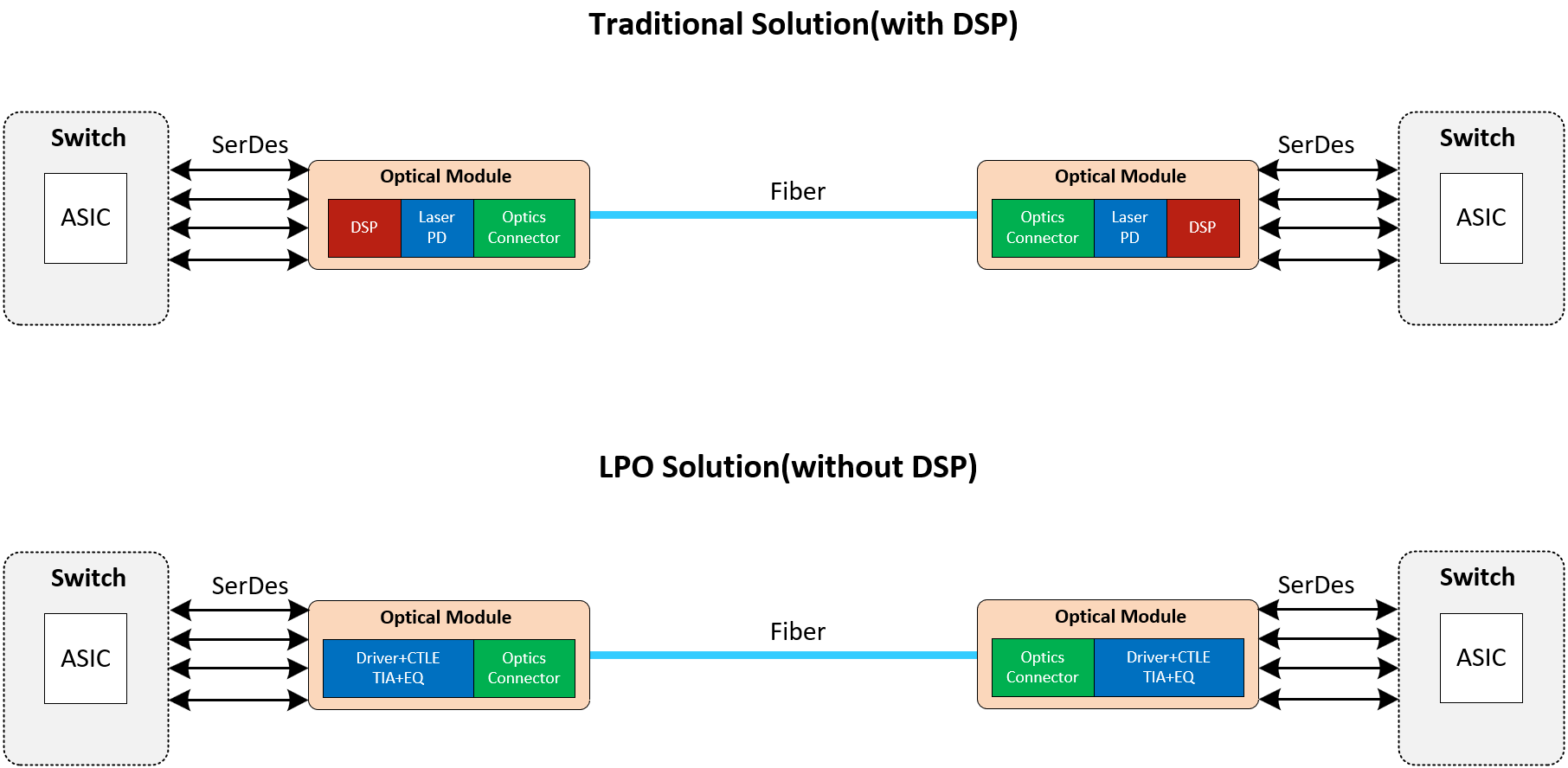
Advantages of LPO Technology: Reducing Power Consumption and Saving Data Center Costs
From the perspective of actual performance data, the advantages of LPO technology are very obvious. Taking the AICPLIGHT 800G DR8 optical module as an example, compared with the traditional DPO solution, the 800G DR8 LPO module reduces power consumption by 50%, with a specific power consumption of only 8W. For large data centers with hundreds of thousands or even millions of optical modules, this significant reduction in power consumption means huge savings in annual electricity costs. At the same time, it also significantly reduces the heat dissipation pressure of data centers, cuts down the investment and operating costs of heat dissipation equipment, and provides important support for data centers to achieve green and low-carbon operation.
LPO Technology: Beyond Power Savings, Breaking Delay Bottlenecks for AI Training
In addition to the advantage of power consumption, LPO technology has also made a breakthrough in signal transmission delay. The DSP chip in the traditional DPO solution causes a certain delay when processing signals. However, LPO technology gets rid of the dependence on DSP chips and directly reduces the signal processing links. As a result, the end-to-end delay of optical modules has dropped from 100ns in the traditional DPO solution to less than 10ns. This extremely low delay is crucial for application scenarios with high real-time requirements such as AI training. During the training of AI large models, a large number of computing nodes need to conduct real-time data interaction and collaborative work. Extremely low delay can effectively improve computing efficiency, shorten the model training cycle, and provide strong support for the rapid iteration of AI technology.
AICPLIGHT 800G DR8 LPO Transceiver
AICPLIGHT's 800GBASE-DR8 OSFP LPO optical transceiver is built for 800GBASE Ethernet, delivering top performance for AI data centers. It supports up to 500m transmission over OS2 single-mode fiber (1310nm wavelength) via dual MTP/MPO-12 APC connectors, and meets key standards like CMIS 5.0, LPO MSA 1.0, and OSFP MSA. With built-in Digital Diagnostics Monitoring (DDM), it lets you check real-time operating data easily—simplifying maintenance.
This transceiver blends cost-efficiency with high performance. Both optical and electrical interfaces handle 8×112Gb/s PAM4 speeds, reaching 500m over single-mode fiber. By using a linear data path instead of traditional retimed DSP, it cuts power use and latency significantly. It also stands up to tough conditions like extreme temperatures, humidity, and EMI. Ideal for AI data centers and high-speed networks, AICPLIGHT's 800G DR8 LPO transceiver is a smart, reliable choice.
Conclusion
From the large-scale commercial use of 400G transceivers, to the explosive demand for 800G transceivers, and then to the gradual implementation of 1.6T transceivers, the optical module industry is responding to the growing bandwidth demand of data centers through rapid technological iteration. The emergence and gradual industrialization of LPO technology not only solves the power consumption and heat dissipation problems faced by high-bandwidth optical modules, but also improves application performance by reducing delay, opening up new space for the further development of optical module technology.
In the future, with the continuous evolution of technologies such as AI, cloud computing and big data, data centers will put forward higher requirements for the rate, power consumption and cost of optical modules. On the one hand, 1.6T optical modules will accelerate technological maturity and cost reduction, and gradually expand their market share. On the other hand, the R&D of optical modules with higher rates (such as 2T and above) will also be put on the agenda, pushing the optical module industry into a competition stage of higher rates. At the same time, LPO technology will continue to be optimized, making breakthroughs in longer transmission distance and higher reliability. It will also be combined with other advanced technologies (such as silicon photonics technology) to further improve the comprehensive performance of optical modules. It can be predicted that driven by technological innovation, the optical module industry will continue to maintain a high-speed development trend and provide more solid underlying support for the prosperity of the digital economy.


