
 English
The network cables we use daily may look identical with their RJ45 connectors, but they differ significantly in shielding types. Choosing the right shielding level is like navigating a "minefield" of confusing acronyms and technical jargon.
Shielded network cables, as the name suggests, incorporate shielding layers to protect against EMI (Electromagnetic Interference), RFI (Radio Frequency Interference) and crosstalk between wire pairs and adjacent cables. They also prevent signal leakage from the cables that could disrupt nearby equipment. Different shielding grades suit varied applications.
Common shielding types include UTP, STP, FTP, and SFTP. This article explains these technical terms to help you quickly grasp their meanings.
UTP (Unshielded Twisted Pair)
- Structure: The most common and fundamental cable with 4 pairs of twisted wires. Plastic jacket (no shielding).
- Use Cases: Home/office networks, low-interference LANs.
- Advantages: Low cost, easy installation.
FTP (Foiled Twisted Pair)
- Structure: Adds a shielding layer to the UTP design. Uses an aluminum foil shield to envelop all four pairs of twisted wires, followed by a plastic outer jacket.
- Use Cases: School/government networks, game streaming and other environments with certain electromagnetic compatibility requirements.
- Advantages: Balanced shielding at moderate cost.
STP (Shielded Twisted Pair)
- Structure: Also incorporates shielding over UTP, but differs from FTP by employing individual shielding. Each twisted pair is wrapped separately in aluminum foil or braided mesh, then enclosed within a plastic outer jacket.
- Use Cases: Industrial settings, medical facilities, and biological research environments where high-power or precision equipment is present.
- Advantages: Superior pair-to-pair isolation.
SFTP (Screened Foiled Twisted Pair)
- Structure: Combines the advantages of both FTP and STP. It first shields each twisted pair individually (like STP), then adds an overall braided shield to all four pairs (similar to FTP), and finally wraps the assembly in a plastic outer jacket.
- Use Cases: Data centers, bank, and other environments demanding extremely high data transmission rates and reliability.
- Advantages: Maximum interference resistance.
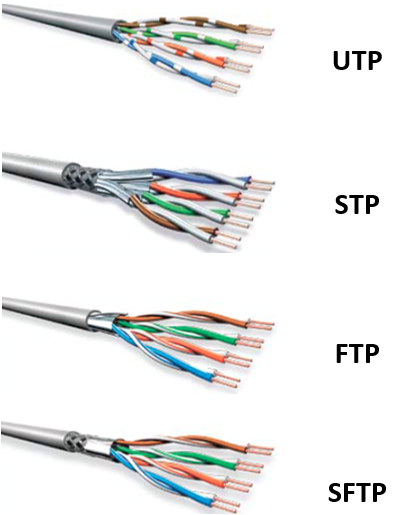
Shielding Effectiveness Comparison
UTP < FTP ≦ STP < SFTP
Functions of Shielding Layers
- Resists external electromagnetic interference (EMI): When transmitting electrical signals, network cables are highly susceptible to interference from external strong electric fields, magnetic fields, radio waves, etc., which degrade data stability. Shielding layers effectively block such external interference.
- Prevents signal leakage: Shielding contains internal signals to avoid inaccurate signal recognition by external devices.
- Crosstalk control: In signal transmission, crosstalk occurs when signals from one pair couple onto adjacent pairs, causing data transmission errors. With four twisted pairs in a cable, each pair's signals slightly affect the others. Individual pair shielding (as in STP/SFTP) significantly reduces this effect.
Choosing the right cable type for your deployment environment, application needs, and EMI/RFI levels is critical. AICPLIGHT offers comprehensive UTP and shielded twisted-pair cable solutions. If you're unsure which cable type is required, our experts stand ready to assist in selecting the optimal solution.


