
 English
DAC (Direct Attach Copper) and AOC (Active Optical Cable) are two cost-effective, plug-and-play interconnect solutions widely adopted in data centers and enterprise networks. They play a critical role in 400G high-speed interconnects. Although emerging technologies like AI and HPC drive the evolution toward 800G and 1.6T optical communication, 400GbE remains dominant in most traditional and transitional enterprise data centers.
Due to their deployment convenience, 400G DAC and 400G AOC have become mainstream choices for short-reach interconnects. A deep understanding of their differences in physical structure, transmission performance, reach, power consumption, cost structure, and application scenarios is essential for network architects, procurement decision-makers, and technology selection teams.
I.Overview of 400G DAC and 400G AOC
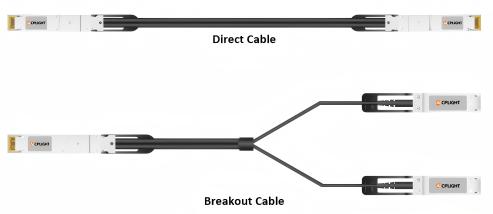
Both DAC and AOC are essentially integrated cable assemblies with connectors on both ends. The mainstream 400G connector types include QSFP-DD, QSFP112, OSFP. The connectors at both ends can be homogeneous (same form factor) or heterogeneous (different form factors), depending on the port types of connected devices.
Based on application, these cables fall into two categories:
- Direct-attach cables: Used for point-to-point connections between same-spec devices.
- Breakout cables: Enable high-bandwidth ports to split into multiple lower-speed connections.
1.1 What is DAC?
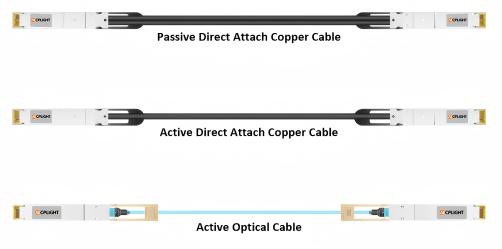
DAC cables are categorized into Passive DAC and Active DAC. Both use copper as the transmission medium, carrying electrical signals directly.
The key difference lies in: active DAC integrates signal amplifiers or retiming chips to compensate for high-frequency signal attenuation in copper, extending the effective transmission distance.
1.2 What is AOC?
AOC cables use fiber optics for transmission, converting electrical signals to optical signals via electro-optical components. They require host power to drive built-in lasers/receivers for O-E-O (optical-to-electrical-to-optical) conversion.
Currently, the vast majority of 400G AOC employs multimode fiber (MMF) transmission solutions, matching the standard MMF optical modules with a maximum reach of 100m.
II. 400G DAC & AOC Types
2.1 DAC (Direct Attach Copper)
| Model | Type | Rate | Form Factor | Transmission Distance |
|---|---|---|---|---|
| QDD-QDD-C | Direct | 400G-to-400G | QSFP-DD to QSFP-DD | Passive: 0.5–3m Active: 1–5m |
| O400-QDD-C | Direct | 400G-to-400G | OSFP to QSFP-DD | Passive: 0.5–2.5m Active: 1–5m |
| O400-2Q200-C | Breakout | 400G-to-2x200G | OSFP to 2x QSFP56 | Passive: 1–2m Active: 1–5m |
| Q400-2Q200-C | Breakout | 400G-to-2x200G | QSFP-DD to 2x QSFP56 | Passive: 1–3m Active: 1–5m |
2.2 AOC (Active Optical Cable)
| Model | Type | Rate | Form Factor | Transmission Distance |
|---|---|---|---|---|
| QDD-QDD-A | Direct | 400G-to-400G | QSFP-DD to QSFP-DD | 1–100m (MMF) |
| O400-QDD-A | Direct | 400G-to-400G | OSFP to QSFP-DD | 1–50m (MMF) |
| O400-2Q200-A | Breakout | 400G-to-2x200G | OSFP to 2x QSFP56 | 1–50m (MMF) |
| Q400-2Q200-A | Breakout | 400G-to-2x200G | QSFP-DD to 2x QSFP56 | 1–50m (MMF) |
III. 400G DAC vs. 400G AOC
3.1 Power Consumption
- DAC: No electro-optical conversion; transmits electrical signals directly. Ultra-low power: 0.1W (typical).
- AOC: Requires power for lasers, drivers, and receivers. Average power: 8W (significantly higher than DAC).
3.2 Transmission Distance
- DAC: Limited by copper signal attenuation. Passive DAC: ≤3m. Active DAC: ≤5m (suitable for intra-rack/adjacent rack connections).
- AOC: Fiber-based, low-loss, EMI-resistant. Supports up to 100m, ideal for cross-rack/zone or small data center interconnects.
3.3 Weight & Cable Management
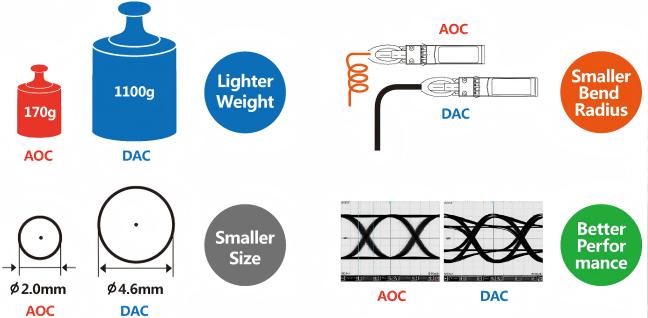
- DAC: Heavy (hundreds of grams per cable) and stiff due to multi-core copper, posing challenges in dense cabling and maintenance.
- AOC: Lightweight (1/3–1/2 of DAC's weight). Easier to organize, bundle, and route, improving airflow and cooling efficiency.
3.4 Diameter & Bend Radius
- DAC: Thick shielded twisted-pair structures (4.6mm diameter) to carry high-frequency differential signals. Rigid; minimum bend radius: 500mm (prone to signal degradation if bent).
- AOC: Slim fiber optic design (~2.0mm diameter). Flexible; minimum bend radius: 30mm (space-efficient).
3.5 Signal Quality & EMI Resistance
- DAC: Susceptible to electromagnetic interference (EMI) and signal attenuation at high frequencies.
- AOC: Immune to EMI; lower bit error rate (BER) and higher signal integrity.
3.6 Cost Efficiency
- DAC: Simple structure, requiring no expensive optical components. 30% cheaper than AOC (ideal for budget-sensitive short-reach links).
- AOC: Higher cost due to fiber and optoelectronic components.
IV. Selecting DAC or AOC for 400G Data Centers
4.1 Selection Based on Distance Between Devices
The physical distance between devices is the primary factor in choosing DAC or AOC:
- ≤5m (same/adjacent racks): DAC is recommended for low cost and power efficiency.
- Cross-rack or cross-room connections: AOC is mandatory to ensure signal integrity and reliable transmission.
4.2 Selection Based on Cabling Space
- DAC: Suitable for deployments with ample cable trays, open pathways, and robust management systems.
- AOC: Preferred in space-constrained, high-density environments due to its slim diameter, lightweight, and flexibility, which improve tidiness and airflow.
4.3 Selection Based on Budget
Cost-sensitive projects: DAC is the clear winner for its significant price advantage.
V. Conclusion
In the rapid evolution of modern data centers, DAC and AOC are not mutually exclusive competitors but complementary strategic partners. The optimal choice depends on application requirements (distance, bandwidth), physical constraints (space, bend radius) and budget priorities, both can serve as ideal cabling solutions for high-speed interconnects.


