
 English
Introduction
In the precision networks of fiber optic communications, connectors serve as critical "bridges." Different types of connectors, with their unique physical structures, dimensions, and locking mechanisms, enable efficient optical signal transmission from data centers to telecommunications networks. Do you find yourself confused by professional abbreviations like LC, SC, FC, ST, CS, SN, MU, and MT-RJ? This article will clearly explain the core features, design purposes, and application scenarios of these eight mainstream fiber optic connectors, helping you quickly grasp the key knowledge of fiber interconnect hardware.
1. What is LC?
LC (Lucent Connector) is a small, square, snap-in fiber optic connector developed by Lucent Technologies. It uses an RJ-style latch mechanism for easy operation.
LC is one of the most widely used connectors in single-mode network equipment. Its key advantage lies in its 1.25mm ferrule, which significantly increases port density in fiber patch panels. Currently, LC dominates the single-mode miniaturized connector market and is gaining rapid adoption in multimode applications.
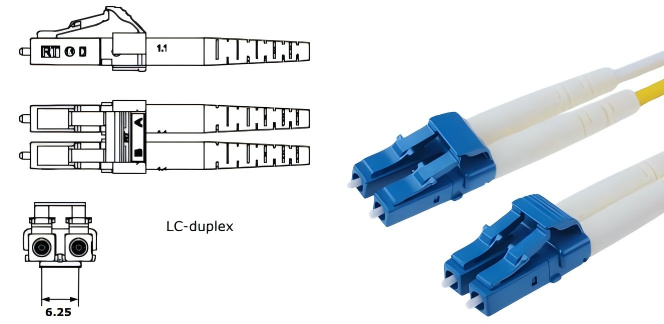
LC Profile Diagram and Actual Product Image
2. What is SC?
SC (Square Connector) is a snap-in square fiber optic connector developed by by NTT of Japan. Its standard rectangular profile enables straight insertion and removal without rotation. Advantages include low cost, easy plugging/unplugging, high insertion loss stability, excellent compression strength, and high installation density.
SC is also a common interface for single-mode equipment, especially in PON networks. It uses a 2.5mm ferrule, distinguishing it from the threaded locking of ST/FC. Thanks to its balanced performance, SC is widely deployed in fiber networks.
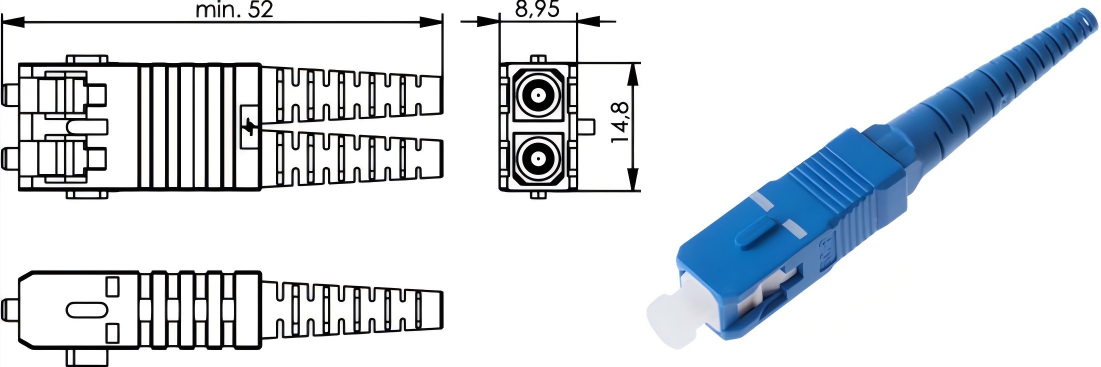
SC Profile Diagram and Actual Product Image
3.What is FC?
FC (Ferrule Connector) is a threaded circular fiber optic connector originally developed by NTT of Japan. Its name derives from its metal-reinforced housing secured via screw coupling. The metal shell ensures superior connection reliability and durability, with a far greater number of insertion cycles than plastic connectors.
FC connectors are widely used in traditional ODF patch panels and optical terminals. They employs a 2.5mm ferrule. Notably, early FC models featured ceramic ferrules embedded in stainless steel sleeves.
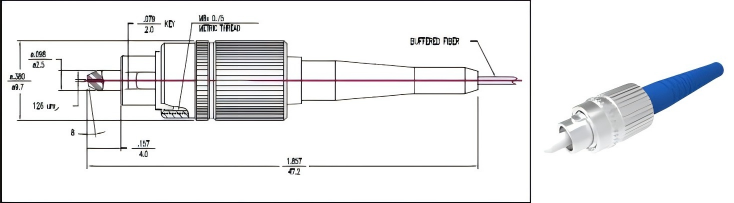
FC Profile Diagram and Actual Product Image
4.What is ST?
ST (Straight Tip) is a bayonet-style circular connector, named for its straight-plug-and-rotate locking mechanism (similar to vintage light bulbs). The housing is circular and employs a bayonet locking mechanism.
The core structure of an ST connector includes a bayonet locking frame and a 2.5mm-long cylindrical ceramic ferrule that holds the fiber. This design ensures both ease of connection and secure retention.

ST Profile Diagram and Actual Product Image
5.What is CS?
CS (Compact Small) connector is an ultra-dense connector designed to replace traditional duplex LC, addressing size limitations of next-gen optical modules while further enhancing port density in patch panels.
CS employs an innovative push-pull mechanism. Its core feature integrates two spring-loaded 1.25mm cylindrical ferrules within a single housing, with a center-to-center distance of just 3.8mm—the minimum spacing meeting current TOSA (Transmitter Optical Sub-Assembly) and ROSA (Receiver Optical Sub-Assembly) packaging requirements.
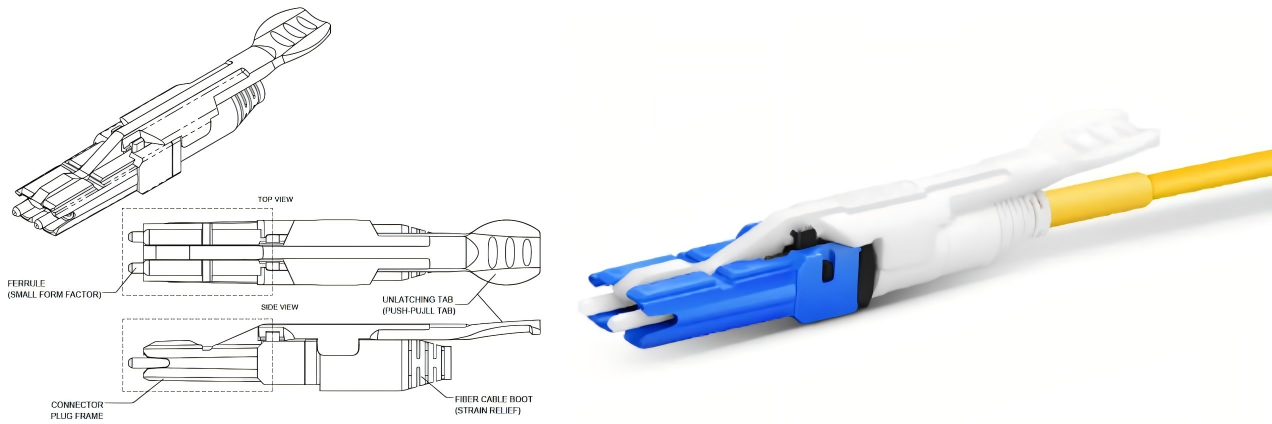
CS Profile Diagram and Actual Product Image
6.What is SN?
6.SN (Simplified Networks) by SENKO is a hyper-compact duplex connector optimized for 400G data centers. It provides an efficient, independent fiber duplex separation solution for four-channel high-speed optical modules like QSFP, QSFP-DD, and OSFP, offering higher efficiency, reliability, and cost advantages over MPO connectors.
SN features a single-shell design integrating two standard LC-type 1.25mm zirconia ferrules. Its breakthrough lies in compressing the center-to-center distance between ferrules to 3.1mm (significantly lower than the 6.25mm of traditional duplex LC connectors), perfectly meeting the demands of high-density, high-speed data centers.
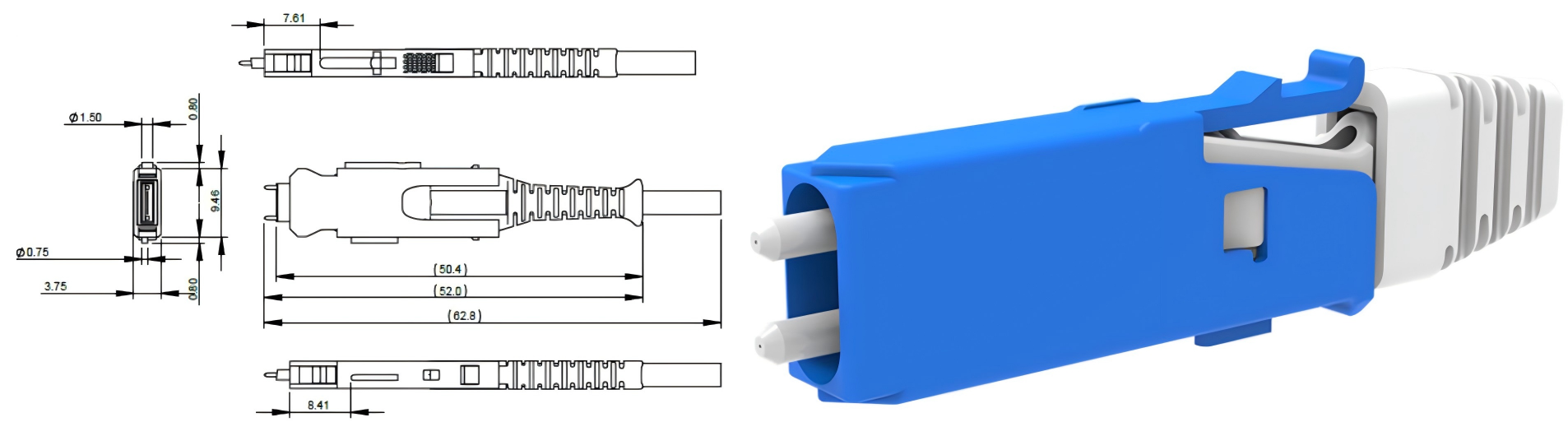
SN Profile Diagram and Actual Product Image
7.What is MU?
MU (Miniature Unit Coupling) is the world's smallest single-fiber connector developed by Japan's NTT, evolved from the SC design. It inherits the SC's insertion and removal mechanism while achieving significantly reduced dimensions.
MU's core innovation lies in its 1.25mm diameter ferrule and efficient self-retaining mechanism, which substantially enhance installation density.
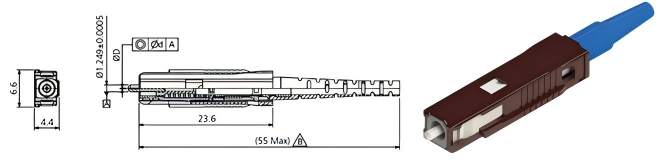
MU Profile Diagram and Actual Product Image
8. What is MT-RJ?
MT-RJ (Mechanical Transfer Registered Jack) originated from NTT's MT connector. It incorporates the same latching mechanism as RJ-45 LAN connectors, resembling standard network cable interfaces. Its dimensions are comparable to those of a standard telephone jack.
It aligns fibers via guide pins mounted on both sides of a small ferrule. For easy connection to optical transceivers, the connector cross-section features dual fibers arranged in parallel (0.75mm spacing). All MT-RJ pigtails bundle these dual fibers together, forming a square, transceiver-integrated optical connector.
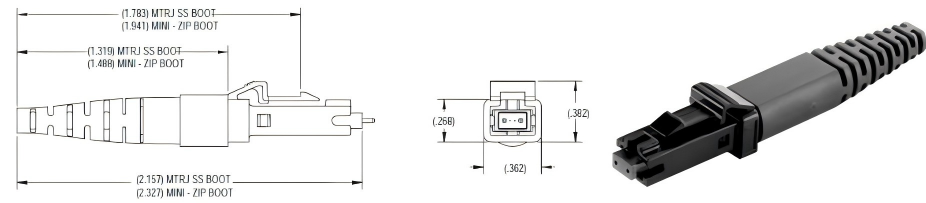
MT-RJ Profile Diagram and Actual Product Image


