
 English
Multimode and single mode fibers have become deeply integrated into modern life, powering everything from home networks and commercial communication systems to hospital IT platforms, campus LANs, and metropolitan optical backbone networks. Despite their widespread adoption across industries, the differences between these fiber types often cause confusion. This article examines their fundamental distinctions across construction, appearance, and performance parameters.
I.Overview
1.1 Single Mode Fiber (SMF)
- Structure: 9μm glass core with 125μm cladding diameter
- Function: Transmits single-mode light at long wavelengths
- Advantages: Smaller core size and laser light source indicates lower chromatic dispersion. Enables long-distance transmission (up to tens of kilometers) in certain scenarios.
1.2 Multimode Fiber (MMF)
- Structure: 50μm/62.5μm common core with 125μm cladding diameter
-
Function: Carries multiple light modes simultaneously
- Types: According to TIA/EIA-492 Standards a.OM1: already been phased out due to its low bandwidth and high loss b.OM2: limited application in low-speed, short-distance scenarios c.OM3/OM4: mainstream choices due to higher bandwidth and cost-effectiveness d.OM5: the latest generation of multimode fiber specifically designed for SWDM technology in high-speed, short-distance applications
II.Single Mode Fiber vs Multimode Fiber
2.1 Outer Jacket Color
While single mode and multimode fibers are visually indistinguishable, the industry uses standardized jacket colors for quick identification:- Single Mode Fiber: Yellow
- Multimode Fiber: a.OM2: Orange b.OM3: Aqua c.OM4: Rose (Erika Violet) d.OM5: Lime Green
This color-coding system significantly improves efficiency in cable installation, maintenance, and management.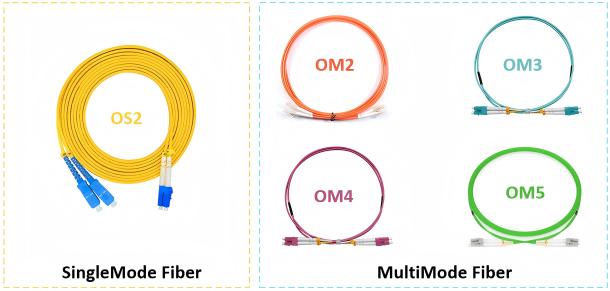
2.2 Core Structure
Single-mode fiber features an ultra-small 9μm core diameter, permitting only one light mode propagation. Multimode fiber's larger core (typically 50μm for OM2-OM5, 62.5μm for legacy OM1) enables multiple concurrent light modes.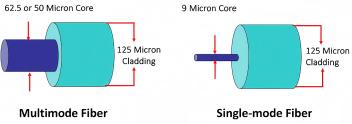
2.3 Bandwidth
Multimode fiber bandwidth is constrained by its multi-mode transmission mechanism, with varying Effective Modal Bandwidth (EMB) across categories (OM1-OM5).Fiber Type Core Size Bandwidth 1000BASE-SX 10GBase-SR OM1 62.5μm 200 MHz·km 275m 33m OM2 50μm 500 MHz·km 550m 82m OM3 50μm 2,000 MHz·km 1000m 300m OM4 50μm 4,700 MHz·km 100m 400m OM5 50μm 28,000 MHz·km 1000m 400m 2.4 Transmission Distance
- Multimode Fiber: Distance decreases significantly at higher data rates and degrades signal integrity due to modal dispersion (caused by multiple light paths). Particularly severe in step-index multimode fibers.
- Single-mode Fiber: Eliminates modal dispersion due to single-mode propagation. Maintains stable transmission for kilometers to tens of kilometers at high speeds.
Types OM1 OM2 OM3 OM4 OM5 1000BASE-SX 275m 550m 1000m 1000m 1000m 10GBASE-SR 33m 82m 300m 400m 400m 25GBASE-SR / / 70m 100m 100m 40GBASE-SR4 / / 100m 150m 150m 100GBASE-SR4 / / 70m 100m 100m 200GBASE-SR4 / / 70m 100m 100m 400GBASE-SR4 / / 30m 50m 50m 400GBASE-SR8 / / 70m 100m 100m 800GBASE-VR8 / / 30m 50m 50m 2.5 Operating Wavelengths
- Multimode: Short wavelengths (850nm/1300nm).
- Single-mode: Long wavelengths (1310nm/1550nm).
2.6 Attenuation Coefficient
The attenuation coefficient is a critical metric for transmission performance, directly impacting the maximum usable transmission distance (dB/km). Lower attenuation translates to higher transmission efficiency and longer distances without the need for repeaters.Fiber Type Wavelength Typical Loss Coefficient (dB/km) MultiMode 850nm 2.5 to 3.0 MultiMode 1300nm 0.8 to 1.5 Single-Mode 1310nm 0.35 to 0.4 Single-Mode 1550nm 0.25 to 0.3
III.FAQs
Q: Can multimode optical modules be used with single-mode fiber?A: No. Multimode modules typically employ 850nm VCSEL light sources that emit divergent multi-mode beams with a large divergence angle, which cannot efficiently couple into the 9μm core of single-mode fiber. This causes severe insertion loss or complete communication failure.
Q: Can single-mode optical modules work with multimode fiber?A: Technically possible but not recommended. While single-mode modules transmit a single light mode that can propagate through multimode fiber's 50μm core, the distance is drastically reduced due to modal dispersion. For example, 1000BASE-LX achieves 10km over single-mode fiber but only 550m over multimode fiber.
Q: How to choose single-mode and multimode fiber?A: The decision depends on required distance and data rate. For example, if two floors are 200m apart and you need to transmit at 10G speed, multimode fiber is most recommended. At 10G speed, OM3 can transmit up to 300m, while OM4 can transmit up to 400m.


