
 English
Overview
A UK university has witnessed rapid growth in AI research and education, yet its existing GPU resources remain fragmented without unified scheduling or management mechanisms. This has led to high idle rates, cumbersome research environment deployment, and underutilized computing power. To address these issues, the university plans to establish an integrated AI management platform, enabling GPU resource pooling and intelligent management to create an efficient, flexible, and scalable AI research and teaching environment.
Challenges
1.Difficulties in Managing Dispersed Resources
GPU servers are distributed across faculties, laboratories, and training buildings, lacking centralized monitoring and management, resulting in low resource utilization.
2.Complex Environment Deployment
AI development environments are diverse, with different faculties and laboratories having varying software version and framework dependencies. Manual deployment is time-consuming and prone to errors.
3.High Concurrent Demand for Multi-user
As the large student population and growing GPU needs for research and coursework, traditional methods struggle to support multi-tenant concurrent usage scenarios.
4.Low Research Collaboration Efficiency
Additionally, research collaboration efficiency is hampered by the dispersion of data, algorithms, and models across disparate systems, with no unified management or sharing mechanism in place.
Solustion
The project ultimately adopted the AICPLIGHT Integrated AI Management Platform as its core system to achieve resource consolidation and computing power pooling.
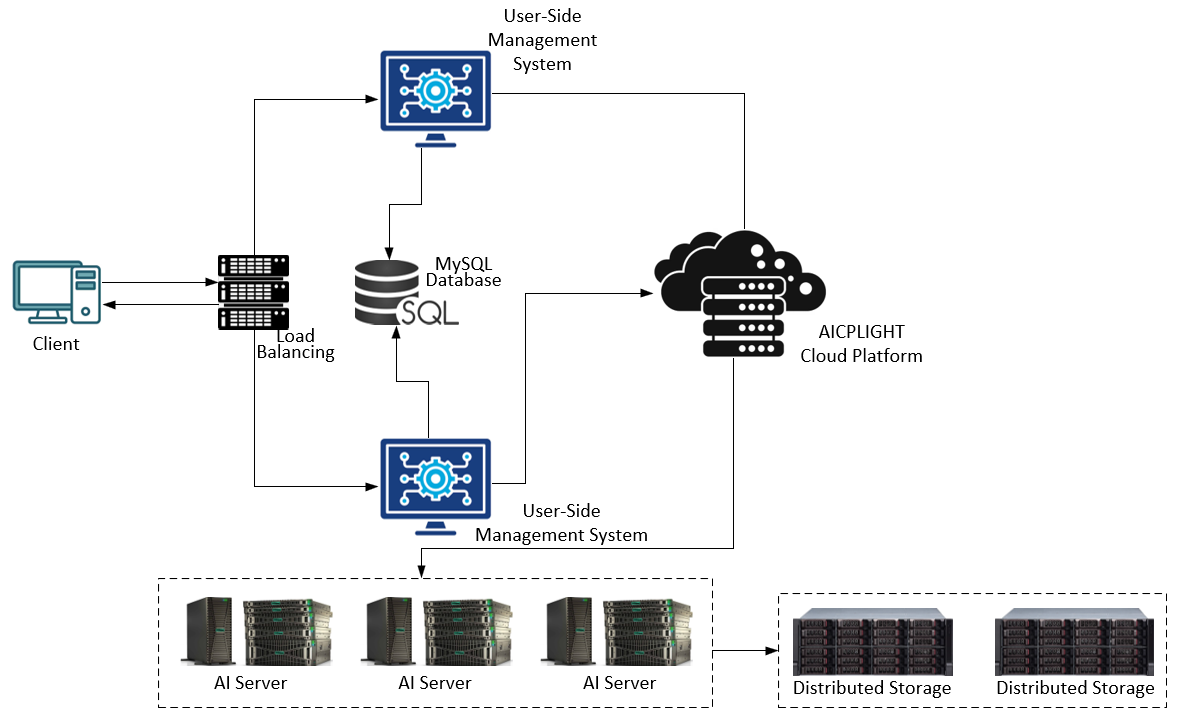
1.Unified Computing Resource Scheduling Platform
Through containerization and Kubernetes (K8s) orchestration, the platform enables flexible allocation of GPU, CPU, and other computing resources. It supports elastic resource scaling, multi-tenant isolation, and on-demand distribution.
2.Integrated Full AI Research Lifecycle
The platform covers end-to-end management from dataset management, algorithm development, model training to model deployment. Supports multiple mainstream frameworks.
3.Multi-Level User Access & Permission Control
Tailored permissions are set for faculty, students, and researchers, supporting self-service environment creation and experiment replication. The intuitive interface lowers the barrier to AI research while enhancing efficiency in both academic and research activities.
Advantages
1.Centralized Computing Power with Elastic Scheduling
Unified scheduling and virtualization of over 100 GPUs achieve >90% utilization.
2.High-Efficiency Research Environment
Supports concurrent AI training and experiments for thousands of users, with hundreds of parallel AI containerized environments.
3.Reduced Deployment & Maintenance Costs
Containerization cuts environment setup time by 70%, while automated management significantly reduces operational overhead.
4.Accelerated Innovation
Unified data and model management fosters cross-disciplinary collaboration and accelerates the delivery of research outcomes.


