
 English
In the field of communication engineering, connections between any two devices rely on interconnect cables. These cables typically feature specific connectors at both ends. Since physical interfaces of communication equipment adhere to various technical standards, this has led to a diversity of connector types and consequently spawned multiple specifications of interconnect cables.
In the early days, there was no unified public protocol to standardize the parameters and specifications of fiber optic connectors. Different manufacturers produced varying products. Although these connectors had similar transmission performance, each had distinct advantages and disadvantages in design and application.
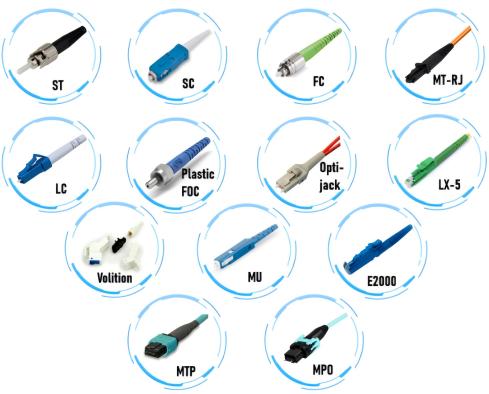
I.Types of Connectors
1.1 LC Connector
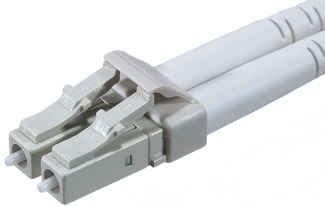
The LC (Lucent Connector) features a compact square design with a locking mechanism similar to modular jacks (RJ). Its 1.25mm ferrule (half the size of SC/FC) boosts port density in fiber patch panels. With simple clip-on adapters, LC connectors can be easily converted to duplex configurations, meeting diverse high-density cabling needs in data centers, communication networks, and various equipment interconnects. They perform exceptionally well in high-density environments.
1.2 SC Connector
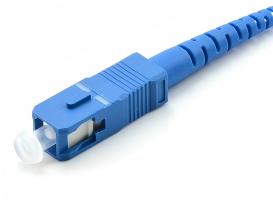
The SC (Standard Connector) uses a rectangular shell with a snap-in latch (no rotation needed). Known for easy insertion and removal, low insertion loss and high durability, it's widely deployed in FTTH, Gigabit BIDI modules interconnecting.
1.3 FC Connector
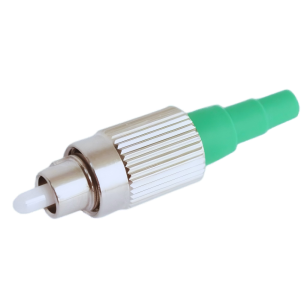
The FC (Ferrule Connector) employs a circular threaded metal shell for secure mating. Its structure is simple and intuitive, offering easy operation and relatively low manufacturing costs. Though prone to dust/Fresnel reflections, its stability makes it ideal for long-distance fiber optic communication systems, telecommunication core nodes, and harsh environments.
1.4 ST Connector
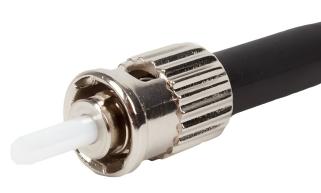
The ST (Straight Tip) uses a bayonet-style metal coupling (½-turn lock). Simple to install but requires panel clearance for rotation. ST fiber connectors are widely used in fiber distribution frames.
1.5 CS Connector
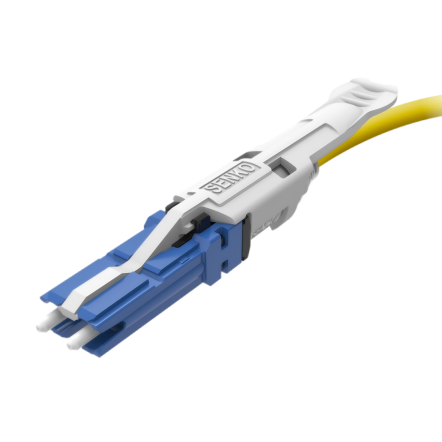
The CS (Connector Small) connectors prioritize space utilization, enabling a significant increase in port density within patch panels. A VSFF (Very Small Form Factor) design, increases port density by 40% vs. LC duplex. Optimized for high-speed OSFP/QSFP-DD modules, it enhances cable management and rack airflow in data centers.
II.Fiber Optic Connector Comparison
| Type | Ferrule | Key Features | Typical Applications | Cost |
|---|---|---|---|---|
| LC | 1.25mm | High density, low insertion loss | Data centers, 1-800G transceivers | Medium |
| SC | 2.5mm | Tool-less push-pull, stable | PON networks, 1G BIDI modules | Low |
| FC | 2.5mm | Threaded metal coupling | Test equipment, long-haul telecom | Medium |
| ST | 2.5mm | Bayonet lock, legacy compatible | Fiber patch panels | Low |
| CS | 1.25mm | Ultra-high density, space-saving | 800G transceivers, hyperscale DCs | High |
III.Types of Fiber Optic Patch Cords
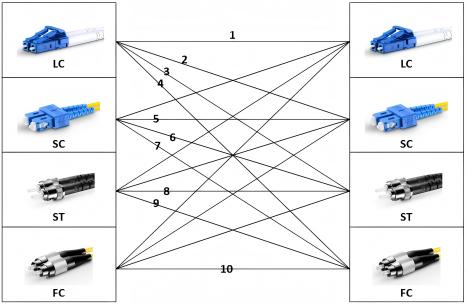
Fiber optic patch cords are optical cables equipped with connectors at both ends. Based on the five connector types mentioned earlier (LC, SC, FC, ST, CS), various patch cord configurations can be created. Among these, CS connectors are typically used only with other CS connectors (i.e., CS-CS patch cords), while LC, SC, FC, and ST connectors can be interchanged to form multiple combinations (e.g., LC-SC, FC-ST).
| Type | Connector A | Connector B | Notes |
|---|---|---|---|
| 1 | LC | LC | Most common in data centers |
| 2 | LC | SC | Hybrid cross-connect |
| 3 | LC | ST | Migration scenarios |
| 4 | LC | FC | Test equipment interfaces |
| 5 | SC | SC | Standard FTTH deployment |
| 6 | SC | ST | Legacy network upgrades |
| 7 | SC | FC | Telecom backbone links |
| 8 | ST | ST | Traditional LAN backbones |
| 9 | ST | FC | Industrial environments |
| 10 | FC | FC | Precision measurement systems |
Note: LC-SC and SC-LC represent different notations for the same patch cord type and are therefore not counted twice. The above combinations total 10 types.
This article comprehensively introduces the types of LC, SC, FC, ST, and CS fiber optic connectors, covering their appearance, structure, features, and application scenarios. For further assistance with fiber connector selection or patch cord procurement, AICPLIGHT's 24/7 technical support team is ready to help.


