
 English
Network virtualization technologies play a critical role in modern network architectures, with two prominent representatives—Virtual Local Area Network (VLAN) and Virtual Extensible Local Area Network (VXLAN)—delivering unique advantages in network management and scalability. This article provides an in-depth analysis of their differences and illustrates their respective application scenarios through concrete examples.
I.What is VLAN
A Virtual Local Area Network (VLAN) is a technology that segments a single physical network into multiple logical networks. Through VLANs, network administrators can group different devices into isolated logical segments, achieving management effects similar to separate physical networks.
VLAN implementation relies on switches, which add a tag to the packet header to identify the VLAN membership. This tag contains a VLAN ID that specifies the logical network affiliation. Switches inspect the tag to forward packets to the correct VLAN.
II.Classification of VLANs
2.1 Port-Based VLAN
VLANs are divided according to switch ports, with each port assigned to one or multiple VLANs. This is the most common VLAN type, implemented through manual port configuration to segment devices. While simple and easy to use, it offers limited flexibility and is suitable for static environments.
2.2 Tag-Based VLAN
VLAN tags are identifiers inserted into Ethernet frame headers to specify VLAN membership. By adding tags to frame headers, multiple VLANs can traverse the same physical network. This approach supports more flexible configurations but requires devices to be compatible with the 802.1Q protocol.
III.VLAN Application Scenarios
3.1 Departmental Network Segmentation
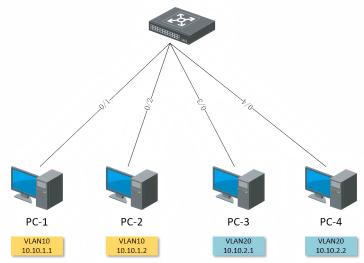
In large enterprises, multiple departments (e.g., sales, R&D, and marketing) share the same physical network. Using VLANs, administrators can assign departmental devices to independent logical networks. For example, sales department devices belong to VLAN 10, while R&D devices are assigned to VLAN 20, achieving logical isolation and efficient management between departments.
3.2 Customer Isolation
Network service providers often need to serve multiple clients on shared infrastructure. VLANs enable the creation of dedicated logical networks for each client. For instance, Customer A's devices are assigned to VLAN 10, while Customer B's devices are placed in VLAN 20, ensuring data isolation and security between clients.
IV.What is VXLAN
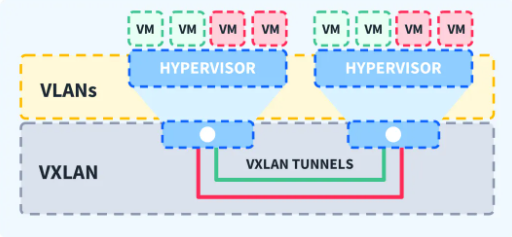
Virtual Extensible Local Area Network (VXLAN) is a technology for extending virtual networks in large-scale cloud computing environments. Compared to traditional VLANs, VXLAN provides a significantly larger identifier space to meet the virtualization demands of complex network architectures.
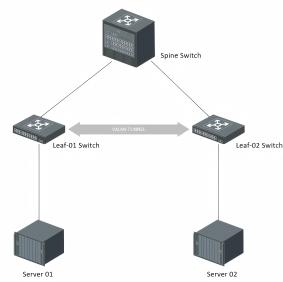
VXLAN achieves network expansion by adding a VXLAN header to the original packet. This header contains a 24-bit VNI (VXLAN Network Identifier) to distinguish virtual networks. After encapsulating the original packet, VXLAN transmits it over the underlying IP network.
V.VXLAN Application Scenarios
5.1 Large-Scale Cloud Networks
Cloud computing environments require highly flexible and scalable virtual networks. With its vast identifier space, VXLAN supports the creation of massive virtual networks. For example, each tenant can be assigned a unique VXLAN identifier, enabling flexible isolation and resource allocation between tenants.
5.2 Cross-Data Center Networks
VXLAN not only extends virtual networks within a single data center but also spans multiple data centers. This capability simplifies global cloud service deployment while maintaining high performance and network isolation.
| Technology | Advantages | Disadvantages |
|---|---|---|
| VLAN |
|
|
| VXLAN |
|
|
VII.VLAN vs. VXLAN
| Feature | VLAN | VXLAN |
|---|---|---|
| Identifier & Scale | 12-bit ID (supporting up to 4,094 VLANs) | 24-bit VNI (scalable to approximately 16 million VXLANs) |
| Connection Layer | Layer 2 Ethernet connection | Layer 3 tunnel connection (MAC-in-UDP encapsulation) |
| Redundancy & Loop Prevention | Relies on Spanning Tree Protocol (STP) | Routing protocol-based, utilizes all paths |
| L3 Scalability | Cannot span Layer 3 subnets | Native L3 extension capability |
| Configuration and Maintenance | Simple configuration in small networks | Suitable for large, distributed environments with easier scaling |
| Multi-tenancy | Limited isolation | Supports independent virtual networks |
| Encapsulation Method | Encapsulates using VLAN tags | Uses MAC-in-UDP encapsulation |
| Path Utilization | Limited by STP, utilizing only partial paths | Fully utilizes all paths via mechanisms like ECMP |
VIII.Summary
VLAN and VXLAN represent two critical phases in the evolution of network virtualization. VLAN is well-suited for small to medium-sized network environments, offering straightforward deployment, cost-effectiveness, and intuitive management. In contrast, VXLAN caters to cloud computing and multi-tenant architectures, emerging as the preferred choice for modern data centers due to its superior scalability and flexibility. Enterprises should evaluate factors such as network scale, business requirements, and maintainability when selecting between these solutions.
Fundamentally, VLAN addresses the challenge of "logical segmentation," while VXLAN solves the problem of "cross-domain extension." As cloud computing and virtualization technologies continue to advance, VXLAN is poised to play an increasingly pivotal role in future network architectures.


