
 English
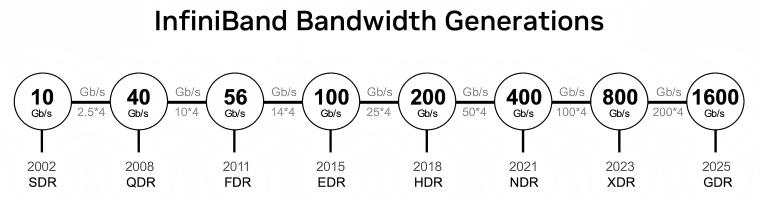
This glossary covers a set of acronyms that define the evolution of high-speed data transmission, primarily within the InfiniBand interconnect standard, which is vital for High-Performance Computing (HPC) and AI. The terms SDR, DDR, and QDR describe fundamental signaling techniques that transfer data one, two, or four times per clock cycle. Succeeding generations—including FDR, EDR, HDR, NDR, and future standards like GDR—are named data rates that mark significant, sequential increases in aggregated bandwidth. Collectively, these terms map the constant industry effort to achieve maximum throughput and minimum latency in modern data centers.
SDR
SDR (Single Data Rate) is an InfiniBand standard introduced in 2001, utilizing 8b/10b encoding with a per-lane rate of 2.5 Gbit/s. A 4x link delivers a theoretical throughput of 10 Gbit/s, with an actual rate of approximately 8 Gbit/s. SDR uses CX4 connectors.
DDR
DDR (Double Data Rate) is an InfiniBand standard introduced in 2005, also employing 8b/10b encoding but doubling the per-lane rate to 5 Gbit/s. A 4x link achieves a theoretical throughput of 20 Gbit/s, with an actual rate of around 16 Gbit/s. It similarly relies on CX4 connectors.
QDR
QDR (Quadruple Data Rate) is an InfiniBand standard introduced in 2007, retaining 8b/10b encoding while increasing the per-lane rate to 10 Gbit/s. A 4x link offers a theoretical throughput of 40 Gbit/s, with an actual rate of roughly 32 Gbit/s. QDR marked the transition to QSFP+ connectors.
FDR
FDR (Fourteen Data Rate) is an InfiniBand standard introduced in 2011, adopting the more efficient 64b/66b encoding with a per-lane rate of 14.0625 Gbit/s. A 4x link provides a theoretical throughput of 56 Gbit/s, with an actual rate of approximately 54.54 Gbit/s.
FDR also uses QSFP+ connectors; however, note that QSFP+ is a standard 40G Ethernet connector. When FDR devices require QSFP+ cables, ensure they are labeled as FDR-compatible to avoid compatibility issues.
- FDR Switch: InfiniBand FDR SwitchX Switch, equipped with 32 FDR QSFP+ ports.
- FDR NIC: Mellanox ConnectX-3 FDR NIC, available in single-port and dual-port FDR QSFP+ configurations.
FDR10
FDR10, introduced in 2011, is a non-standard InfiniBand data rate. Its 4x ports operate at 10.3125 Gbit/s per lane with 64b/66b encoding, achieving an effective bandwidth of 40 Gbit/s. Due to the higher encoding efficiency (64b/66b), FDR10 supports greater bandwidth than QDR.
EDR
EDR (Enhanced Data Rate) is an InfiniBand standard introduced in 2014, utilizing 64b/66b encoding with a per-lane rate of 25.78125 Gbit/s. A 4x link delivers a theoretical throughput of 103.125 Gbit/s, with an actual rate of approximately 100 Gbit/s.
EDR adopts QSFP28 connectors. Due to its speed alignment with 100GE Ethernet, ensure QSFP28 connectors are explicitly labeled as InfiniBand EDR-compatible to avoid compatibility issues.
- EDR Switch: Mellanox InfiniBand EDR SwitchIB2 series, equipped with 36 EDR QSFP28 ports.
- EDR NIC: Mellanox ConnectX-5 EDR NIC, available in single-port and dual-port EDR QSFP28 configurations.
Note: The ConnectX-5 EDR NIC uses a PCIe 3.0 x16 interface. Due to bandwidth limitations, dual-port EDR QSFP28 NIC operation at 100 Gb/s per port cannot achieve an aggregate 200 Gb/s throughput.
HDR
HDR (High Data Rate) is an InfiniBand standard introduced in 2018, employing 256b/257b encoding with a per-lane rate of 53.125 Gbit/s. A 4x link provides a theoretical throughput of 212.5 Gbit/s, with an actual rate of around 200 Gbit/s.
HDR uses QSFP56 connectors. Similarly, as its speed matches 200GE Ethernet, verify QSFP56 connectors are marked for InfiniBand HDR support.
- HDR Switch: Mellanox Quantum™ HDR Switch, featuring 40 InfiniBand HDR ports.
- HDR NIC: Mellanox ConnectX-6 NIC, offered in single-port and dual-port HDR QSFP56 variants.
Note: ConnectX-6 HDR NICs utilize a PCIe 4.0 x16 interface. Due to performance limitations of this interface, when both network ports of a dual-port HDR QSFP56 NIC operate at 200 Gb/s, the combined total bandwidth cannot exceed 400 Gb/s.
HDR100
HDR100, also introduced in 2018, differs from HDR by using a 2x link configuration with 53.125 Gbit/s per lane, yielding a total rate of 100 Gbit/s. It similarly employs QSFP56 connectors.
While HDR100 and EDR both offer 100G speeds, HDR100 leverages 50G PAM4 modulation, whereas EDR uses 25G NRZ. Consequently, HDR100 products cannot be used with EDR network interface cards.
NDR
NDR (Next Data Rate) is an InfiniBand standard introduced in 2022, employing 256b/257b encoding with a per-lane rate of 106.25 Gbit/s. A 4x link achieves a theoretical throughput of 425 Gbit/s, with an actual rate of approximately 400 Gbit/s.
NDR utilizes two connector types: OSFP and QSFP112.
OSFP connectors come in two hardware variants: finned top (used in NVIDIA Quantum™-2 NDR Switches) and flat top (used in NVIDIA DGX systems or ConnectX-7 NICs).
QSFP112 connectors are exclusive to NVIDIA ConnectX-7 NICs. Due to their compact size, they are typically found on dual-port QSFP112 CX7 NICs.
- NDR Switches: The NVIDIA Quantum™-2 NDR Switch features 64 InfiniBand NDR ports (32 physical ports, each supporting up to 800 Gbit/s, enabling dual NDR links per port).
- NDR NICs: Since connectors for Mellanox ConnectX-7 NICs include both OSFP (flat top) and QSFP112 variants, single-port ConnectX-7 NICs are available in both specifications. Due to the larger size and slightly higher power consumption of high-speed OSFP connectors, dual-port ConnectX-7 NICs typically do not use OSFP and are therefore only available in the QSFP112 specification.
NDR200
NDR200, also introduced in 2022, adopts a 2x link configuration with 106.25 Gbit/s per lane, delivering a total rate of 200 Gbit/s.
NDR200 uses the same connectors as NDR. Although NDR connectors are designed for 400G speeds, they can auto-detect NDR200 devices and throttle down to 200G (by disabling two of the four lanes).
Although NDR200 and HDR share the same data rate, NDR200 employs 100G PAM4 modulation while HDR uses 50G PAM4 modulation. Consequently, they are not interoperable.
XDR
XDR (eXtreme Data Rate) is an InfiniBand standard introduced in 2024, utilizing 256b/257b encoding with a per-lane rate of 212.5 Gbit/s. A 4x link delivers a theoretical throughput of 850 Gbit/s, with an actual rate of approximately 800 Gbit/s.
XDR employs OSFP connectors, identical to NDR, with two variants: OSFP (finned top) for switches and OSFP (flat top) for NICs.
As the latest InfiniBand technology, XDR entered commercial deployment in 2025 with NVIDIA's release of the NVIDIA Quantum-X800 switch and NVIDIA ConnectX-8 XDR NIC.
XDR Switches:
- Q3200-RA: 36 × 1.6 Tbit/s OSFP (finned top) ports, supporting 72 XDR links.
- Q3400-RA: 72 × 1.6 Tbit/s OSFP (finned top) ports, supporting 144 XDR links.
Note: Both models include an additional OSFP port for UFM management, a feature absent in NDR switches.
XDR NICs:
The Mellanox ConnectX-8 NIC is currently available only in a single-port XDR OSFP (flat top) configuration, with backward compatibility for NDR OSFP (flat top).
GDR
GDR (Gxx Data Rate) is the next-generation InfiniBand standard, targeting double the speed of XDR. With XDR products commercially launched in 2025, GDR is expected to finalize its specification in 2026 and achieve commercial availability by 2028.


