As data center networks scale to support AI training clusters, disaggregated compute, and next-generation switching ASICs, 1.6T optical transceivers are rapidly transitioning from roadmap discussions into early system planning. Unlike previous bandwidth upgrades, however, the move to 1.6Tb/s optical modules does not follow a single, unified form factor path.
Instead, the industry is converging on two distinct—but complementary—1.6T optical module form factors: OSFP1600 and OSFP-XD. While both deliver the same aggregate bandwidth, they are based on different assumptions regarding electrical SerDes evolution, front-panel density, mechanical compatibility, and system-level design priorities.
This article provides a system-level comparison of OSFP1600 vs. OSFP-XD, examining their electrical architectures, mechanical and thermal implications, and typical deployment scenarios to help network architects determine which 1.6T form factor best fits their platform requirements.
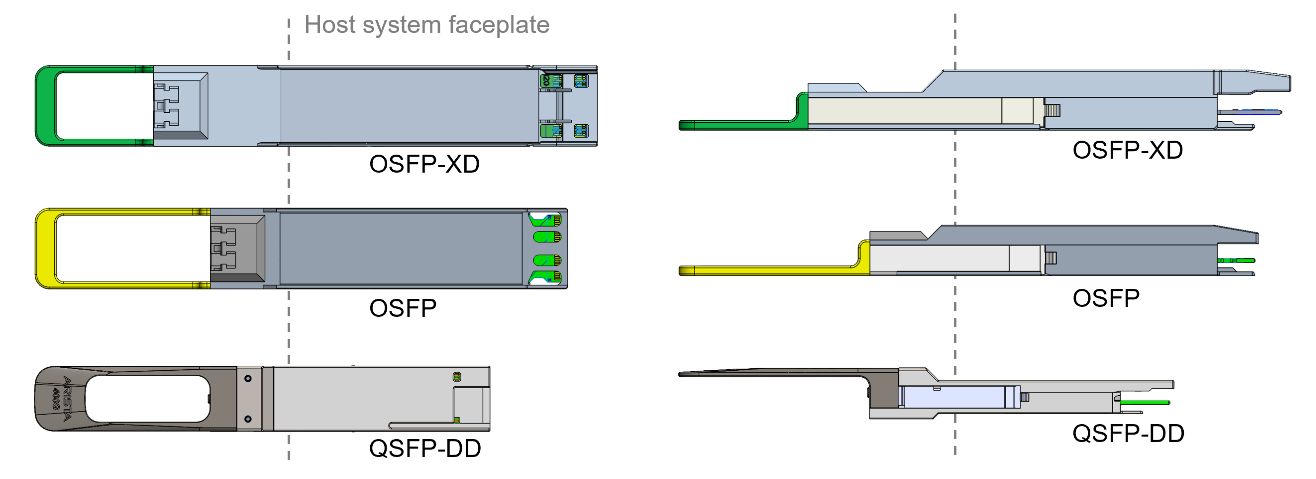
Figure 1: Size comparison of OSFP-XD, OSFP, and QSFP-DD modules
OSFP1600: Extending the OSFP Lineage to 1.6T with 200G SerDes
The OSFP form factor has been broadly adopted for 400G (8 × 50 Gb/s) and 800G (8 × 100 Gb/s) pluggable optics, forming a mature ecosystem across hyperscale data centers and high-performance Ethernet and InfiniBand switches.
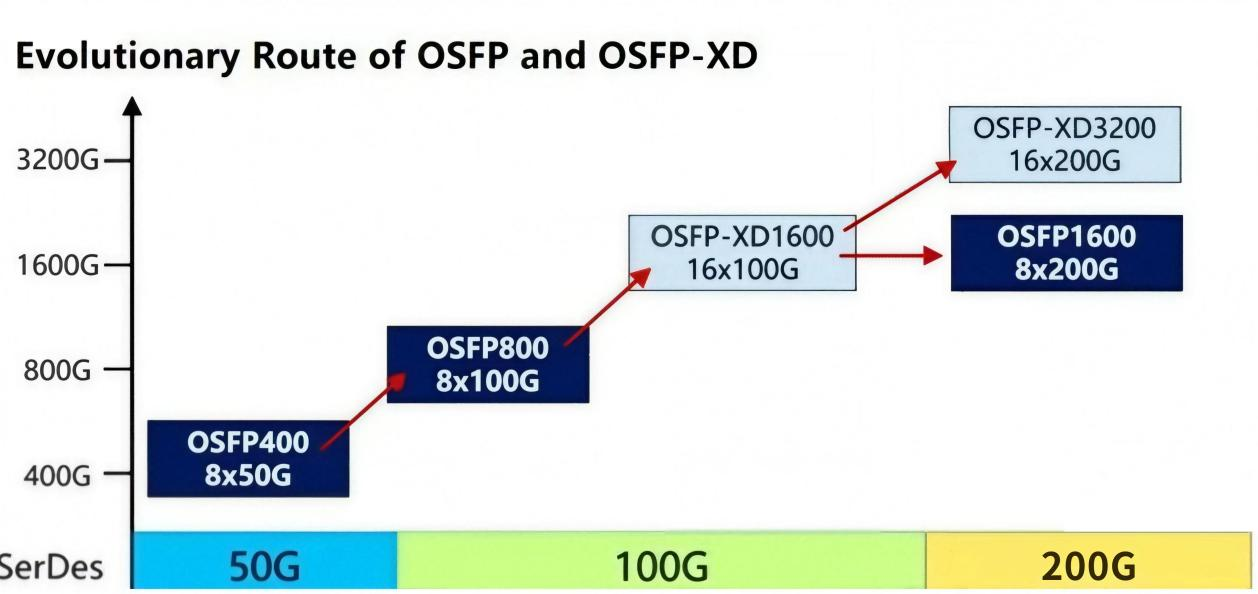
The OSFP1600 specification extends this established lineage by supporting 8 × 200 Gb/s electrical host lanes, enabling 1.6Tb/s optical transceiver bandwidth within the familiar OSFP mechanical envelope.
Key Characteristics of OSFP1600 include:
-
Electrical interface: 8 × 200 Gb/s host lanes.
-
Mechanical compatibility: Backward compatibility at the cage and front-panel level with OSFP800 designs.
-
Design philosophy: Fewer, higher-speed lanes to reduce electrical routing and connector complexity.
-
Target ecosystem: Next-generation switch ASICs with native 200G SerDes support.
By preserving OSFP mechanical continuity, OSFP1600 allows system vendors to reuse existing front-panel layouts, thermal designs, and manufacturing infrastructure. For platforms already standardized on OSFP, this approach minimizes system redesign effort and accelerates time to market for
1.6T optical module deployments.
However, OSFP1600 inherently assumes that 200G SerDes technology is sufficiently mature, power-efficient, and cost-effective for large-scale deployment—an assumption that may vary depending on vendor roadmap, process node, and deployment timeline.
OSFP-XD: A High-Density 1.6T Optical Module with 16 Electrical Lanes
While OSFP1600 targets the emerging 200G SerDes ecosystem, there remains strong demand for 1.6T optical transceivers built on the widely deployed 100G SerDes infrastructure. OSFP-XD (eXtra Dense) was developed to address this requirement by increasing electrical lane density rather than per-lane speed.
OSFP-XD doubles the number of electrical lanes from 8 to 16, enabling:
This architectural choice allows system designers to reach 1.6T using a proven electrical ecosystem while preserving a forward path toward higher aggregate bandwidth.
Figure 2: Evolutionary Route of OSFP and OSFP-XD
Design Objectives and System Capabilities of OSFP-XD
To support its higher lane count and power envelope, OSFP-XD introduces several mechanical and thermal enhancements:
-
Designed to support power levels up to ~40W, targeting future 1600ZR-class and extended-reach optical modules.
-
Support for passive copper DAC solutions compliant with 100GBASE-CR1.
-
High front-panel density, enabling up to 32 ports in 1RU or 64 ports in 2U switch chassis.
By prioritizing electrical lane scalability and port density, OSFP-XD enables significantly higher aggregate bandwidth per rack unit—an increasingly critical metric for AI data center networking and HPC fabrics.
Electrical Architecture Comparison: 8 Lanes vs. 16 Lanes
The most fundamental distinction between OSFP1600 and OSFP-XD lies in their electrical architectures.
OSFP1600:
OSFP-XD:
From a system design perspective, fewer electrical lanes typically translate to lower routing complexity, reduced connector loss, and simpler signal integrity validation. In contrast, higher lane counts increase ASIC I/O planning complexity, PCB layer utilization, and routing congestion.
OSFP-XD accepts these system-level challenges in exchange for higher front-panel density and compatibility with today's dominant 100G SerDes ecosystem.
Mechanical Compatibility and Platform Integration
Mechanical compatibility further differentiates the two 1.6T form factors.
-
OSFP1600 maintains mechanical compatibility with existing OSFP cages and front panels, enabling incremental upgrades within established platforms.
-
OSFP-XD, due to its increased module height and thicker paddle card, is not mechanically compatible with standard OSFP ports.
To prevent accidental insertion, OSFP-XD cages incorporate keying features that physically block standard OSFP modules. As a result, adopting OSFP-XD typically requires a new chassis and front-panel design, representing a more disruptive—but potentially more scalable—platform transition.
Thermal and Power Considerations for 1.6T Optical Modules
As 1.6Tb/s optical transceivers push toward higher power consumption, thermal design has become a primary system constraint rather than a secondary consideration.
OSFP-XD's increased module height and thermal mass provide greater flexibility for heat-sink design and airflow management, making it well suited for 40W-class optical modules used in long-reach and high-performance applications.
OSFP1600, while benefiting from fewer electrical lanes and potentially lower electrical loss, operates within tighter airflow and heatsink constraints inherited from the standard OSFP mechanical envelope. System designers must carefully balance airflow, port density, and per-module power budgets when scaling OSFP1600-based platforms.
Port Density and Aggregate System Bandwidth
One of OSFP-XD's most significant advantages is front-panel bandwidth density. By doubling the electrical lane count per module, OSFP-XD effectively doubles front-panel bandwidth density compared to 8-lane OSFP or QSFP-DD designs, under comparable front-panel width constraints.
OSFP1600, while still delivering 1.6T per port, prioritizes electrical simplicity, backward compatibility, and lower system redesign cost over maximum density.
Typical Deployment Scenarios
The choice between OSFP1600 vs. OSFP-XD depends on overall system context rather than absolute performance.
OSFP1600 is well suited for:
-
Platforms transitioning from OSFP800 to 1.6T optical modules.
-
Early adoption of 200G SerDes switch ASICs.
-
Environments prioritizing backward compatibility and faster time to market.
OSFP-XD is better aligned with:
-
High-density AI and HPC switching fabrics.
-
Continued reliance on 100G SerDes ecosystems.
-
New chassis designs targeting maximum bandwidth per rack unit.
Conclusion: Choosing the Right 1.6T Optical Transceiver Form Factor
OSFP1600 and OSFP-XD represent two complementary paths toward 1.6Tb/s optical transceivers. OSFP1600 extends a proven form factor into the 200G SerDes era with minimal disruption, while OSFP-XD rethinks electrical lane density and mechanical design to maximize system scalability and front-panel bandwidth.
Rather than competing directly, these 1.6T optical transceiver form factors address different stages of electrical technology maturity and different system-level optimization goals. Understanding their trade-offs is essential for designing scalable, power-efficient, and future-ready data center networks.

 English