
 English
As global digital transformation accelerates, data centers - recognized as the nerve centers of the information age - play a crucial role in storing, processing, and transmitting vast volumes of data. The explosive growth of artificial intelligence, big data, and cloud computing has triggered an unprecedented surge in data traffic, placing ever-higher demands on transmission rate, bandwidth, and energy efficiency.
To meet these challenges, 224G/448G copper interconnects and 1.6T optical modules have emerged as two core technologies reshaping the architecture of next-generation data centers. Together, they address both short-range and long-range transmission bottlenecks, driving high-speed, energy-efficient, and sustainable infrastructure evolution.
224G/448G Copper Cable Technology: The Cost-Effective Backbone of Short-Range Interconnection
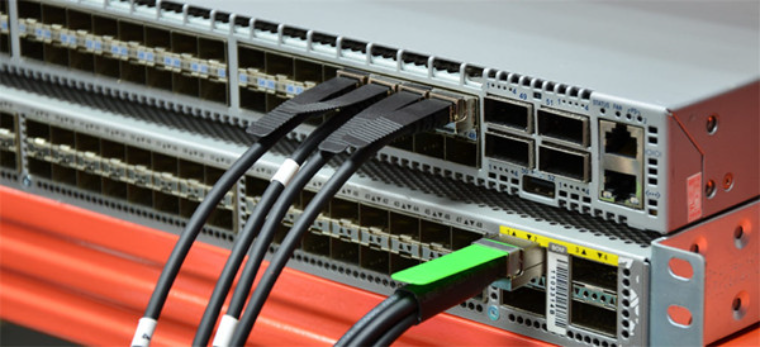
Within the dense and high-speed environment of modern data centers, especially inside or between racks, ultra-low latency and cost-efficiency are key. Direct Attach Copper (DAC) and Active Electrical Cables (AEC) remain the most reliable solutions for these short-distance connections.
As transmission rates evolve from 400G and 800G toward the 224G-per-lane era, copper cable technology continues to demonstrate strong adaptability and value. The introduction of 224G/448G interconnect solutions enables data centers to handle exponential growth in computing and networking workloads while maintaining excellent signal integrity and power performance.
Core Technical Advantages
- Ultra-High Bandwidth Density: Each lane supports up to 224 Gbps, enabling aggregated configurations of 400G, 800G, and even 1.6T. This high density allows for more compact switch and GPU server interconnections, meeting the needs of AI training clusters, high-performance computing (HPC) platforms, and edge-cloud hybrid deployments.
- Energy and Latency Optimization: Passive DAC cables consume nearly zero power, while AECs offer dramatically lower energy usage than optical modules. Combined with direct electrical transmission, these solutions deliver nanosecond-level latency, ensuring real-time responsiveness for large-scale inference, distributed training, and memory-intensive workloads.
- Cost and Maintainability Advantages: For connections within 3 meters, copper-based links significantly reduce both capital and operational expenditures (CapEx + OpEx). Their plug-and-play nature simplifies deployment, improves reliability, and enhances maintainability, making them ideal for large-scale rollouts.
Key Application Scenarios
224G/448G copper cables are widely adopted in:
- Server-to-switch connections within racks
- Inter-rack links between adjacent cabinets
- Internal communication among GPU cluster nodes
Functioning as the "capillaries" of a data center, 224G/448G copper cables ensure high-speed, seamless connectivity between computing units, supporting the smooth operation of massive parallel workloads.
1.6T Optical Module Technology: Driving Long-Range, High-Bandwidth Connectivity
When data transmission extends across rooms, campuses, or even regions, the distance limitations of copper cables become apparent - making optical interconnection indispensable. As the next evolutionary step beyond 800G, 1.6T optical modules redefine long-haul communication for hyperscale data centers and inter-regional links.
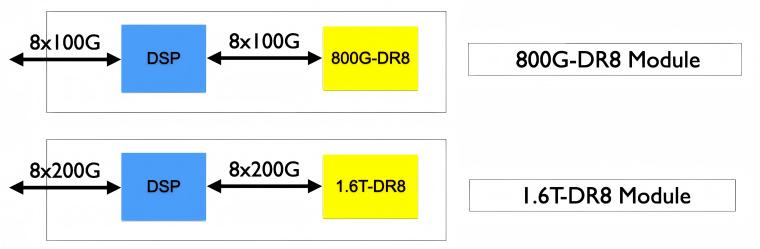
Utilizing advanced PAM4 modulation, multi-channel architectures (e.g., 8 X 200G or 4 X 400G), and advanced packaging technologies like Co-Packaged Optics (CPO) and Linear Pluggable Optics (LPO), 1.6T modules deliver up to 2 x throughput increase without a proportional rise in power consumption.
Key Advantages
- Breakthrough Bandwidth Expansion: The 1.6T data rate allows a single optical fiber to carry massive volumes of data, ideal for AI model synchronization, distributed training, and cross-data center data replication. This unlocks the ability to handle multi-trillion parameter models and data-intensive workloads with ease.
- Flexible Distance Coverage: Supporting SR, DR, LR, and ZR variants, 1.6T modules meet diverse requirements from intra-data center links to cross-city data center interconnect (DCI) deployments, achieving both high capacity and flexibility across different network layers.
- Green and Energy-Efficient Design: Despite doubling the transmission rate compared to 800G optical modules, 1.6T optical modules leverage innovations like CPO to shorten signal paths and reduce energy per bit, supporting sustainable, low-carbon data center operations while maintaining top-tier performance.
They ensure high-speed, reliable data transport across vast geographical distances, empowering seamless, global-scale digital infrastructure.
Synergistic Ecosystem: Copper + Optical for the Future Data Center
Rather than competing, 224G/448G copper cables and 1.6T optical modules form a complementary dual-tier ecosystem that integrates short-range efficiency with long-range scalability.
| Layer | Technology | Typical Range | Key Strength |
|---|---|---|---|
| Intra-rack / Near-rack | 224G/448G Copper (DAC/AEC) | 0 - 3 m | Low cost, ultra-low latency |
| Inter-rack / Cross-room | 1.6T Optical Modules | 10 m - 10 km+ | High bandwidth, low power per bit |
This hybrid model allows data centers to achieve:
- Hierarchical network design for flexible resource allocation
- Energy-efficient operation through optimal technology matching
- Future scalability to 3.2T and beyond through standardized interfaces
Summary
224G/448G copper cables and 1.6T optical modules are not competing technologies, but complementary pillars of a unified interconnection ecosystem. Copper cables deliver low-cost, ultra-low-latency links for short-range intra-rack or inter-rack connectivity. Optical modules provide long-distance, high-capacity transmission across data halls, campuses, and regions. Together, they construct a layered, high-performance, and flexible data center network architecture, paving the way for the next era of intelligent, energy-efficient, and scalable computing infrastructure.


