
 English
As high-speed data center interconnects continue to evolve, 800G optical modules have become the backbone of next-generation network infrastructure. Faced with the choices between QSFP-DD and OSFP form factors, as well as SR8 and 2xSR4 solutions, many engineers and decision-makers find themselves confused. This article will delve into the technical details of 800G multimode optical modules to help you make the most informed selection decisions.
800G Optical Modules Form Factors: QSFP-DD or OSFP ?
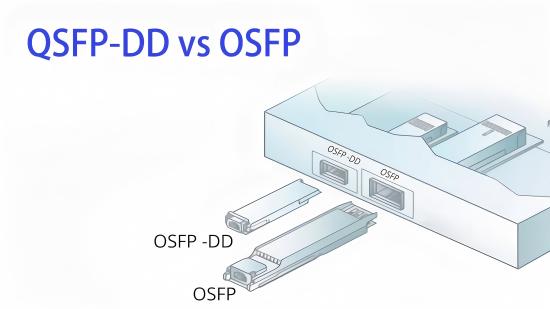
The differentiation between QSFP-DD and OSFP form factors is essentially an inevitable result of different electrical lane speed evolution paths, reflecting diverse data center upgrade strategies.
Technical Positioning of QSFP-DD
The QSFP-DD form factor first emerged to address two core demands of the 400G era: higher port density and seamless backward compatibility. Built on 56 Gbps NRZ electrical lanes (8x50G to achieve 400G), its core advantage lies in retaining full compatibility with legacy QSFP-series modules, eliminating the need for hardware overhauls during network upgrades.
Entering the 800G era, QSFP-DD has successfully extended its lifecycle despite the heightened power consumption and thermal challenges posed by 112G PAM4 electrical lanes. Leveraging its mature, widely deployed physical form factor and robust ecosystem, it delivers doubled bandwidth (800G) without modifying interface specifications, which is enabled by advancements in chip energy efficiency and enhanced system-level thermal management. This makes QSFP-DD a mainstream 800G solution, ideal for organizations prioritizing multi-generational compatibility and smooth, cost-effective network scaling.
Technical Advantages of OSFP
OSFP is a native form factor platform designed specifically for 112 Gbps PAM4 and next-generation electrical lanes. Its larger size, integrated metal thermal substrate, and enhanced connector pin current capacity provide necessary thermal management and power delivery headroom for high-speed DSPs, driver chips, and future Co-Packaged Optics (CPO). It sacrifices compatibility with QSFP ports in exchange for technical inclusivity of cutting-edge performance and future evolution.
Significance of the Two Form Factors
The coexistence of these two form factors accurately reflects two parallel strategies for data center network upgrades: QSFP-DD represents a cost-effective path centered on compatibility and smooth transition, while OSFP embodies a native architecture path targeting extreme performance and technological forward-looking.
Models of 800G Multimode Optical Modules
Currently, there are four mainstream models of 800G multimode optical modules on the market: 800G QSFP-DD SR8, 800G QSFP-DD 2xSR4, 800G OSFP SR8, and 800G OSFP 2xSR4. Each model has specific application scenarios and advantages.
800G QSFP-DD SR8
The 800G QSFP-DD SR8 adopts the advanced QSFP-DD form factor and is equipped with one MPO-16 interface. This module uses 8 channels of 850nm VCSEL lasers and PAM4 modulation technology, with a per-channel transmission rate of up to 106.25Gbps and an aggregated bandwidth of 800G. As the most mainstream 800G multimode solution, it supports an effective transmission distance of 50 meters on OM4 multimode fiber and approximately 30 meters on OM3 fiber. This module is mainly used for short-distance, high-density interconnection scenarios of in-rack or Top-of-Rack (ToR) switches in data centers.
800G QSFP-DD 2xSR4
The 800G QSFP-DD 2xSR4 features a standardized design compliant with the Common Management Interface Specification (CMIS). Physically an 800G module, it can be logically configured by switch ports into two independent, logically isolated 400G ports (i.e., Breakout mode), each with one MPO-12 interface. Its core value lies in providing ultimate deployment flexibility for network architectures, allowing operators to use one 800G switch port to connect two 400G servers or devices, rather than solely for building a single 800G link.
800G OSFP SR8
The 800G OSFP SR8 has basically the same performance parameters as the 800G QSFP-DD SR8, with the key difference being the OSFP form factor. The OSFP specification is slightly larger with superior heat dissipation capabilities, typically supporting applications with higher power consumption or stricter cooling requirements. It also uses an MPO-16 interface and supports 50-meter transmission on OM4 fiber. Its primary target market is network equipment requiring the OSFP interface specification, especially high-performance computing environments with demanding heat dissipation needs.
800G OSFP 2xSR4
Similar to the QSFP-DD version, this model typically integrates two 400G-SR4 channels within the OSFP form factor, providing two independent 400G ports each equipped with one MPO-12 interface. Its value lies in offering port splitting flexibility for devices adopting the OSFP architecture, while leveraging OSFP's better heat dissipation characteristics to ensure the stability and reliability of dual-channel operation.
How to Choose Fiber Patch Cable for 800G Multimode Optical Module?
Selecting fiber patch cables for 800G multimode optical modules requires following one core principle: check the interface, count the fiber cores, determine the polarity, and select the fiber type.
Check the Interface: If the optical module has male connectors, the fiber patch cables must use female connectors.
Count the Fiber Cores: SR8 corresponds to the MPO-16 interface (using 16-core fiber patch cable), while SR4 corresponds to the MPO-12 interface (using 12-core fiber patch cable).
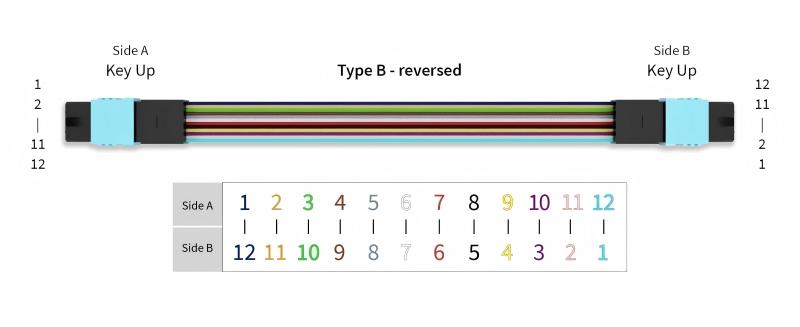
Determine the Polarity: Choose Type B polarity fiber patch cable for direct device connections.
Select the Fiber Type: OM4 multimode fiber patch cable is preferred for short-distance multimode transmission.
Regardless of the module model, fiber patch cable selection depends on the physical specifications of the optical interface and has no inherent correlation with the form factor. The table below summarizes the key selection points for the four types.
| Optical Module Model | Fiber Type & Quantity | Fiber Connector | Polarity | Selection Logic |
|---|---|---|---|---|
| 800G QSFP-DD SR8 | OM4, 1x16-core | MPO-16/APC Female | Type B | The module has a male MPO-16 connector, requiring a female jumper for matching. The 16-core fiber corresponds to its 8-transmit/8-receive channel structure. Type B polarity ensures correct path (Tx→Rx) for direct connections. OM4 fiber supports its maximum 50-meter distance. |
| 800G QSFP-DD 2×SR4 | OM4, 2x12-core | 2x MPO-12/APC Female | Type B | The module provides two male MPO-12 interfaces, thus requiring two independent female MPO-12 jumpers. Each interface essentially functions as a 400G SR4 (4-transmit/4-receive), so 12-core fiber is used (8 cores in common use, 4 cores reserved as spare). |
| 800G OSFP SR8 | OM4, 1x16-core | MPO-16/APC Female | Type B | The module has a male MPO-16 connector, requiring a female jumper for matching. The 16-core fiber corresponds to its 8-transmit/8-receive channel structure. Type B polarity ensures correct path (Tx→Rx) for direct connections. OM4 fiber supports its maximum 50-meter distance. |
| 800G OSFP 2xSR4 | OM4, 2x12-core | 2x MPO-12/APC Female | Type B | The module provides two male MPO-12 interfaces, thus requiring two independent female MPO-12 jumpers. Each interface essentially functions as a 400G SR4 (4-transmit/4-receive), so 12-core fiber is used (8 cores in common use, 4 cores reserved as spare). |
800G 2xSR4 vs 800G SR8 Solutions: Application Scenario Analysis
In 800G network deployments, both 2xSR4 and SR8 solutions coexist with distinct applicable scenarios, a differentiation determined by the inherent characteristics of network architectures.
Leaf-to-Server Connections: Choose 800G 2xSR4 Solution
In 800G networking, the vast majority of servers are equipped with 400G Network Interface Cards (NICs). If 800G switch ports directly use single-port 800G optical modules, they cannot connect to these lower-speed NICs.
The 800G 2×SR4 optical module splits one physical 800G port into (Breakout) two independent 400G ports. This allows one 800G switch port to connect to two servers equipped with 400G NICs.
This approach greatly improves switch port utilization and reduces the access cost per server. Compared to using two independent 400G switch ports to connect two servers, using one 800G port for Breakout is generally more cost-effective and offers higher port density.
Advantages of the 800G 2xSR4 Solution:
- One 800G port connects two 400G servers.
- Improves switch port utilization and reduces costs.
- More economical and efficient than using two independent 400G ports.
- Suitable for Leaf switch downlink ports (connecting to servers).
Therefore, for Leaf switch downlink ports (the end connecting to servers), the 2×SR4 solution is the most economical and efficient way to meet the current mainstream bandwidth needs of servers.
Spine-to-Leaf Connections: Choose 800G SR8 Solution
Spine switches need to aggregate traffic from all Leaf switches, and the 800G SR8 provides a complete, native 800G channel.
Compared to the 800G 2×SR4 solution (2×400G implemented with two MPO-12 interface fiber jumpers), the 800G SR8 solution (using one MPO-16 interface fiber jumper) significantly reduces the number of fibers. There are often massive interconnection cables between Leaf and Spine layers, where the SR8 solution maximizes the value of simplified cabling, saved data center space, and easier operation and maintenance. Tidy cables are crucial for ensuring heat dissipation and reducing the risk of misoperation.
Looking to the Future: The Spine layer is the backbone of the network, and its technical selection requires more forward-looking planning. Investing in MPO-16 fiber cabling infrastructure for Spine interconnections prepares for a smooth upgrade to 1.6T in the future.
Conclusion
When selecting 800G multimode optical modules, comprehensive consideration should be given to network architecture, device compatibility, cost budget, and future scalability:
- For Leaf-to-Server connections, prioritize the 800G 2xSR4 optical module solution to improve port utilization and reduce costs.
- For Spine-to-Leaf connections, the 800G SR8 solution offers better performance and cleaner cabling.
- For form factor selection, choose QSFP-DD for backward compatibility and cost optimization; choose OSFP for extreme performance and future evolution capabilities.
- For fiber patch cable selection, strictly follow the principle of check the interface, count the fiber cores, determine the polarity, and select the fiber type.
Based on the analysis presented in this article, you can make optimal selection decisions for 800G optical modules and MPO fiber jumpers aligned with your actual business requirements, laying the foundation for a high-speed, reliable, and future-ready network infrastructure that powers your data center's evolving needs.


