In modern AI data centers, choosing the right interconnect is no longer a minor infrastructure decision—it directly impacts performance, power consumption, and total cost of ownership (TCO). As GPU clusters scale to hundreds or even thousands of nodes, network architects must decide:
Should you use AOC, DAC, ACC, or AEC cables?
Which solution delivers the best balance of cost, power, and reach?
This guide provides a complete comparison of AOC vs DAC vs ACC vs AEC, helping you select the optimal interconnect for your AI workloads.
Overview of Active Optical Cables (AOC)
Active Optical Cables (AOC) integrate optical transceivers and fiber into a single, factory-terminated assembly. Each end of an AOC contains an embedded optical module with electro-optical and opto-electrical conversion components, enabling high-speed, long-distance data transmission with low signal loss.
Unlike traditional solutions that pair pluggable optical modules with separate fiber jumpers, AOCs provide an all-in-one design that simplifies deployment and improves signal integrity. The integrated laser and photodiode components reduce the risk of optical port contamination and enhance overall link reliability. In addition, many AOC designs streamline optical components and omit Digital Diagnostic Monitoring (DDM) to strike a balance between performance and cost.
Key Advantages of AOC
Active Optical Cables offer several compelling benefits:
-
High bandwidth and long reach: AOCs support high data rates over significantly longer distances than copper-based solutions.
-
Low electromagnetic interference (EMI): Optical transmission is immune to EMI, reducing packet loss and improving stability.
-
Lightweight and compact design: Compared to bulky copper cables, AOCs enable higher port density and improved airflow in dense racks.
-
Ease of installation: Pre-terminated assemblies reduce deployment complexity.
These characteristics make AOCs especially suitable for data centers, high-performance computing (HPC) environments, and AI clusters where long-distance, high-speed interconnects are required.
Limitations of AOC
Despite their advantages, AOCs also present certain trade-offs:
-
Limited flexibility: The cable length must be specified at the time of manufacturing. Post-deployment adjustments are not possible.
-
Maintenance considerations: If one end of an AOC fails, the entire cable must be replaced, unlike pluggable optics where only the module can be swapped.
-
Higher cost and power consumption: Compared to DAC solutions, AOCs generally consume more power and come at a higher price point.
Additionally, due to the physical characteristics of OSFP connectors—larger size and heavier weight—OSFP-based AOCs are more prone to mechanical stress during installation.
Overview of Direct Attach Copper (DAC)
Direct Attach Copper (DAC) cables are high-speed copper interconnects designed for short-reach connections within data centers. They use fixed electrical connectors on both ends to connect switches, servers, NICs, and storage devices, delivering low latency and high reliability at a competitive cost.
DACs are typically used for distances up to 7 meters and are available in both passive and active variants. Active versions—such as Active Copper Cables (ACC) and Active Electrical Cables (AEC)—integrate signal conditioning chips to extend reach and improve signal quality.
Why DAC Is Widely Used in Data Centers
Because DACs do not require electro-optical conversion, they offer substantial cost and power advantages. Their simple electrical connectors and direct signal transmission make them a popular choice for:
-
Server-to-switch connections
-
Switch-to-switch interconnects within racks
-
Short-reach links in storage and compute clusters
In large-scale GPU deployments, DACs are often favored for their cost efficiency. For example, in a 128-node HGX H100 cluster, using DAC cables instead of multimode optical modules can reduce interconnect costs by approximately 35%.
Advantages of DAC in Large GPU Clusters
DAC cables offer several critical advantages in AI and GPU-dense environments:
-
High-speed performance: DACs support data rates of tens of gigabits per second per lane, delivering high bandwidth and low latency over short distances.
-
Cost efficiency: Compared to optical solutions, DACs are significantly more affordable, making them ideal for dense, short-reach interconnects.
-
Low power consumption: DACs consume far less power than optical alternatives. For example, an NVIDIA Quantum-2 InfiniBand switch consumes approximately 747W when using DACs, compared to up to 1500W with multimode optical modules.
-
Thermal efficiency and stability: Copper cables dissipate heat effectively and are mechanically robust, reducing the risk of signal jitter, transmission errors, and link failures.
-
Simplified deployment and maintenance: DACs eliminate the need for complex fiber infrastructure. Their plug-and-play nature and durability significantly reduce operational overhead in high-density GPU clusters.
Limitations of DAC
Despite their strengths, DACs are not without constraints:
-
Limited reach: Due to copper's physical properties, DACs are generally limited to short distances—typically under 7 meters.
-
Reduced flexibility: Copper cables are thicker and less flexible than fiber, making cable management more challenging in dense racks.
-
Susceptibility to EMI: In extremely high-density electronic environments, copper-based transmission can be affected by electromagnetic interference, potentially impacting signal integrity.
To overcome these limitations while maintaining copper's cost and power advantages, ACC and AEC technologies have been developed.
AOC vs. DAC: Architectural Differences
AOC and DAC solutions often share the same form factors and electrical interfaces, such as SFP, QSFP, or OSFP, ensuring compatibility with switches and NICs.
The fundamental difference lies in signal transmission:
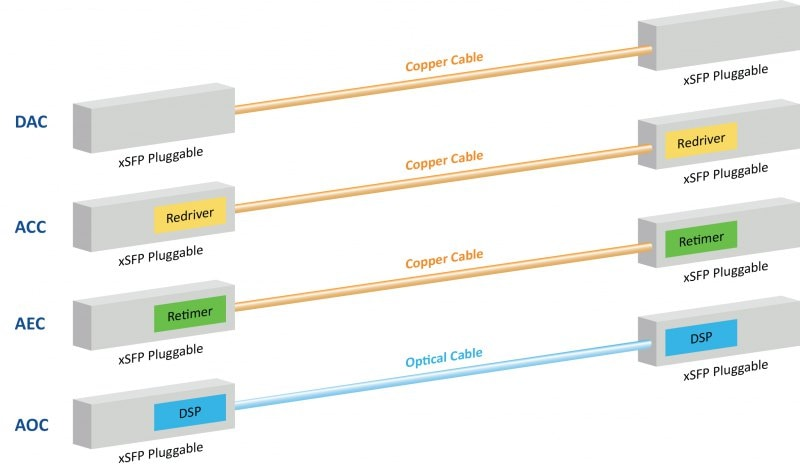
AOC integrates electro-optical conversion components inside the module, including CDR, retimers or gearboxes, lasers, and photodiodes. Electrical signals are converted into optical signals for transmission over fiber.
DAC uses passive or lightly conditioned copper cables, transmitting electrical signals directly without any optical conversion.
This distinction directly impacts reach, power consumption, cost, and deployment flexibility.
Understanding ACC and AEC
Passive DACs remain highly relevant due to their low cost and zero power consumption—even at 800G speeds. However, as data rates increase, their effective reach has shortened. At 800G, passive DACs are typically limited to 2–3 meters.
At the same time, the number of lanes per interface continues to grow—from 4 to 8 and eventually 16—resulting in thicker cables and more complex airflow and cable management challenges.
While AOCs can address longer distances, their higher power consumption and cost make them less attractive for mid-range links. This gap has driven the adoption of Active Copper Cables (ACC) and Active Electrical Cables (AEC) as balanced solutions for medium-distance interconnects.
ACC vs. AEC: Key Differences
Active Copper Cable (ACC): ACC solutions are based on redriver architectures, using analog signal amplification and Continuous-Time Linear Equalization (CTLE) at the receiver side. They enhance signal strength but do not recover clock information.
Active Electrical Cable (AEC): AECs employ more advanced retimer architectures, performing signal conditioning at both the transmitter and receiver. By integrating Clock Data Recovery (CDR), retimers significantly reduce jitter and improve signal integrity.
ACC vs. AEC in Practice
-
ACC primarily amplifies electrical signals and is best suited for moderate extensions beyond passive DAC limits.
-
AEC resets both signal loss and timing, delivering cleaner eye diagrams and supporting longer distances—typically up to 5–7 meters.
-
With retimers and Forward Error Correction (FEC), AECs offer superior performance for demanding AI workloads.
While AECs consume more power than passive DACs (typically 6–12W), they remain more energy-efficient than optical solutions. For ultra-short links (2–3 meters), passive DACs still offer the best cost and power efficiency.
Summary
There is no single "best" interconnect solution for all scenarios. In practice, these four technologies complement rather than replace one another. Each serves a distinct role within modern AI data center architectures, especially those supporting large-scale GPU clusters—network architectures are typically built using a hybrid approach:
-
DAC, ACC, and AEC act as the "capillaries" of the network, enabling cost-effective, low-latency connections within and between racks.
-
AOC serves as the "arteries," providing high-bandwidth, long-distance links between pods, clusters, or data center halls.
By understanding the underlying principles, strengths, and trade-offs of AOC, DAC, ACC, and AEC solutions, network architects can design interconnect fabrics that optimize performance, cost, power efficiency, and scalability—achieving the best possible performance-per-dollar for AI workloads.

 English