
 English
As data center networks continue their rapid evolution from 100G/200G toward 400G, 800G, and even 1.6T, high-speed interconnects are becoming the backbone of servers, switches, and GPU clusters. Among today's mainstream high-speed interconnect solutions, DAC, ACC, AEC, and AOC are the four most critical cable types. They differ significantly in medium, embedded chips, power consumption, and supported distance, but they also complement one another to cover the entire short-, mid-, and long-reach connectivity range. This guide explains each cable type through concepts, technical characteristics, performance differences, application scenarios, and practical selection guidance.
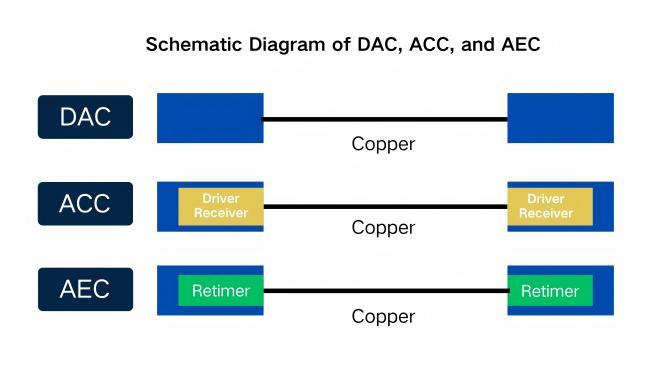
Figure 1: Schematic diagram of DAC vs ACC vs AEC copper cables
DAC: The Most Cost-Effective Solution for Short-Reach Interconnects
What Is DAC?
DAC (Direct Attach Copper) is a passive copper cable consisting of copper wires with fixed module-like connectors at both ends and no electronic components inside.
Technical Characteristics
- Medium: Copper
- Chip: None
- Signal Type: Electrical
- Power Consumption: 0W (passive)
- Reliability: Very high
- Cost: Lowest among all four options
Recommended Transmission Distance
Why does 800G DAC only support up to 2 m?
112G PAM4 electrical signals experience severe attenuation in copper cables, significantly reducing the effective channel budget.
Application Scenarios
- Intra-rack server-to-ToR switch connections
- GPU node to same-rack switch connections
- Ultra-short-distance and budget-sensitive deployments
Use DAC whenever distance permits. It provides the lowest cost, zero power consumption, and extremely stable performance.
ACC: The Enhanced DAC Designed for Short-to-Medium Reach
What Is ACC?
ACC (Active Copper Cable) is an active copper solution that integrates an equalizer chip (EQ) to compensate for signal loss in high-speed copper transmission.
Technical Characteristics
- Medium: Copper
- Chip: Equalizer (EQ only, no retimer)
- Power Consumption: Low
- Cost: Lower than AOC
- Performance: Better than DAC but lower than AEC
Recommended Transmission Distance
- 100G/200G ACC: 3-7m
- 400G ACC: 2-7m
- 800G ACC: 1-5m
Note: ACC only compensates for the attenuation of DAC and cannot extend the copper cable distance indefinitely.
Application Scenarios
- Short-distance connections between adjacent racks (>3m)
- Copper cable infrastructure upgrades
- Cost-sensitive environments where distance slightly exceeds DAC limits
ACC is an enhanced DAC, suitable for 3–5m mid-short-reach interconnects.
AEC: The Most Powerful Copper-Based Solution for 800G Interconnects
What Is AEC?
AEC (Active Electrical Cable) integrates a retimer chip that performs signal recovery and reconstruction. It is a new copper-based solution developed for 400G/800G high-speed applications.
Technical Characteristics
- Medium: Copper
- Chip: Retimer (signal regeneration)
- Signal Quality: Best among copper-based options
- Supported Speeds: 400G / 800G
- Latency: Extremely low (nanoseconds level)
AEC is considered one of the future cabling trends in AI data centers.
Recommended Transmission Distance
- 400G AEC: 3-7m (maximum 10m)
- 800G AEC: 3-7m (mainstream deployment range)
Important Note: No copper cable (including AEC) can exceed approximately 10m. For distances beyond this, fiber optic solutions must be used.
Application Scenarios
- High-speed 400G/800G GPU-switch interconnections
- High-density AI training clusters
- Medium-distance interconnections within racks or between adjacent racks
- Latency-sensitive scenarios (AEC has lower latency than AOC)
AEC is the most reliable medium-reach solution for 400G/800G and a key trend in next-generation AI data center copper cabling.
AOC: The Best Choice for Long-Distance High-Performance Connectivity
What Is AOC?
AOC (Active Optical Cable) is an optical-fiber–based cable with integrated optical modules at both ends.
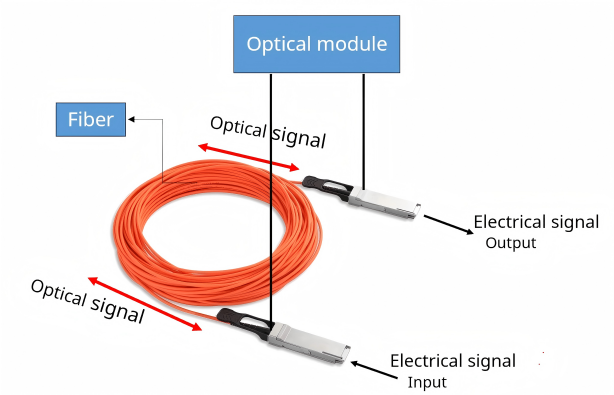
Figure 2: Optoelectronic conversion of AOC cable
Technical Characteristics
- Medium: Optical fiber (MMF/SMF)
- Chip: Optical modules integrated on both ends
- EMI Resistance: Excellent
- Cabling: Lightweight and easy to manage
- Power Consumption: Higher than copper cables
Typical Transmission Distance
- Multimode AOC (OM3/OM4): 3-30m (up to 50m for some models)
- Single-mode AOC (OS2): 20-100m (up to 150m for some models)
Note: For distances exceeding 150m, optical modules + fiber jumpers must be used instead of AOC.
Application Scenarios
- Interconnects across racks or row-to-row
- Spine–Leaf network architecture
- Complex environments with severe electromagnetic interference
- Large-scale AI/RoCE data center backbone networks
AOC is the optimal solution for 5–100m with superior stability and ease of deployment.
Key Differences Among the Four Cable Types
| Type | Medium | Chip | Power Consumption | Cost | Application Scenarios | Distance Range |
|---|---|---|---|---|---|---|
| DAC | Copper | None | 0W | Lowest | Short-distance within the same rack | 0.5-3m |
| ACC | Copper | EQ | Low | Low | Short-distance between adjacent racks | 1-5m |
| AEC | Copper | Retimer | Medium | Medium | High-speed medium-distance (400G/800G) | 3-7m (maximum 10m) |
| AOC | Fiber Optics | Optical chips | High | Medium-High | Cross-rack/row long-reach interconnections | 5-100m |
How to Choose the Right Cable for Your Data Center
- Distance ≤ 2 m: Choose DAC (best price/performance)
- Distance 2–5m: Choose ACC for general needs; Choose AEC for 400G/800G high-speed needs
- Distance 5–30m: Choose multimode AOC (OM3/OM4)
- Distance 30–100m: Choose single-mode AOC (OS2)
- Distance > 100m: Choose optical transceivers & fiber patch cables (FR4/DR4/LR4, etc.)
Conclusion
Whether you're deploying:
- AI large-model training cluster
- 800G/1.6T Spine–Leaf fabric
- HPC interconnect system
- Enterprise-scale data center
Choosing the appropriate DAC, ACC, AEC, or AOC is essential for optimizing network performance, reducing cabling costs, and improving maintainability.


