
 English
PON
PON (Passive Optical Network) is an access network technology primarily composed of an OLT (Optical Line Terminal), ODN (Optical Distribution Network), and ONU (Optical Network Unit). The system contains no active devices between these components, relying solely on fiber optics and passive optical components for connectivity. PON adopts a point-to-multipoint (P2MP) architecture and serves as a core technology for FTTB/FTTH deployments.
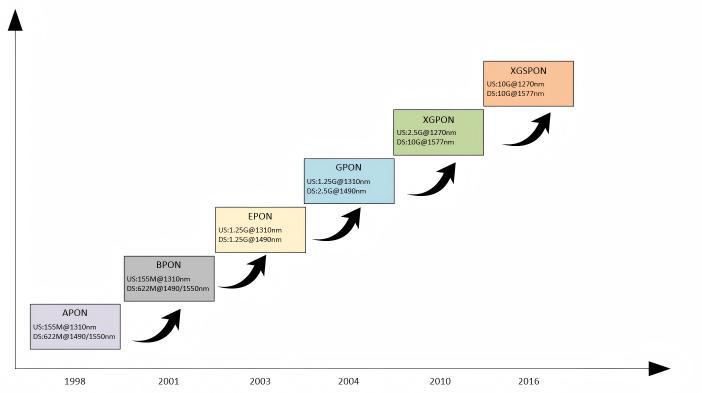
APON
APON (ATM Passive Optical Network), proposed by the ITU in 1998, is an access technology based on ATM (Asynchronous Transfer Mode) for packet communication. Leveraging ATM's statistical multiplexing and centralized features—combined with passive splitters for shared fiber and terminal resources—APON reduces deployment costs by 20%–40% compared to circuit-switched PDH/SDH systems.
Key specifications:
-
Downstream: 622 Mbps (1490/1550 nm wavelength)
-
Upstream: 155 Mbps (1310 nm wavelength)
BPON
BPON (Broadband Passive Optical Network) is an enhanced version of APON, initially referred to as APON before being renamed for distinction.
BPON introduces dynamic bandwidth allocation, protection switching, and support for Ethernet access, video distribution, and high-speed leased lines. Its upstream/downstream rates and operating wavelength bands remain consistent with APON.
EPON
EPON (Ethernet Passive Optical Network) merges PON and Ethernet technologies, employing a P2MP structure over passive fiber to deliver multi-service Ethernet-based transmission.
Recognized for its low cost and high efficiency, EPON is a practical solution for "last-mile" access. Standardized by IEEE in 2004, EPON features symmetrical 1.25 Gbps rates. It utilizes a 1490 nm wavelength for downstream transmission and a 1310 nm wavelength for upstream transmission.
GPON
GPON (Gigabit Passive Optical Network), compliant with ITU-T G.984, outperforms EPON in bandwidth and multi-service scalability but involves higher complexity and costs.
Key specifications:
-
Downstream: 2.5 Gbps (1490/1550 nm)
-
Upstream: 1.25 Gbps (1310 nm)
XG-PON
XG-PON (10-Gigabit Passive Optical Network) is an advanced fiber access technology evolved from GPON, designed to meet growing bandwidth demands driven by increasing traffic, innovations in user-side access technologies, and the need for higher split ratios and longer transmission distances.
Key Features:
-
Backward Compatibility: Operators can upgrade from GPON to XG-PON incrementally without replacing existing infrastructure, protecting investments.
-
Enhanced Rates:
Downstream: 10 Gbps (1577 nm wavelength)
Upstream: 2.5 Gbps (1270 nm wavelength)
XGS-PON
XGS-PON (10-Gigabit Symmetric Passive Optical Network), standardized under ITU-T G.9807.x, extends XG-PON by offering symmetrical 10 Gbps speeds for both upstream and downstream. It addresses limitations of asymmetric PONs, making it ideal for bandwidth-balanced applications like enterprise leased lines, data center interconnects, and high-definition video surveillance backhaul.
Technical Specifications:
-
Symmetrical Rates: 10 Gbps (Downstream: 1577 nm / Upstream: 1270 nm)
-
WDM Support: Enables bidirectional transmission over a single fiber.


