
 English
The core function of optical modules (also known as optical transceivers) is to convert between electrical and optical signals, primarily used in optical communication systems. Their key advantages lies in supporting long-distance, high-speed, and high-capacity signal transmission. As the most fundamental and widely used component in optical communication systems, optical modules play a critical role.
I.What is an SFP Optical Module?
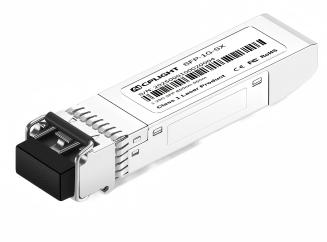
SFP (Small Form-factor Pluggable) is a compact, hot-pluggable optical transceiver. It can be considered an upgraded version of the GBIC (Gigabit Interface Converter) module. Unlike GBIC, which uses SC fiber interfaces, SFP adopts the smaller LC interface, with a physical size roughly half that of GBIC, significantly saving equipment space. SFP modules connect network device motherboards to fiber or copper cables and are designed to support various communication standards such as SONET, Gigabit Ethernet, and Fibre Channel.
II.Structure of SFP Optical Modules
SFP optical modules consist of the following core components: optical transceiver assembly, PCB board, optical interface, metal housing, dust plug and metal pull tab.
2.1 Optical Transceiver Assembly
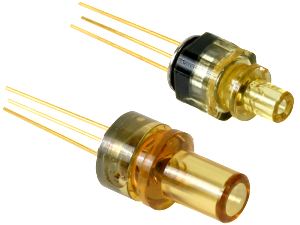
- TOSA (Transmitter Optical Sub-Assembly): Converts input electrical signals into optical signals. Its core component is a laser diode (e.g., DFB, EML, FP, VCSEL) driven by a laser driver, with the type selected based on transmission distance requirements.
- ROSA (Receiver Optical Sub-Assembly): Performs the reverse function to TOSA, converting received optical signals into electrical signals. Its core includes a photodetector (PIN or APD) that transforms weak light signals into electrical current signals, which are then amplified by a TIA before output.
- BOSA (Bi-Directional Optical Sub-Assembly): Some modules integrate TOSA and ROSA into a single component, combining both transmission and reception capabilities.
2.2 PCB Board
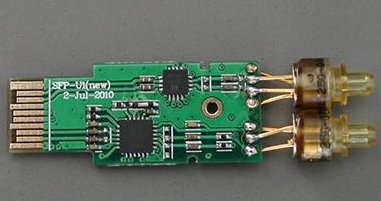
The PCB board of an optical module not only contains conventional power supply circuits but also integrates multiple functional chips. These chips are critical for the module's advanced functionalities and typically account for over 50% of the total module cost. Higher-speed modules often see an even greater proportion of costs attributed to these chips.
2.3 Optical Interface
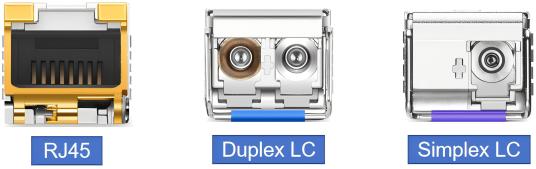
SFP optical modules feature compact designs, reflected in their miniaturized optical interfaces. Common interface types include duplex LC, simplex LC, simplex SC, and RJ45.
2.4 Metal Housing
The metal housing encloses the internal PCB and electronic components, primarily serving as an efficient thermal conductor. The housing surface often features a matte finish, enhancing the metallic texture while increasing surface friction for easier insertion and removal.

2.5 Dust Plug
Dust plugs prevent airborne particles from entering the optical interface and blocking light channels. This is especially critical for single-mode modules, whose fiber cores typically measure only 9 micrometers (µm)—where even microscopic dust can disrupt optical paths.
2.6 Metal Pull Tab
The metal pull tab is a critical component of SFP modules. When inserted into a device port, its latch mechanism securely locks the module in place, ensuring stable optical connections. For removal, pulling the tab releases the module effortlessly. Different colored tabs are often used to distinguish between various types of SFP optical modules.
III.SFP Module Classification
3.1 Classification by Fiber Mode
3.1.1 Multimode SFP ModulesMultimode SFP modules typically operate at 850nm (primary) or 1310nm wavelengths for short-range transmission (≤2 km), requiring multimode fiber.
3.1.2 Single-mode SFP Modules
Single-mode modules commonly use 1310nm, 1550nm, or WDM wavelengths for long-haul applications. The 1310nm wavelength has higher loss but lower dispersion, typically supporting distances up to 40km. The 1550nm wavelength exhibits low loss but higher dispersion, enabling transmission distances exceeding 40km and reaching up to 120km without repeaters. It requires use with single-mode fiber.
3.2 Classification by Wavelength Characteristics
The wavelength range used in optical communications spans 850nm to 1650nm (near-infrared spectrum), invisible to the human eye. Optical modules can be categorized by wavelength into gray light modules and visible light modules.
3.2.1 Gray Light Modules
These modules feature a single central wavelength (e.g., 850nm, 1310nm, 1550nm), transmitting data without complex wavelength-division multiplexing (WDM) technology, focusing on providing stable and reliable transmission. Their advantages include simple structure, low cost, and ease of deployment/maintenance, making them ideal for internal data center connections or short-distance device interconnections.
3.2.2 Colored Light Modules
Employing WDM technology, these modules transmit multiple wavelengths simultaneously over a single fiber, significantly enhancing capacity and efficiency. They are primarily used for long-haul, high-capacity applications like data-center interconnects and telecommunications backbone networks.
3.3 Classification by Transmission Mode
3.3.1 Duplex ModulesStandard modules with duplex optical interfaces use separate fibers for transmit (Tx) and receive (Rx) paths.
3.3.2 Copper Modules
Also called electrical interface modules, these hot-pluggable SFPs feature RJ45 connectors and use UTP cables. Limited to <100m due to Ethernet's UTP design constraints, they serve short-distance data transmission needs.
3.3.3 BiDi Modules
Bidirectional single-fiber modules employ WDM technology to transmit/receive on different wavelengths over a single fiber.
3.3.4 Single-Tx/Rx Modules
Dedicated transmitter-only or receiver-only modules, typically deployed in pairs for specialized scenarios like unidirectional monitoring.
3.4 Classification by Network Protocol
3.4.1 Ethernet SFPThe most widely deployed type, used in metropolitan area network client-side connections, wireless access networks, data centers, and wired access. Typical rates include 100Mbps, 1Gbps, 2.5Gbps, and 5Gbps.
3.4.2 FC SFP
Fibre Channel (FC), a high-speed networking technology primarily connecting computer storage devices. FC SFPs are essential for Storage Area Networks (SANs) in data centers, supporting standard rates of 2Gbps, 4Gbps, and 8Gbps.
3.4.3 SONET/SDH SFP
SONET and SDH are standards widely used for high-speed voice transmission across numerous global fiber networks. Unlike Ethernet modules for data transmission, they are specifically designed for voice communication, whereas Ethernet is tailored for data transmission. They connect to SONET/SDH equipment. SONET and SDH SFP speeds are listed in the table below:
| SONET Level | SDH Level | Rate |
|---|---|---|
| OC-1 | STM-0 | 51.84Mbps |
| OC-3 | STM-1 | 155.52Mbps |
| OC-12 | STM-4 | 2.488Gbps |
| OC-48 | STM-16 | 9.953Gbps |
| OC-192 | STM-64 | 39.813Gbps |
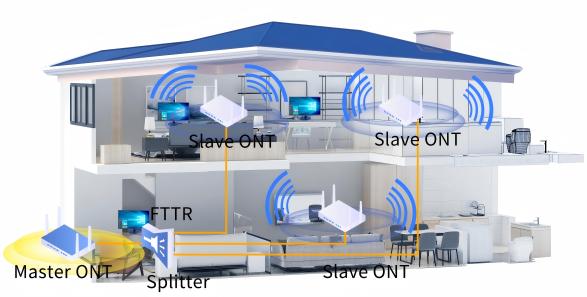
Compliant with ITU-T G.984.2 for passive optical networks, these modules enable asymmetric/symmetric communication between OLTs and ONUs/ONTs using specific wavelengths, differing fundamentally from Ethernet modules in protocol stack and wavelength plan. Key parameter comparisons are as follows:
| Parameter | GPON | XG-PON | XGS-PON |
|---|---|---|---|
| Standard | ITU-T G.984 | ITU-T G.987/G.988 | ITU-T G.9807.1/G.989.3 |
| Downstream Rate | 2.48832 Gbps | 9.95328 Gbps | 9.95328 Gbps |
| Upstream Rate | 1.24416 Gbps | 2.48832 Gbps | 9.95328 Gbps |
| Splitting Ratio | 1:64/128 | 1:64/128/256 | 1:64/128/256 |
| Downstream λ | 1480-1500 nm | 1575-1580 nm | 1575-1580 nm |
| Upstream λ | 1290-1330 nm | 1260-1280 nm | 1260-1280 nm |
| Max Reach | 60 km (with EDFA) | 60 km | 60 km |
3.4.5 CATV Optical Modules
Core components in cable TV fiber networks, comprising dedicated transmitter and receiver modules. The transmitter converts electrical signals to optical signals (typically 1310/1550nm), while the receiver performs the reverse operation, often implemented as separate single-Tx/Rx units.
3.4.6 SDI Optical Module
Specialized for HD video transport, these modules employ unique encoding schemes, testing standards, and application scenarios. SDI optical modules primarily convert SDI video signals into optical signals for transmission via fiber. They support multiple SDI standards, including SD-SDI, HD-SDI, 3G-SDI, 6G-SDI, and 12G-SDI, accommodating varying resolutions and transmission rates. The core functionality of SDI optical modules lies in their distinct video data stream encoding compared to telecommunications data. They require passing "robustness testing" against video standards to ensure signal stability and reliability during transmission.

3.4.7 CPRI Optical Modules
Designed based on the CPRI (Common Public Radio Interface) protocol, this module is specifically tailored for wireless communication applications, particularly internal connections within base stations. It employs a specialized frame structure and transmission mechanism to meet the practical demands of wireless communication systems. Optimized for the characteristics of wireless communication systems, it enables efficient data transmission and control communication.
| CPRI Rate | Bit Rate |
|---|---|
| Rate 1 | 614.4 Mbps |
| Rate 2 | 1.2288 Gbps |
| Rate 3 | 2.4576 Gbps |
| Rate 4 | 3.0720 Gbps |
| Rate 5 | 4.9152 Gbps |
| Rate 6 | 6.1440 Gbps |
| Rate 7A | 8.11008 Gbps |
| Rate 7 | 9.8304 Gbps |
| Rate 8 | 10.1376 Gbps |
| Rate 9 | 12.16512 Gbps |
| Rate 10 | 24.33024 Gbps |
As the most widely deployed module type in optical communication systems, SFP optical modules have become core components in data centers, metropolitan area networks, and telecommunications networks. Their advantages include miniaturization, hot-swappable capability, diverse interfaces, and strong compatibility. With continuous increases in network speeds and technological evolution, SFP optical modules are advancing toward higher bandwidth, lower power consumption, and greater intelligence, supporting the efficient operation and ongoing upgrades of modern communication networks.


