As discussed in our
800G vs 1.6T comparison, next-gen interconnects are reshaping AI cluster design.The rapid growth of AI workloads—driven by large language models and large-scale GPU clusters—is pushing data center interconnects to their limits. Network bandwidth is moving quickly from 400G to 800G and toward 1.6T, while power consumption, thermal constraints, and total cost of ownership (TCO) have become critical challenges.
Traditional DSP-based pluggable optics struggle to scale efficiently at these data rates, prompting the industry to explore new optical architectures. Among them, Co-Packaged Optics (CPO), Linear Pluggable Optics (LPO), and Silicon Photonics (SiPh) have emerged as the most important technology paths for AI data centers.
CPO vs LPO vs Silicon Photonics: Understanding the Three Technologies
CPO, LPO, and silicon photonics address different layers of AI optical interconnects: CPO maximizes bandwidth density, LPO balances power and cost, while silicon photonics enables long-term integration and scalability.
What Is Co-Packaged Optics (CPO)?
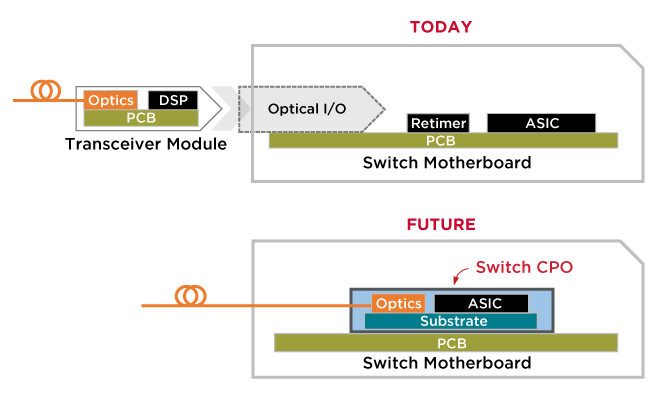
CPO places optical engines in close physical proximity to the switch ASIC, typically within the same package or substrate. By shortening the electrical interconnect between the switch SerDes and the optical interface from centimeters to millimeters, CPO dramatically reduces electrical signal loss and the need for power-hungry signal conditioning.
Figure 1: The diagram highlights the trend toward co-packaged optics to streamline switch design, reduce complexity, and likely improve performance and efficiency in optical networking (Source:Broadcom)
This architecture enables extremely high bandwidth density and improved energy efficiency, making it a strong candidate for future-generation switches operating at 51.2T, 102.4T, and beyond. CPO is often associated with advanced 2.5D or 3D packaging techniques and relies heavily on silicon photonics for optical integration.
However, CPO also introduces new challenges. Tight coupling between optics and the switch ASIC complicates manufacturing, thermal design, and system-level maintenance. When optical failures occur, repair is far more complex than replacing a pluggable module, which impacts operational flexibility and mean time to repair (MTTR).
What Is Linear Pluggable Optics (LPO)?
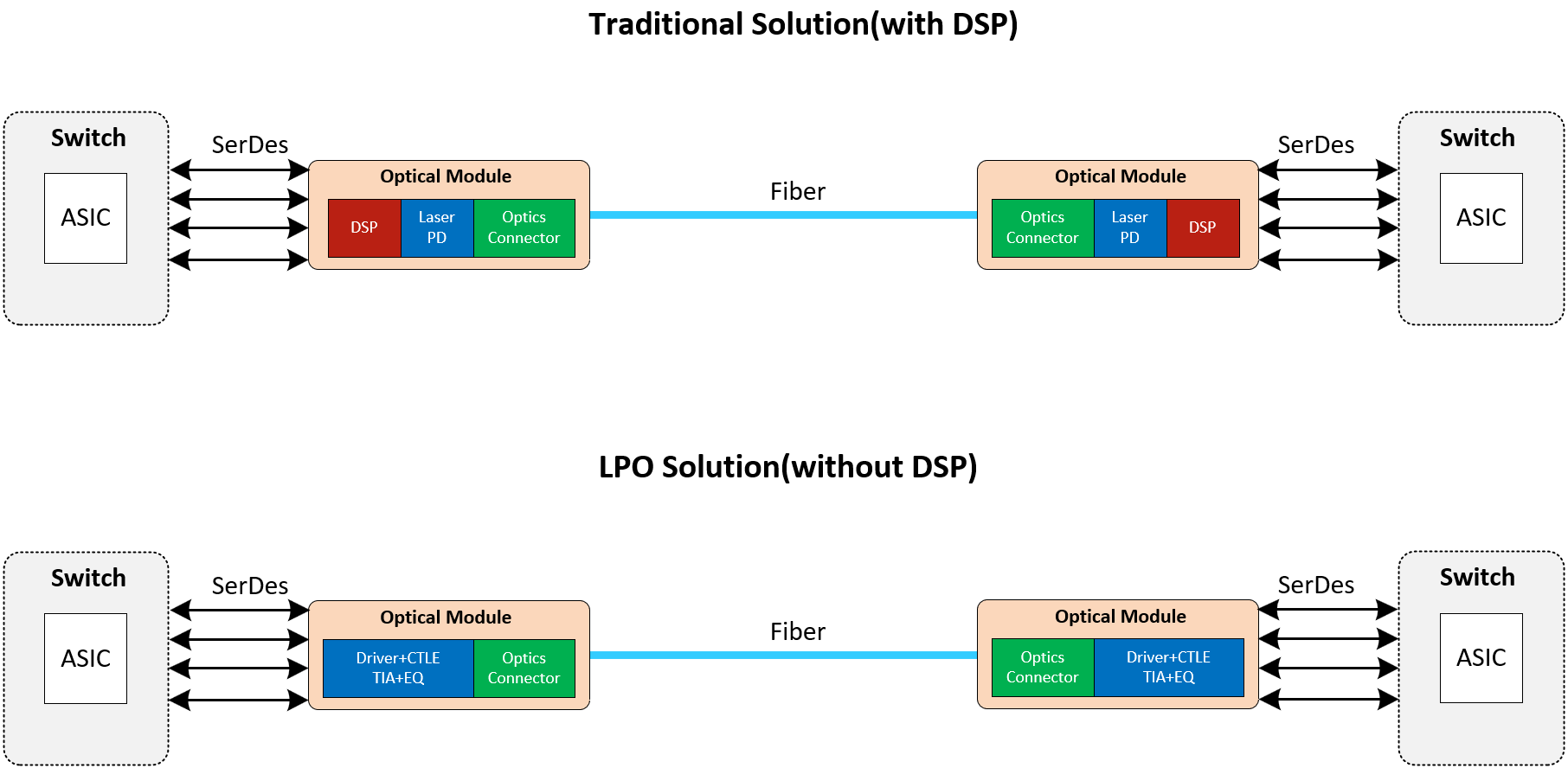
LPO takes a more evolutionary approach. Instead of redesigning the system architecture, it simplifies the optical module itself by removing the DSP. In an LPO design, linear driver and TIA components are used, and signal compensation is shifted to the switch ASIC.
Figure 2: LPO solution vs Traditional solution
Crucially, LPO retains standard pluggable form factors such as QSFP-DD and OSFP. This allows operators to deploy LPO modules in existing switch platforms while preserving hot-swappability, established operational workflows, and vendor interoperability.
By eliminating the DSP, LPO significantly reduces module power consumption and BOM cost, especially in short-reach applications. However, LPO places stricter requirements on signal quality and is typically limited to shorter distances, making it most suitable for AI clusters with controlled link budgets.
What Is Silicon Photonics (SiPh)?
Silicon photonics is not a module type or architecture but a foundational integration technology. It enables optical components—modulators, detectors, and waveguides—to be fabricated using CMOS-compatible processes, allowing tighter integration and improved manufacturability.
Figure 3: This image illustrates a silicon photonics link where electrical signals are converted to light, sent over fiber, and converted back to connect a switch with an AI accelerator.
SiPh plays a critical role across the optical ecosystem. It is a key enabler for CPO optical engines, supports cost and power optimization in LPO modules, and is widely adopted in modern DSP-based pluggable transceivers. Over time, silicon photonics is expected to drive higher levels of integration and lower cost at scale.
CPO vs LPO vs Silicon Photonics: Key Comparison Dimensions
Power Efficiency
Power consumption is a top priority in AI data centers, where networking power contributes directly to cooling demand and operational cost.
-
CPO achieves the highest energy efficiency by minimizing electrical losses and reducing the need for complex signal conditioning.
-
LPO delivers substantial power savings compared to traditional DSP-based modules by removing the DSP entirely.
-
Silicon photonics contributes incremental power improvements through integration but is not, by itself, a complete solution.
At scale, even modest per-port power reductions can translate into significant infrastructure-level savings.
Cost Structure
Cost considerations extend beyond module BOM to include deployment, maintenance, and long-term scalability.
-
CPO currently has the highest upfront cost due to advanced packaging, integration complexity, and limited manufacturing scale.
-
LPO offers the strongest near-term cost-performance balance, reducing BOM cost while avoiding changes to network architecture or operational practices.
-
Silicon photonics enables long-term cost reduction through high-volume manufacturing, though initial development investment remains high.
For most operators, near-term economics favor incremental approaches rather than radical architectural shifts.
Compatibility and Operational Impact
Compatibility is critical for protecting existing investments and ensuring operational efficiency.
-
CPO requires a fundamentally new system design and offers limited backward compatibility with pluggable-based networks.
-
LPO maintains full compatibility with existing QSFP-DD and OSFP ports and supports standard maintenance practices.
-
Silicon photonics is adaptable across multiple form factors and architectures, supporting gradual technology evolution.
CPO vs LPO vs Silicon Photonics: Technology Selection by AI Scenario
CPO for Ultra-Large AI Training Clusters: CPO is best suited for hyperscale AI training environments where maximum bandwidth density and power efficiency are paramount, and cost or maintenance complexity can be tolerated. It is typically evaluated in tightly integrated, vendor-specific systems.
LPO for Cost-Sensitive AI Clusters: LPO is well matched to short-reach AI inference clusters, edge deployments, and medium-scale GPU fabrics. Its balance of lower power, reduced cost, and seamless deployment makes it the most practical option for near-term AI networking.
Silicon Photonics as a Strategic Foundation: Silicon photonics should be viewed as a long-term strategic technology rather than a direct alternative. It underpins both CPO and LPO and will continue to shape the evolution of optical interconnects across data center architectures.
Future Outlook: Coexistence and System-Level Optimization
Rather than replacing one another, CPO, LPO, and silicon photonics are expected to coexist. The industry is moving toward system-level optimization, where architectural choices are guided by application requirements rather than a single performance metric.
As AI workloads continue to scale, successful optical strategies will balance bandwidth, power, cost, and operational flexibility—leveraging different technologies at different layers of the network.
Conclusion
There is no universal best optical interconnect technology for AI data centers.
-
LPO offers the most practical near-term solution for cost-sensitive, short-reach AI deployments.
-
CPO addresses long-term bandwidth and energy efficiency challenges at extreme scale.
-
Silicon photonics is the foundational technology enabling both paths.
Choosing the right approach requires aligning technology selection with real deployment scenarios, budget constraints, and long-term infrastructure strategy.

 English