
 English
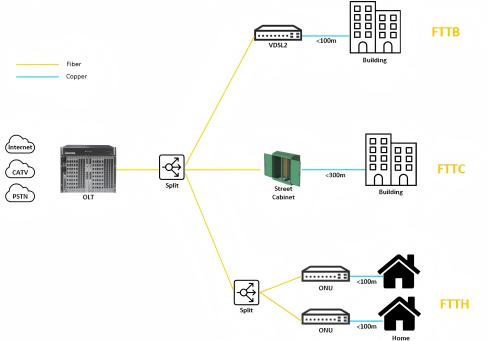
In access networks, operators predominantly deploy FTTx networking architectures. FTTx stands for "Fiber To The x," representing a generic term for various fiber optic communication networks, where "x" represents the destination of the fiber line. Based on the extent to which fiber reaches end-users, FTTX can be categorized into FTTH, FTTB, FTTC, FTTR, and FTTO.
FTTX employs a P2MP (Point-to-Multipoint) technology, offering advantages such as flexible networking, reduced cabling costs, and easier management and maintenance compared to P2P (Point-to-Point) solutions.
FTTH
FTTH (Fiber To The Home) delivers fiber directly to residence. In this setup, the fiber-optic line spans the entire access network, connecting the operator's optical node to the user's home terminal. FTTH provides ultra-high bandwidth and low latency, reliably supporting bandwidth-intensive applications like HD video streaming, online gaming, and remote education. With the rapid growth of smart homes, FTTH is increasingly becoming the ideal network foundation for connecting various smart devices within households.
FTTB
FTTB (Fiber To The Building) is designed for multi-user shared access scenarios, such as residential communities, apartment buildings, and offices. In an FTTB system, fiber is deployed to the building's interior, extending from the optical node to individual units or floors. Users then connect to the ONU (Optical Network Unit) via copper twisted-pair cables or wireless methods to achieve high-speed network access. FTTB retains the advantages of fiber optic transmission while effectively reducing overall construction costs, making it suitable for broadband access needs in medium to large buildings.
FTTC
FTTC (Fiber To The Curb) deploys fiber transmission lines to access nodes near streets or residential areas, then transmits signals to user homes via copper twisted-pair networks. FTTC offers broader coverage and is commonly used in urban and suburban areas. By reducing the length of fiber laid directly to homes, FTTC is more cost-effective than FTTH while still delivering stable broadband performance.
FTTO
FTTO (Fiber To The Office) extends fiber directly to each workstation or office, representing an advanced evolution of FTTB/FTTH. It leverages fiber's high speed, long-distance reach, lightweight cabling, anti-interference capability, and durability to address challenges like large coverage areas and copper cable limitations. FTTO supports high-speed, reliable connectivity for smart campuses, remote education, cloud-based enterprises, and other demanding applications.
FTTR
FTTR (Fiber To The Room) pushes fiber from the network node into every room of a home. Building on FTTB (fiber to the building in the 10Mbps era) and FTTH (fiber to the home in the 100Mbps era), FTTR enables gigabit fiber access in each room, creating a whole-home Wi-Fi 6 coverage solution for next-gen residential networks.


