Introduction
With the rapid development of the digital economy, data centers—the core hubs for information storage and exchange—are placing increasing emphasis on the safety and compliance of their infrastructure. Among the various security risks in data centers, fire hazards stand out as a critical concern due to their potential to cause large-scale data loss, operational disruptions, and even casualties. The choice of cable sheathing materials directly impacts flame spread speed, smoke emission, and toxic gas production during a fire, thereby determining a data center's compliance with fire safety regulations.
Currently, the most commonly used cable sheathing materials in data centers are polyvinyl chloride (PVC) and low-smoke zero-halogen (LSZH). These two materials exhibit significant differences in flame retardancy, environmental safety, and cost efficiency, which directly affect a data center's fire safety compliance.
1. Core Characteristics of LSZH vs. PVC Sheathing Materials
1.1 Flame Retardancy & Fire Spread Control
Flame retardancy is a critical safety metric for cable sheathing materials, determining how quickly a fire spreads in its early stages.
-
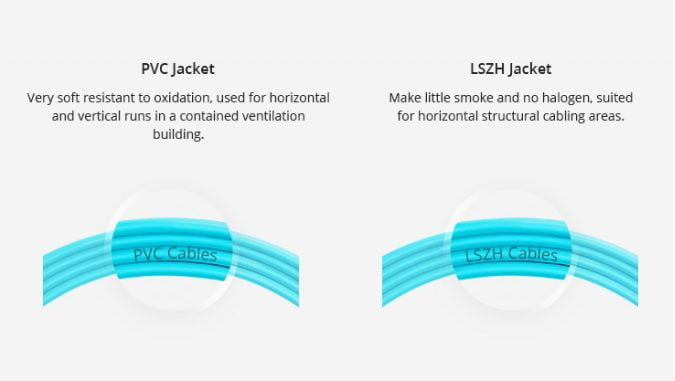
PVC: Achieves basic flame retardancy (typically V-1 rating, extinguishing within 30 seconds after ignition) through flame-retardant additives. However, under high temperatures, these additives degrade, leading to rapid flame spread—especially in densely bundled cables—making PVC unsuitable for high-density wiring environments.
-
LSZH: Uses a halogen-free flame-retardant formula, often achieving B1 or higher (some even meet Class A non-combustible standards). In bundled cable tests, LSZH significantly reduces flame spread and prevents cross-region fire propagation, making it ideal for dense server racks and complex cable trays. Additionally, LSZH offers superior long-term heat resistance (-30°C to 105°C), reducing the risk of short-circuit fires due to material degradation.
1.2 Smoke & Toxicity Emissions
In enclosed data centers, smoke and toxic gases are major contributors to casualties and secondary equipment damage.
-
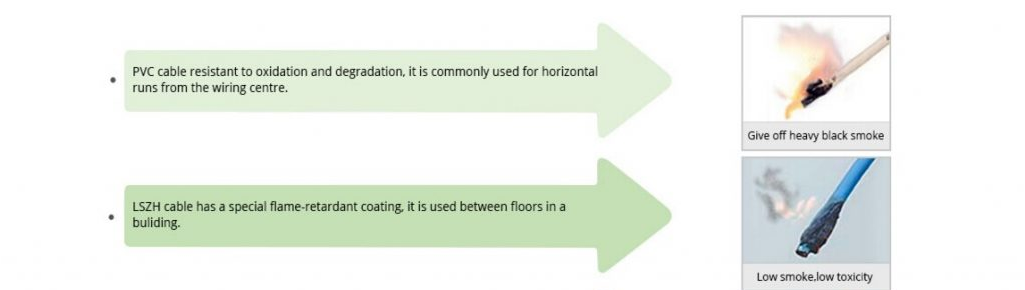
PVC: Contains ~30% chlorine, releasing highly toxic HCl gas and dense black smoke (smoke density >400%) when burned, which can cause suffocation and corrode sensitive IT equipment.
-
LSZH: Emits minimal white smoke (smoke density <80%) and produces only CO₂ and water vapor, ensuring safer evacuation and reducing post-fire recovery costs. This makes LSZH especially critical for underground or poorly ventilated server rooms.
1.3 Physical Properties & Installation Suitability
-
PVC: Hard but brittle (impact strength: 3–5 kJ/m²), prone to cracking in cold environments, and less flexible for tight bends.
-
LSZH: Higher tensile strength, better flexibility, and no plasticizer migration, making it ideal for complex cable routing.
In terms of cost, PVC cables have a simple manufacturing process and a unit price of approximately 3–5 yuan per meter, offering a clear cost advantage; In contrast, LSZH cables require specialized cross-linking equipment, resulting in higher production costs and a unit price of approximately 8–12 yuan per meter. However, considering their role in ensuring safety during fires and their effectiveness in minimizing post-disaster losses, they offer superior long-term comprehensive benefits.
2. Fire Safety Standards for Data Center Cable Sheathing
2.1 International Standards
-
UL 910 (Plenum Rating): Mandates extremely low smoke/toxicity emissions, disqualifying PVC in air-handling spaces. Only LSZH meets this standard.
-
UL 1424 (CL2P/CL3P): Requires halogen-free flame-retardant compounds for critical circuits.
-
EN 50575 (EU): Prioritizes LSZH in high-occupancy facilities, restricting PVC in confined areas.
2.2 China's GB Standards
GB 51348-2019:
GB 50217-2018:
-
Requires halogen-free sheaths (e.g., polyethylene) in humid, corrosive, or crowded environments.
-
Underground/refuge areas demand B1 flame resistance, t0 toxicity, and d0 drip ratings—exclusive to LSZH.
2.3 Key Compliance Tests
-
Flame Retardancy (GB/T 18380 / UL 910): Measures flame spread and self-extinguishing time.
-
Smoke Density (GB/T 17651): LSZH must be <80%; PVC fails at >400%.
-
Toxicity (GB/T 20284): LSZH achieves t0/t1, while PVC ranks t2+ (unsuitable for sealed spaces).
3. Cable Sheathing Selection Strategy for Data Centers
Fire risk levels vary across different areas of a data center, so the selection of sheathing materials should be tailored accordingly. For areas with poor ventilation or high fire spread risks—such as plenum spaces, cable shafts, and server room ceilings—LSZH-sheathed plenum-rated fiber optic cables must be used, strictly complying with UL 910 or GB 51348-2019 Class B1 requirements, and the use of PVC cables must be prohibited.
For non-enclosed areas such as under standard server room floors and inside server cabinets, LSZH materials are still recommended for Class B and higher data centers to enhance safety redundancy. For Class C data centers with limited budgets, PVC cables may be used provided they meet the GB 50217-2018 Class B2 flame-retardant requirements; however, excessive bundling must be avoided. For outdoor cabling or low-temperature environments, LSZH materials should be prioritized to ensure cabling safety through their superior weather resistance and flexibility.
When selecting fiber optic cables, in addition to the sheath material, flame-retardant performance must be balanced with transmission requirements. LSZH-sheathed cables should be prioritized for flame-retardant fiber optics, while ensuring compatibility between fiber type, core count, and transmission speed. For high-density cabling scenarios, indoor ribbon fiber optic cables are recommended; their LSZH sheath effectively reduces space requirements while meeting flame-retardant compliance standards.

 English