
 English
Introduction
With the explosive growth in data center bandwidth demands and the large-scale deployment of 5G technology, high-density, low-loss fiber optic connections have become a core requirement for upgrading communication infrastructure. MPO and MTP connectors, as key components for high-density fiber optic connections, are widely used in various high-speed transmission scenarios. Although the two share a common technical lineage, they exhibit significant differences in performance, compatibility, and other dimensions, directly impacting the effectiveness and stability of low-loss cabling systems.
1. Fundamentals of MPO and MTP Connectors
1.1 MPO Connectors
The MPO (Multi-Fiber Push-On) connector is a multi-fiber connector based on the IEC 61754-7 standard, characterized by its ability to achieve parallel connections for multiple fibers through a single connector assembly. It employs precision ceramic ferrules for alignment and is commonly available in 12-, 16-, and 24-fiber configurations, catering to high-density scenarios where traditional connectors like LC or SC fall short. The push-pull design enhances operational convenience, but due to limitations in early standards, MPO connectors face challenges in insertion loss stability and repeated mating cycles. They are primarily used in medium-to-low-speed transmission and cost-sensitive cabling applications.
1.2 MTP Connectors
The MTP connector, developed by US Conec, is an enhanced version of the MPO connector and remains fundamentally compliant with MPO standards. Key improvements include:
-
High-precision polished fiber arrays
-
Floating ferrule design for better alignment
-
Reinforced housing for mechanical stability
Available in 12-, 24-, and 48-fiber variants, MTP connectors offer lower insertion loss, superior repeatability, and higher durability. They also feature better environmental resistance, making them ideal for high-speed transmission and low-loss cabling systems, particularly in high-end data centers.
1.3 Core Differences: MPO vs. MTP
The primary distinctions between MPO and MTP lie in precision, performance, and manufacturing:
-
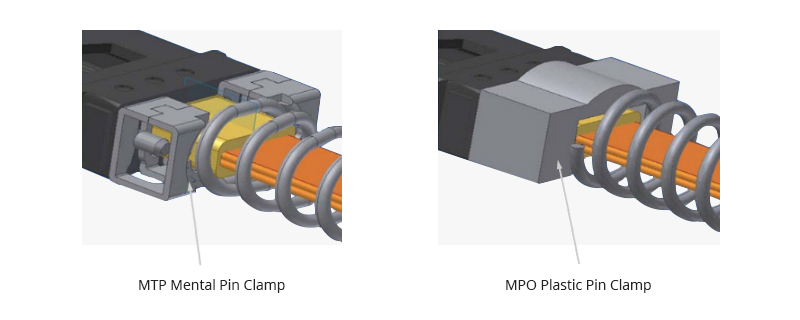
Precision: MTP uses higher-tolerance ceramic ferrules and fiber arrays, reducing alignment errors by over 30% compared to MPO.
-
Performance: MTP achieves lower insertion loss (≤0.3 dB vs. MPO's ≤0.5 dB) and longer lifespan (1,000+ cycles vs. MPO's ~500).
-
Design: MTP incorporates advanced features like floating guide pins and dust caps, while MPO adheres to basic standardized designs.
-
Compatibility: MTP is backward-compatible with MPO, but not vice versa.
-
Cost: MTP is more expensive due to its enhanced engineering.
2. Core Technologies for Low-Loss Cabling
2.1 Factors Affecting MTP/MPO Insertion Loss
The insertion loss of MTP/MPO connectors is primarily influenced by device characteristics, installation practices, and environmental conditions.
2.1.1 Device Factors
Fiber end-face polish quality and the positioning tolerance of ceramic ferrules directly determine core alignment accuracy. MTP's superior polishing and tighter tolerances (as previously discussed) minimize these losses.
2.1.2 Installation Factors
Axial misalignment during mating and excessive bend radius in fiber jumpers induce micro-bending losses. Repeated insertions beyond rated cycles (e.g., >500 for MPO, >1,000 for MTP) accelerate end-face wear.
2.1.3 Environmental Factors
High temperature/humidity can oxidize metal components or cause condensation on end-faces. Dust contamination leads to scratches, significantly increasing insertion loss and requiring stringent control, particularly in low-loss cabling systems.
2.2 Key Advantages of MTP/MPO
MTP/MPO technology excels in density, loss control, and compatibility.
2.2.1 High Density
Supports 12–48 fibers in a single connector, reducing cabling space by >60% versus single-fiber solutions (e.g., LC/SC), ideal for dense data centers.
2.2.2 Low-Loss Performance
MTP achieves ≤0.3 dB insertion loss; MPO (≤0.5 dB) still outperforms traditional multi-fiber options. Compatible with low-loss fiber jumpers for end-to-end optimized links.
2.2.3 Compatibility & Scalability
MTP is backward-compatible with MPO, enabling seamless upgrades. Supports cross-vendor interoperability, reducing maintenance costs.
2.3 MTP/MPO 12-Fiber vs. 16-Fiber Configurations
The choice between 12-fiber and 16-fiber MTP/MPO depends on application.
2.3.1 12-Fiber (MTP/MPO-12)
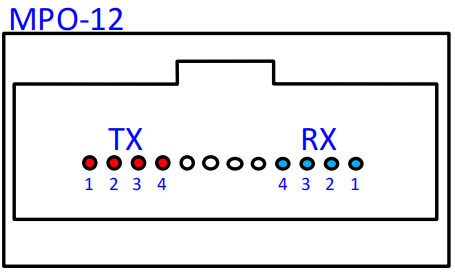
Used in 4-lane transceivers (e.g., 100G-SR4, 400G-SR4), where 8 fibers transmit data (4Tx + 4Rx) and 4 remain unused.
2.3.2 16-Fiber (MTP/MPO-16)
The 16-fiber configuration differs significantly, typically serving 8-channel modules like 400G-SR8 and 800G-DR8. Here, all 16 fibers are utilized for signal transmission, with no unused fibers. Both densities feature distinct connector designs to facilitate user differentiation and proper application.


