
 English
I. What is a Network Interface Card?
A Network Interface Card (NIC), also known as network interface controller. It is a network component operating at Layer 2—the Data Link Layer—typically installed on a computer to connect to a network and provide a dedicated network interface.
Though small in size, NICs play a critical role as a "converter" that transforms data into digital signals for transmission via cables or wireless routers. Functioning as the TCP/IP interface, it handles signal transmission at the physical layer and packet forwarding at the network layer. Regardless of the layer, it serves as the essential bridge between computers/servers and data networks.
When a user requests a webpage, the NIC collects data from the device, sends it to the web server, and delivers the server's response back to the user.
II. Components of a Network Interface Card
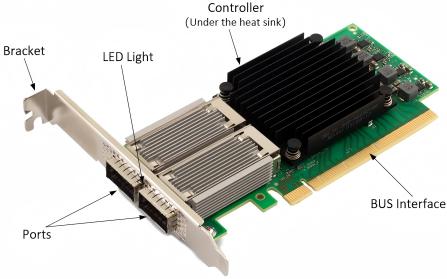
A NIC primarily consists of a controller, Boot ROM slot, port, bus interface, LED indicators, bracket, and several electronic components. The functions of each part are as follows:
- Controller: The core component, akin to a micro CPU, processes incoming/outgoing packets and directly determines the NIC's performance.
- Boot ROM Slot: Enables BootROM functionality, allowing diskless workstations to boot over the network, enhancing security and reducing hardware costs.
- Port: Typically an RJ45 copper port or optical port for transceivers, used for signal transmission/reception.
- Bus Interface: Located on the circuit board edge (often called "golden fingers"), it connects to the motherboard's expansion slot for communication between the NIC and computer/server.
- LED Indicators: Display operational status (e.g., link, activity, full-duplex, power).
- Bracket: Secures the NIC in computer/server expansion slots, with common sizes including full-height (120mm) and half-height (79.2mm).
III. Network Adapter Interfaces
3.1 Copper Port (RJ45)
Copper-port NICs use RJ45 interfaces for direct Ethernet cable connections, supporting common speeds like 100Mbps, 1Gbps, and 10Gbps. They are widely deployed in PCs, workstations, and low-speed network devices.
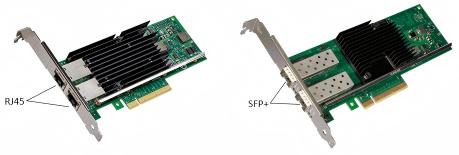
Due to their simple design and stable performance, many devices integrate copper-port NICs directly on motherboards—users only need to plug in an network cable. They are also prevalent in smart home appliances and IoT devices.
3.2 Optical Port NICs
Optical-port NICs vary by interface type and speed. Common form factors include:
| Network Interface Speed | Interface Form Factor |
|---|---|
| 1G | SFP |
| 10G | SFP+ |
| 25G | SFP28 |
| 40G | QSFP+ |
| 100G | QSFP28 |
| 200G | QSFP56 |
| 400G | OSFP (Flat Top)/QSFP112/QSFP-DD |
| 800G | OSFP (Flat Top) |
Optical-port NICs require matching optical modules for data transmission over distances ranging from hundreds of meters to tens of kilometers. Interfaces within the same form factor family support downspeeding (e.g., an SFP28 25G port can use a 10G SFP+ module). However, cross-family compatibility (e.g., QSFP-DD with OSFP) is not supported.
IV. Primary Functions of Network Interface Cards
Operating at the physical and data link layers of the TCP/IP model, NICs perform these core functions:
- Data Transmission/Reception: Packages data into network frames (adding header and trailer identifiers during transmission, and performing de-packetization upon reception).
- Encoding/Decoding: Converts digital data into signals for transmission, or reconstructing received signals into processable digital data.
- Link Management: Optimizes network performance through flow control algorithms and collision avoidance protocols.
- Protocol Support: Modern NICs support VLAN, MLAG, RDMA, and other protocols for diverse network architectures.
- DPDK Compatibility: The Data Plane Development Kit bypasses kernel processing for direct hardware access, boosting throughput and reducing latency in cloud/data center deployments.
V. NIC Classifications
5.1 By Transmission Protocol
- Ethernet NICs: Utilize the IP protocol, connecting to Ethernet switches via fiber optic or twisted-pair cables. Common interfaces include RJ45, SFP, QSFP, etc.
- FC NICs: Employ the Fibre Channel protocol, commonly used in Storage Area Networks (SANs), primarily connecting to Fibre Channel switches via fiber optic cables.
- InfiniBand (IB) NICs: Employ the InfiniBand protocol, commonly used in high-performance computing and RDMA storage networks, featuring ultra-low latency and high bandwidth.
5.2 By Transmission Rate
| Transmission Rate | Typical Use Cases |
|---|---|
| 10/100M auto-negotiating NICs | Capable of automatic negotiation, compatible with both 10Mbps and 100Mbps network environments. |
| 1G NICs | Provides higher bandwidth, standard for PCs/workstations/SMB LANs. |
| 10G NICs | Campus networks, server-workstation links. |
| 25G NICs | Data centers as the high-speed interconnect standard between servers and access switches. |
| 100G NICs | High-bandwidth interconnects between spine switches in enterprise data centers. |
| 200G NICs | Cloud Data Centers, HPC clusters. |
| 400G NICs | Top-tier supercomputing centers, AI clusters, and large-scale cloud computing environments to support extreme high-performance computing (HPC) and AI training scenarios. |
| 800G NICs | Next-gen AI/HPC (e.g., NVIDIA ConnectX-8). |
5.3 By Bus Type
- ISA NICs: 1981 standard, slow I/O speeds (maximum 33MB/s), now obsolete.
- PCI NICs: 1993 release, faster I/O speeds (266MB/s). Once mainstream, now replaced by PCI-X or USB.
- PCI-X NICs: Enhanced PCI, higher speeds (1064MB/s) and backward compatibility with PCI.
- PCIe NICs: Dominant for high-speed expansion via motherboard slots.
VI. Types of Network Interface Cards
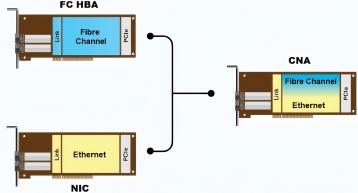
- NIC (Network Interface Card): Specifically refers to Ethernet adapters supporting TCP/IP protocols for LAN connectivity.
- CNA (Converged Network Adapter): A variant of NICs that supports FCoE (Fibre Channel over Ethernet), combining HBA and NIC functionalities. It connects FC SAN storage devices or servers via PCIe while simultaneously transmitting Ethernet traffic to LANs.
- HBA (Host Bus Adapter): Facilitates physical connections and I/O processing between servers and storage devices, reducing CPU load. Commonly used in FC networks to connect storage or fiber switches.
- HCA (Host Channel Adapter): Specifically refers to InfiniBand networks, providing high-bandwidth, low-latency connectivity (e.g., for HPC clusters).
VII. Server-Grade NICs vs. Standard NICs
Standard NICs, used in PCs, workstations, and consumer electronics, have lower reliability and security requirements. In contrast, server-grade NICs must support continuous operation with these enhanced features:
7.1 High-Speed Data Transfer
Servers handle constant data computation and exchange, making consumer NICs (10/100Mbps) inadequate. Modern server NICs typically operate at 10Gbps, 25Gbps, or higher.
7.2 Low CPU Utilization
Servers process massive workloads, and excessive CPU involvement in network tasks degrades performance. Server NICs integrate dedicated control chips for hardware offloading (e.g., checksum calculations, packet filtering), reducing CPU overhead.
7.3 Enhanced Reliability
A NIC failure can render a server unresponsive. Thus, server NICs incorporate fault-tolerant technologies like Intel's AFT (Adapter Fault Tolerance) for redundancy and ALB (Adaptive Load Balancing) for traffic optimization.
VIII. Leading NICs Manufacturers
8.1 NVIDIA
With Mellanox's expertise in InfiniBand and high-speed Ethernet, NVIDIA's ConnectX series NICs excels in ultra-low latency and high throughput. It dominates the HPC and AI data center markets.
8.2 Broadcom
As the global leader in switch chips, Broadcom wields significant influence across data center ecosystems. Its NetXtreme E-Series holds a key position in enterprise and cloud Ethernet adapters through mature technology and extensive OEM partnerships.
8.3 Intel
The world's largest server CPU provider leverages synergy between its Xeon processors and Ethernet Network Adapters. Intel leads in general-purpose servers and traditional data centers due to brand recognition, compatibility, and vast distribution channels.
8.4 Xilinx
Xilinx's NIC solutions fundamentally differ from traditional ASIC-based NICs, relying primarily on its core FPGA (Field-Programmable Gate Array) technology. Xilinx NICs target specialized customers and applications requiring custom hardware acceleration and ultra-low latency, with programmability as their core competitive advantage.
8.5 Chelsio
Specializing in high-performance Ethernet adapters, Chelsio is renowned for full protocol offload capabilities. Its adapters maximize network efficiency with iWARP RDMA support, ideal for CPU-load-sensitive environments.


