English
I. What is a Network Interface Card?
II. Components of a Network Interface Card
-
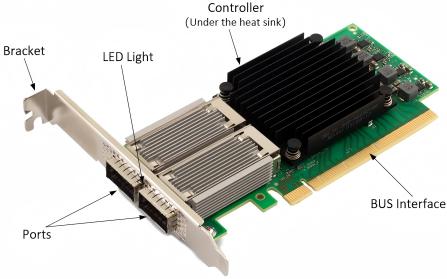
Controller: The core component, akin to a micro CPU, processes incoming/outgoing packets and directly determines the NIC's performance.
-
Boot ROM Slot: Enables BootROM functionality, allowing diskless workstations to boot over the network, enhancing security and reducing hardware costs.
-
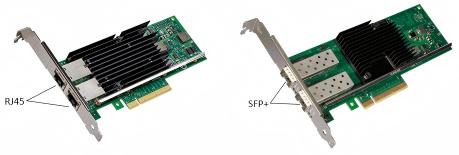
Port: Typically an RJ45 copper port or optical port for transceivers, used for signal transmission/reception.
-
Bus Interface: Located on the circuit board edge (often called "golden fingers"), it connects to the motherboard's expansion slot for communication between the NIC and computer/server.
-
LED Indicators: Display operational status (e.g., link, activity, full-duplex, power).
-
Bracket: Secures the NIC in computer/server expansion slots, with common sizes including full-height (120mm) and half-height (79.2mm).
III. Network Adapter Interfaces
3.1 Copper Port (RJ45)
3.2 Optical Port NICs
| Network Interface Speed | Interface Form Factor |
|---|---|
| 1G | SFP |
| 10G | SFP+ |
| 25G | SFP28 |
| 40G | QSFP+ |
| 100G | QSFP28 |
| 200G | QSFP56 |
| 400G | OSFP (Flat Top)/QSFP112/QSFP-DD |
| 800G | OSFP (Flat Top) |
IV. Primary Functions of Network Interface Cards
-
Data Transmission/Reception: Packages data into network frames (adding header and trailer identifiers during transmission, and performing de-packetization upon reception).
-
Encoding/Decoding: Converts digital data into signals for transmission, or reconstructing received signals into processable digital data.
-
Link Management: Optimizes network performance through flow control algorithms and collision avoidance protocols.
-
Protocol Support: Modern NICs support VLAN, MLAG, RDMA, and other protocols for diverse network architectures.
-
DPDK Compatibility: The Data Plane Development Kit bypasses kernel processing for direct hardware access, boosting throughput and reducing latency in cloud/data center deployments.
V. NIC Classifications
5.1 By Transmission Protocol
-
Ethernet NICs: Utilize the IP protocol, connecting to Ethernet switches via fiber optic or twisted-pair cables. Common interfaces include RJ45, SFP, QSFP, etc.
-
FC NICs: Employ the Fibre Channel protocol, commonly used in Storage Area Networks (SANs), primarily connecting to Fibre Channel switches via fiber optic cables.
-
InfiniBand (IB) NICs: Employ the InfiniBand protocol, commonly used in high-performance computing and RDMA storage networks, featuring ultra-low latency and high bandwidth.
5.2 By Transmission Rate
| Transmission Rate | Typical Use Cases |
|---|---|
| 10/100M auto-negotiating NICs | Capable of automatic negotiation, compatible with both 10Mbps and 100Mbps network environments. |
| 1G NICs | Provides higher bandwidth, standard for PCs/workstations/SMB LANs. |
| 10G NICs | Campus networks, server-workstation links. |
| 25G NICs | Data centers as the high-speed interconnect standard between servers and access switches. |
| 100G NICs | High-bandwidth interconnects between spine switches in enterprise data centers. |
| 200G NICs | Cloud Data Centers, HPC clusters. |
| 400G NICs | Top-tier supercomputing centers, AI clusters, and large-scale cloud computing environments to support extreme high-performance computing (HPC) and AI training scenarios. |
| 800G NICs | Next-gen AI/HPC (e.g., NVIDIA ConnectX-8). |
5.3 By Bus Type
-
ISA NICs: 1981 standard, slow I/O speeds (maximum 33MB/s), now obsolete.
-
PCI NICs: 1993 release, faster I/O speeds (266MB/s). Once mainstream, now replaced by PCI-X or USB.
-
PCI-X NICs: Enhanced PCI, higher speeds (1064MB/s) and backward compatibility with PCI.
-
PCIe NICs: Dominant for high-speed expansion via motherboard slots.
VI. Types of Network Interface Cards
-
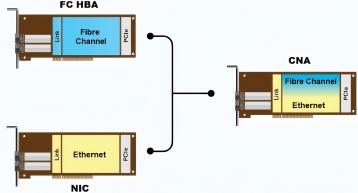
NIC (Network Interface Card): Specifically refers to Ethernet adapters supporting TCP/IP protocols for LAN connectivity.
-
CNA (Converged Network Adapter): A variant of NICs that supports FCoE (Fibre Channel over Ethernet), combining HBA and NIC functionalities. It connects FC SAN storage devices or servers via PCIe while simultaneously transmitting Ethernet traffic to LANs.
-
HBA (Host Bus Adapter): Facilitates physical connections and I/O processing between servers and storage devices, reducing CPU load. Commonly used in FC networks to connect storage or fiber switches.
-
HCA (Host Channel Adapter): Specifically refers to InfiniBand networks, providing high-bandwidth, low-latency connectivity (e.g., for HPC clusters).