
 English
Introduction
Short-distance high-speed interconnection serves as the fundamental support for efficient data center operations. Multimode fiber (MMF), with its cost and power consumption advantages, has become the mainstream transmission medium for such scenarios.
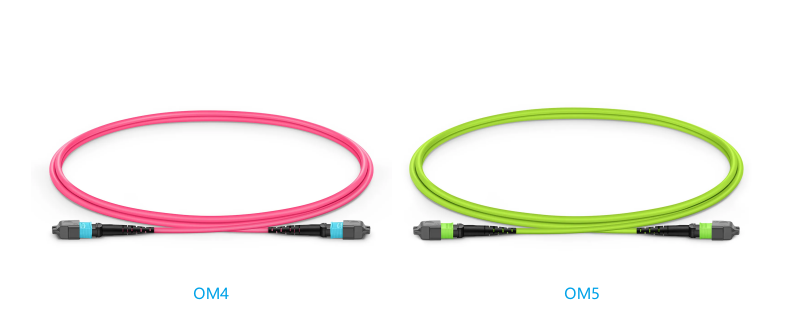
As the primary options for MMF, OM4 and OM5 directly determine link transmission performance, scalability potential, and deployment costs through their technical characteristics. The selection process requires precise alignment with bandwidth requirements, transmission distance, and future upgrade plans—particularly clarifying their differences in key dimensions such as technical specifications and SWDM (Shortwave Wavelength Division Multiplexing) compatibility. This article will systematically explore technical parameters, application scenarios, and core technologies to provide professional guidance for OM4 and OM5 selection in data center short-reach links.
1.Technical Specifications of OM4 and OM5 Multimode Fiber
1.1 OM4 Fiber Technical Specifications
OM4, a mainstream MMF model, focuses on short-reach high-speed transmission.
| Category | Technical Parameters |
|---|---|
| Standard | IEC 60793-2-10 |
| Physical Structure | • Core: 50μm • Cladding: 125μm |
| Bandwidth | • EMB @850nm: ≥4700 MHz·km • EMB @1300nm: ≥1500 MHz·km |
| Attenuation | • 850nm: ≤3.5 dB/km • 1300nm: ≤1.5 dB/km |
| Transmission | • 100G-SR4: 150m • 40G-SR4: 150m • 25G-SR: 300m |
| Application | Short-range interconnects in medium-to-large data centers. |
1.2 OM5 Fiber Technical Specifications
OM5, also known as Wideband Multimode Fiber (WBMMF), represents an optimized upgrade from OM4. The enhanced attenuation stability across the broad wavelength band enables adaptation to multi-wavelength parallel transmission scenarios, providing greater scalability for data center bandwidth upgrades.
| Category | Technical Parameters |
|---|---|
| Standard | IEC 60793-2-10 |
| Physical Structure | • Core: 50μm • Cladding: 125μm |
| Bandwidth | • EMB @850-950nm: All wavelengths ≥4700 MHz·km |
| Attenuation | • 850nm: ≤3.0 dB/km |
| Transmission | • 100G-SR4: 150m • 25G-SR: 300m |
| Key Advantage | Supports multi-wavelength transmission over a single fiber via SWDM |
1.3 OM4 vs. OM5 Core Technical Differences (2026 Standards)
| Parameter | OM4 | OM5 |
|---|---|---|
| Release Year | 2009 | 2016 |
| Outer Jacket Color | Aqua/Violet | Lime Green |
| Fiber Diameter | 50μm core/125μm cladding | 50μm core/125μm cladding |
| Operating Wavelengths | 850nm, 953nm (dual) | 850nm, 880nm, 910nm, 940nm (multi) |
| Light Source | VCSEL | VCSEL |
| Bandwidth-Distance Product | 4700 MHz·km @850nm | >3500 MHz·km (per wavelength) |
| Max Data Rate | 100Gbps | 400Gbps |
| Jacket Material | Ge-doped core + Low-index cladding | Ultra-bend insensitive (≤7.5mm radius) |
| Primary Applications | • High-density data centers • Cloud infrastructure |
• SWDM4 systems • 5G fronthaul |
2.OM4 vs. OM5 Fiber Comparison
2.1 Application Scenarios
| Fiber Type | Key Applications | Technical Advantages |
|---|---|---|
| OM4 | • Medium/large data center interconnects (≤100G) • Cost-sensitive cloud server-switch links • Enterprise 25G/40G deployments |
• Proven reliability (17+ years in service) • 40% lower cost vs. OM5 • 300m reach @25G-SR |
| OM5 | • Hyperscale DCs (400G/1.6T ready) • HPC clusters • 5G fronthaul with SWDM4 • Space-constrained edge DCs |
• 75% fiber reduction via SWDM4 • Bend-insensitive design (7.5mm radius) • Future-proof to 2029 standards |
2.2 What is SWDM
SWDM (Short Wavelength Division Multiplexing) is a bandwidth expansion technology for multimode fiber. It divides the 850nm-950nm wavelength band into four independent sub-wavelengths (typically 850nm, 880nm, 910nm, and 940nm), enabling parallel transmission of multiple signals over a single multimode fiber.
Standardized by the SWDM MSA protocol, this technology reduces the number of fiber cores required for 40G/100G transmission by 75%, significantly lowering data center cabling costs and space requirements. Leveraging cost-effective VCSEL light sources, SWDM enables seamless speed upgrades from 10G/25G to 40G/100G without modifying existing cabling infrastructure. The 100G SWDM4 solution achieves transmission distances exceeding 150 meters.
Its core value lies in overcoming the fiber resource constraints of multimode fiber parallel transmission. The wide bandwidth characteristics of OM5 fiber perfectly match SWDM's full-band transmission requirements. Together, they form the key solution for high-speed upgrades over multimode fiber.
3.Multimode Fiber Development Trends
Driven by demands from AI computing clusters and cloud computing, multimode fiber is evolving toward wider bandwidth, higher speeds, and lower energy consumption. Leveraging its full-band compatibility across 850nm-950nm, OM5 fiber will accelerate its market penetration, becoming the mainstream choice for new hyperscale data centers and enabling upgrades to 400G and even 1.6T high-speed transmission.
The deep integration of SWDM technology with OM5 will emerge as a core trend. Multi-wavelength multiplexing will further enhance fiber bandwidth density, alleviating fiber resource constraints in data centers. Concurrently, multimode fiber will continuously optimize attenuation characteristics and thermal stability.
Aligned with green and low-carbon demands, this will drive the adoption of eco-friendly products like halogen-free jackets. Furthermore, to ensure upgrade compatibility, future multimode fiber products will enhance compatibility with existing OM4 links and VCSEL optical modules.
Industry standards will also continue to evolve around higher effective mode bandwidth (EMB) and laser optimization performance, building a more robust high-speed multimode transmission ecosystem.


