
 English
The rapid expansion of AI, machine learning, and HPC workloads is driving unprecedented demand for network bandwidth. As 800G and emerging 1.6T optical modules increase performance, they also introduce significant thermal challenges. OSFP has become a leading form factor for high-density, high-power deployments. To address rising module power—often exceeding 30W—the OSFP MSA defines two thermal designs: Integrated Heat Sink (IHS) and Riding Heat Sink (RHS).
Selecting the right OSFP thermal solution is critical, as it directly affects module reliability, system cooling architecture, port density, and long-term scalability. This article examines the key differences between OSFP-IHS and OSFP-RHS to help guide informed decisions.
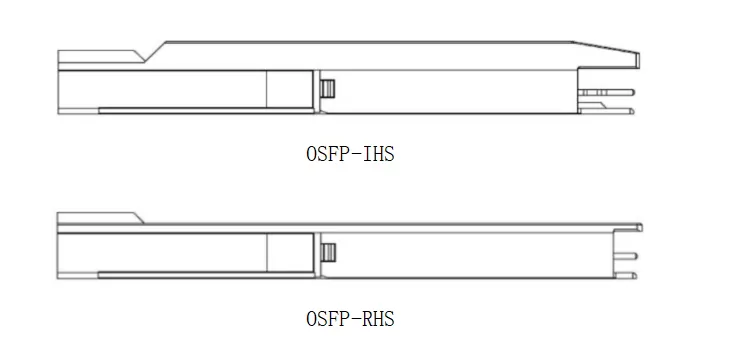
Figure 1: Side View Comparison of OSFP-IHS vs OSFP-RHS
What Is OSFP-IHS (Integrated Heat Sink)?
OSFP-IHS is the standard and most widely deployed OSFP thermal solution. In this design, the heat sink is fully integrated into the optical module itself, allowing the module to dissipate heat independently.
Structure and Thermal Path
An OSFP-IHS module features a finned heat sink mounted directly on the top surface of the module, with an overall height of approximately 13 mm. Heat generated by internal components—such as the DSP and laser drivers—is transferred through the module housing to the integrated heat sink, where it is removed by airflow from the host system fans.
Advantages and Disadvantages
| Feature | Pros (Advantages) | Cons (Disadvantages) |
|---|---|---|
| Deployment Flexibility | High universality, compatible with all standard air-cooled switches designed for OSFP IHS. | Heat dissipation capacity is limited by the size and shape of the integrated heat sink on the module's top surface. |
| System Design | Host system only needs to provide standard ventilation airflow, requiring no custom thermal structures. | The heat sink on the module's top can become a limiting factor in ultra-high-density or height-constrained system designs. |
| Thermal Performance | Performs well in internal module heat dissipation and can support 30W-class modules under carefully optimized airflow conditions, depending on system design. | Less adaptable to future liquid cooling architectures; no clear direct transition path. |
The OSFP-IHS is the ideal choice for existing data center environments, especially those relying primarily on standard air-cooling systems. It is the solid, reliable, and universal solution for users who prioritize simple deployment and do not wish to modify the host device's thermal design.
What Is OSFP-RHS (Riding Heat Sink)?
OSFP-RHS is designed for next-generation, high-power, and high-density deployments. Instead of integrating the heat sink into the module, RHS shifts thermal responsibility to the host system.
Structure and Thermal Path
In an OSFP-RHS module, the top surface is flat metal with no integrated heat sink, reducing the overall module height to approximately 9.5 mm. Heat is transferred from the module through a thermal interface material (TIM) to a riding heat sink, cold plate, or system-level thermal solution mounted on the host side.
Interoperability Warning: OSFP-RHS modules are mechanically incompatible with standard OSFP cages. Dedicated RHS cages and chassis designs are required, preventing accidental insertion into IHS-only systems. Host compatibility must be explicitly verified before deployment.
Advantages and Disadvantages
| Feature | Pros (Advantages) | Cons (Disadvantages) |
|---|---|---|
| System-Level Cooling | Offers higher heat dissipation capacity and superior system-level thermal scalability. | Requires a specialized cage or host system with an integrated RHS, leading to higher deployment costs and design complexity. |
| Density & Height | The 9.5 mm height supports ultra-high-density deployments, particularly for Network Interface Cards (NICs) or height-constrained environments. | The module's intrinsic thermal management capacity is weaker, and its performance heavily relies on the host system's thermal design. |
| Future Cooling | Perfectly optimized for advanced cooling architectures like Cold Plates and Liquid Cooling systems. Provides a controlled technical path for transitioning from air to liquid cooling. | High-power active copper cable (AEC) deployments may place additional thermal demands on RHS-based systems, requiring careful host-level thermal design. |
The OSFP-RHS is specifically designed for modern data center environments characterized by ultra-high density, extreme power consumption, and the use of system-level or liquid-cooling solutions. It is widely regarded as an increasingly preferred thermal architecture for 1.6Tb/s and future ultra-high-power deployments, as it better integrates module heat into the overall host system cooling plan, achieving more efficient thermal management and higher port density.
OSFP-IHS vs. OSFP-RHS: How to Make Your Choice
The decision between IHS and RHS ultimately depends on your system's thermal architecture and your future scalability requirements.
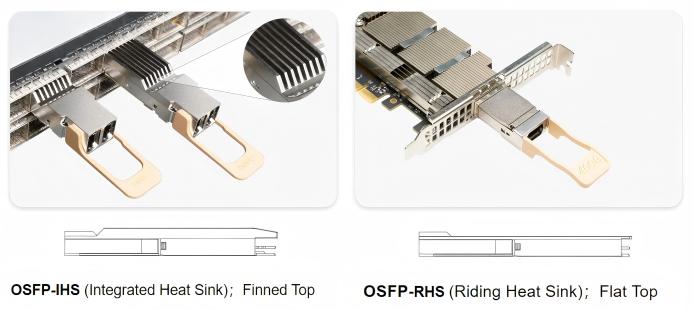
Figure 2: Comparison between two types of OSFP transceiver module heat sink solutions: OSFP-IHS (module-level cooling) and OSFP-RHS (system-level cooling).
| Decision Factor | OSFP-IHS (Integrated Heat Sink) | OSFP-RHS (Riding Heat Sink) | Guiding Principle for Selection |
|---|---|---|---|
| Cooling Environment | Standard Air-Cooled | System-Level / Liquid-Cooled / Cold Plate | IHS is for traditional air-cooled chassis; RHS is the preferred choice for liquid-cooled and custom thermal management. |
| Host Compatibility | High compatibility, fits into standard OSFP cages. | Incompatible with standard OSFP cages. Requires a dedicated, RHS-integrated cage and host design. | Crucially, confirm whether the host switch/NIC explicitly supports the RHS design before purchase. |
| Deployment Density | Suitable for regular high-density deployments. | Best suited for ultra-high-density deployments, such as NICs or scenarios requiring a lower module height. | The low-profile RHS design offers greater flexibility for system designers. |
| Power & Thermal Scale | Good thermal performance at the module level, supporting high power (e.g., 30W+). | Thermal performance relies on system-level design, offering higher system-level thermal scalability. | As module power continues to climb (approaching 40W), the RHS solution, combined with system-level liquid cooling, gains a significant advantage. |
Conclusion
If your system is a traditional air-cooled switch and you do not plan to upgrade to liquid cooling in the near future: Choose OSFP-IHS. It offers plug-and-play simplicity, flexible deployment, and reliably manages module heat under standard airflow.
If your system is a new-generation AI/ML platform, utilizes Network Interface Cards (NICs), or plans to adopt Cold Plate/Liquid Cooling technology: Choose OSFP-RHS. Despite requiring a customized host design, the RHS enables higher port density, superior system thermal scalability, and provides a controlled technical path for transitioning to liquid cooling systems. It is the key to embracing the 1.6Tb/s and future bandwidth eras.
Understanding the fundamental differences in structure, thermal management capability, system integration, and application scenarios between OSFP-IHS and OSFP-RHS is crucial for ensuring that your next-generation network infrastructure is both high-performing and thermally sustainable.


