
 English
Introduction
From 100G to 400G and the upcoming commercialization of 800G, data center interconnect (DCI) and metropolitan area networks (MANs) are facing three major bottlenecks: bandwidth, latency, and energy consumption. Traditional fixed coherent modules struggle to balance flexibility and cost, while pluggable coherent optics, with their three key advantages—"compact size, low power consumption, and hot-pluggability"—have emerged as a critical solution.
1. Pluggable Coherent Optics Technology
1.1 Technical Architecture of Pluggable Coherent Modules
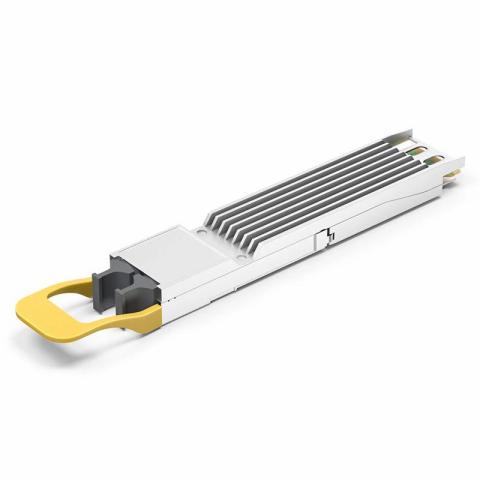
Pluggable coherent modules adopt a highly integrated architecture, consisting of four core components: a photonic integrated circuit (PIC), a digital signal processor (DSP), high-speed electro-optical/optical-electrical conversion units, and standardized pluggable interfaces. The PIC integrates critical optical components such as narrow-linewidth tunable lasers, IQ modulators, and polarization beam splitters/combiners, significantly reducing module size and power consumption. The DSP, as the core processing unit, enables functions like high-order modulation/demodulation, dispersion compensation, and polarization tracking to ensure signal transmission quality. Standardized interfaces (e.g., QSFP-DD, OSFP) ensure compatibility with routers and switches. This architecture decouples optical functions from network equipment, providing foundational support for flexible deployment and upgrades.
1.2 Core Principles of Pluggable Coherent Modules
Pluggable coherent modules rely on coherent modulation and detection for high-performance transmission. On the transmitter side, the IQ modulator encodes electrical signals onto optical carriers by modulating amplitude, phase, and other parameters. Techniques like QPSK, 16QAM, and dual-polarization multiplexing increase capacity within a single wavelength channel. On the receiver side, a local oscillator laser and 90° optical hybrid enable interference between the signal and local oscillator light, which is then converted to electrical signals by balanced photodetectors. The DSP performs real-time processing to compensate for fiber impairments (e.g., chromatic dispersion, polarization mode dispersion) and executes carrier recovery and clock synchronization, ultimately restoring high-quality signals and surpassing traditional optical transmission limits.
1.3 Comparison with Traditional Fixed Modules
Compared to fixed modules, pluggable coherent modules excel in deployment flexibility, performance adaptability, and lifecycle cost. Fixed modules feature fixed wavelengths and functions integrated into line cards, requiring downtime for replacement and struggling to adapt to multi-rate, multi-scenario demands. Pluggable modules support hot-swapping and tunable wavelengths, enabling on-demand deployment for dynamic DCI and MAN upgrades. Performance-wise, fixed modules rely on external dispersion compensation, limiting transmission distance and interference resistance, while pluggable modules leverage DSP-based electrical compensation for superior performance. Cost-wise, pluggable modules simplify maintenance, reduce spare inventory costs, and enable lightweight "pay-as-you-grow" expansion.
2. Low-Latency Practices in DCI Scenarios
2.1 Core Requirements of DCI Networks
DCI networks facilitate cross-data-center computing collaboration and service orchestration, demanding ultra-low latency, high bandwidth, and zero packet loss. In AI model training and high-frequency trading, latency directly impacts competitiveness—e.g., a 100ns reduction in Hong Kong-Shenzhen stock trades can boost algorithmic trading profits by ~0.5%. With distributed AI computing trends, DCI must support TB-scale bandwidth and flexible scaling. Additionally, SDN and SRv6 technologies, promoted by China's MIIT, require agile cloud-network convergence.
2.2 Optical Module Density Revolution in Spine-Leaf Architectures
AI computing drives DCI networks from traditional three-tier to flat spine-leaf architectures, which reduce hops but require 10x more optical modules. Traditional modules' bulk and high power consumption limit port density, while pluggable coherent modules, with compact QSFP-DD/OSFP packaging and silicon photonics, increase rack density by 2–4x. Google's Jupiter DCI employs optical circuit switches (OCS) and pluggable coherent modules, achieving 30% higher bandwidth density and 40% lower power while maintaining low latency.
2.3 Deployment Practices of Pluggable Coherent Modules
Key to DCI deployment is simplifying architecture and minimizing latency. Modules like 400ZR and 800G ZR+ plug directly into IP switches via IPoDWDM, eliminating transponder layers and reducing latency. For example, Inphi and NeoPhotonics' 400ZR modules achieve error-free transmission over 120km C-band links using 7nm DSPs. Critical techniques include ultra-narrow tunable lasers for wavelength compatibility, DSP-based impairment compensation, and hot-pluggability for zero-downtime upgrades.
3. Three Upgrade Paths for MANs
3.1 Smooth Evolution of Existing OTN Networks

The goal is to boost bandwidth while reusing legacy infrastructure. Pluggable coherent modules (e.g., 400G+) enable 10x capacity gains without OTN hardware overhauls, supporting hot-swapping to avoid outages. Adaptive modulation via DSPs adjusts formats based on link loss, fitting core-to-aggregation distances. Huawei's metro pooling solution shows 80% space/power savings while paving the way for 1.6T upgrades.
3.2 IPoDWDM for Greenfield Networks
IPoDWDM merges IP and optical layers, with pluggable coherent modules as key enablers. Modules like 400G ZR/ZR+ plug into IP switches, eliminating transponders and cutting latency by 60%. The scheme supports point-to-multipoint topologies, as demonstrated by Infinera's XR optics for 5G backhaul and cloud services. Standardized interfaces ensure multi-vendor interoperability.
3.3 Short-Reach Edge Data Center Interconnects
Edge DC interconnects (typically <20km) demand compact, low-power solutions. O-band "Coherent-Lite" pluggable modules with streamlined DSPs deliver 100G–1.6T bandwidth at <15W. Vendors like Eoptolink and Accelink have commercialized 1.6T silicon photonics modules for edge-core and edge-edge links, with tunability supporting dynamic scaling.


