
 English
The Ultimate Guide to QSFP Optical Modules: 40G to 800G Interconnect Evolution
In today's digital era sweeping across the globe, data centers—the core hubs of information processing—have an insatiable demand for high-speed, high-density data transmission solutions. QSFP (Quad Small Form-Factor Pluggable) optical modules emerged to meet this demand, becoming a pivotal technology for data center interconnects due to their compact size and exceptional performance.
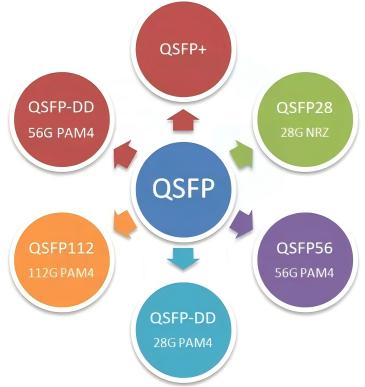
From the initial 40G to today's 800G, the QSFP family has continuously evolved, driving the iterative upgrades of high-speed networks like Ethernet and InfiniBand. This article provides an in-depth exploration of QSFP's development, key variants, and irreplaceable advantages.
1.What is QSFP?
The original QSFP (Quad Small Form-Factor Pluggable) standard emerged in 2006, introducing a design philosophy centered on miniaturization and high-density connectivity. The first-generation QSFP supported 4-channel transmission, with each channel typically operating at 10 Gbps, primarily used for data center interconnects and server-to-server links. Its birth marked the dawn of a new era in high-speed data transmission.
2.QSFP Series
The QSFP series was developed to meet market demands for higher-density, high-speed pluggable solutions. Its core feature lies in possessing four independent full-duplex transceiver channels. The QSFP product family continues to expand based on single-channel transmission rates and packaging density.
| Module Type | Total Rate | Modulation | Electrical Channels | Optical Channels |
|---|---|---|---|---|
| QSFP+ | 40G | 10G NRZ | 4 | 4 |
| QSFP28 | 100G | 25G NRZ | 4 | 4 |
| QSFP56 | 200G | 50G PAM4 | 4 | 4 |
| QSFP112 | 400G | 100G PAM4 | 4 | 4 |
| QSFP224 | 800G | 200G PAM4 | 4 | 4 |
| QSFP-DD | 200G/400G | 25G NRZ/50G PAM4 | 8 | 4 or 8 |
| QSFP-DD800 | 800G | 100G PAM4 | 8 | 8 |
2.1 QSFP+
QSFP+ (Quad Small Form-Factor Pluggable Plus), the first mainstream member of the QSFP family, supports 4-channel transmission with each channel operating at 10.3125 Gb/s, delivering an aggregate rate of 41.25 Gb/s primarily for 40GbE applications.
Notably, its maximum speed isn't limited to 40G. Under InfiniBand FDR standards, each channel can reach 14 Gb/s, enabling QSFP+ optical modules to achieve a total throughput of 56 Gb/s.
Its compact size and hot-swappable design make QSFP+ ideal for high-density interconnects between switches, servers, and storage in data centers. Additionally, QSFP+ can utilize MPO-LC breakout cables to achieve 4x10G connectivity, interoperating with 10G SFP+ modules.
2.2 QSFP28
Released in 2016, QSFP28 (Quad Small Form-Factor Pluggable 28) supports 25.78125 Gb/s per channel, enabling 100G aggregate rates and revolutionizing high-speed interconnects for big data, cloud computing, and supercomputing.
Technological advancements in QSFP28 have also spurred upgrades in SFP packaging. Engineers integrated the individual 25G channels from QSFP28 into an SFP package, giving rise to the subsequent SFP28 optical module. Using MPO-LC breakout cables, one QSFP28 module can connect four SFP28 modules, dramatically increasing switch port density.
2.3 QSFP56
QSFP56 (Quad Small Form-Factor Pluggable 56) features four transmit and receive channels, each operating at 53.125 Gb/s, delivering a total data rate of 200 Gb/s. Unlike earlier NRZ-based QSFP variants, it adopts PAM4 (Pulse Amplitude Modulation with four levels) digital modulation for the first time, doubling per-lane speeds—a milestone in high-density 200G solutions and InfiniBand HDR.
2.4 QSFP112
QSFP112 (Quad Small Form-Factor Pluggable 112), a 400G form factor defined by the MSA consortium, features 4 transmit/receive channels with 112G PAM4 modulation for 400G aggregate rates. It offers superior signal integrity, high density, and thermal efficiency, providing a seamless upgrade path. QSFP112 has a more compact footprint compared to OSFP.
In NIC card designs constrained by thermal and space limitations, only one OSFP port can typically be integrated, whereas two QSFP112 ports are feasible. This higher front-panel port density makes QSFP112 the preferred choice for data centers.
2.5 QSFP224
QSFP224 (Quad Small Form-Factor Pluggable 224), the next-gen ultra-high-speed module, targets 224 Gb/s per channel with an expected 850 Gb/s aggregate rate. No relevant industry standards have been defined yet. However, with the advancement of optical module technology, corresponding standards are expected to be established by 2027, with mass production anticipated by 2029.
2.6 QSFP-DD
QSFP-DD (Quad Small Form-Factor Pluggable Double Density) complies with IEEE 802.3bs and QSFP-DD MSA standards. Its "Double Density" design doubles electrical lanes to 8 channels, supporting:
-
200G: 25G NRZ per lane
-
400G: 50G PAM4 per lane
Thus, 200G variants (NRZ) are termed QSFP28-DD, while 400G (PAM4) are called QSFP56-DD. Given QSFP56's cost and adoption advantages over QSFP28-DD, the latter sees limited use. Currently, the industry generally defaults to 400G as the QSFP-DD data rate, and QSFP56-DD is often abbreviated as QSFP-DD or QDD.
2.7 QSFP-DD800
QSFP-DD800, as the name implies, delivers 800Gb/s speeds. As an enhanced version of QSFP-DD, it retains 8 optical channels but increases each channel's rate to 112G. With twice the optical channels of standard QSFP modules, it typically uses "Dual" interfaces—e.g., Cisco's QDD-8X100G-FR employs a Dual MPO-12 interface.
3.QSFP Advantages
3.1 Compact Size
Among form factors with equivalent speeds, QSFP series consistently offers superior density.
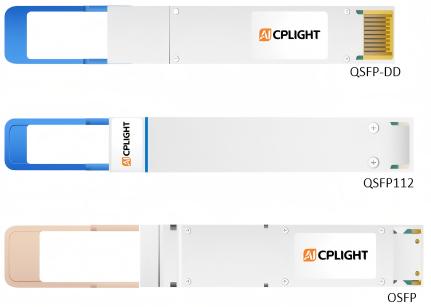
Take the popular 400G options: QSFP-DD, QSFP112, and OSFP. Comparative data shows QSFP-DD and QSFP112 have smaller length/width/height than OSFP, enabling higher port density within the same space.
| Module Type | Width(mm) | Height(mm) | Length(mm) |
|---|---|---|---|
| OSFP(Flat Top) | 22.5 | 13.00 | 107.8 |
| OSFP(Finned Top) | 22.5 | 13.9 | 111.9 |
| QSFP-DD | 18.35 | 8.5 | 89.4 |
| QSFP112 | 18.35 | 8.5 | 89.4~92.4 |
3.2 Lower Power Consumption
QSFP-DD maintains the same panel width as traditional QSFP modules but adopts a more compact design. This smaller form factor limits its maximum manageable thermal power, so the module is designed to minimize power consumption as much as possible. Typical power consumption design targets for QSFP-DD modules are generally around 7W to 12W.
In contrast, the larger OSFP form factor allows integration of larger heat sinks, enabling higher thermal dissipation capacity. OSFP modules are typically designed to handle higher power consumption, with a typical power consumption design target ranging from 12W to 15W.
3.3 Forward Compatibility
The QSFP family excels in backward compatibility: Switch ports with QSFP-DD interfaces can directly accommodate and utilize QSFP family optical modules operating at speeds lower than QSFP-DD, including even the earliest 40G QSFP+ modules.
However, switches with OSFP optical ports, only accept OSFP modules due to physical size differences, limiting flexibility compared to QSFP's universal adoption.


