English
Building a 10G Ethernet network requires SFP+ optical modules as indispensable components. As an upgraded version of SFP, SFP+ maintains a compact form factor while boosting data rates to 10Gbps, significantly enhancing port density and network efficiency. However, with a vast array of SFP+ models available, how do you select the most suitable one for your specific application? This article provides an in-depth analysis of SFP+ module types—covering definitions, specifications, use cases, and key differences—to simplify complex cabling decisions.
1.What is SFP+?
SFP (Small Form-factor Pluggable) refers to compact, hot-swappable optical modules. SFP+ (or SFP PLUS), is an upgraded version of SFP, offering transmission speeds up to 10Gbps while retaining the identical size of SFP, enabling higher deployment density within the same space.
2.Types of SFP+ Modules
Numerous SFP+ optical module models are currently available on the market, including:
- Copper SFP+: For ultra-short distances.
- Multimode SFP+: For short-distance.
- Singlemode SFP+: For medium-to-short distances.
- Extended Reach SFP+: For ultra-long distance.
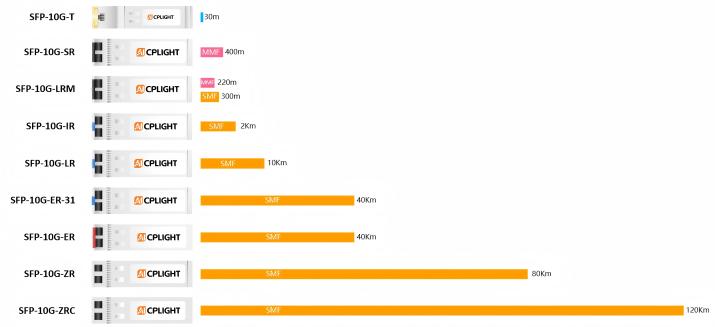
| Model | Specifications | Standard | Wavelength | Type | Max Distance |
|---|---|---|---|---|---|
| SFP-10G-T | 10GBASE-T | 802.3an-2006 (CL55) | / | Copper | 30m |
| SFP-10G-SR | 10GBASE-SR | 802.3ae-2002 (CL49/52) | 850nm | Multimode | 400m |
| SFP-10G-LRM | 10GBASE-LRM | 802.3aq-2006 (CL49/68) | 1310nm | Multimode/Singlemode | 300m |
| SFP-10G-IR | 10GBASE-LR | 802.3ae-2002 (CL49/52) | 1310nm | Singlemode | 2km |
| SFP-10G-LR | 10GBASE-LR | 802.3ae-2002 (CL49/52) | 1310nm | Singlemode | 20km |
| SFP-10G-ER-31 | 10GBASE-ER | / | 1310nm | Singlemode | 40km |
| SFP-10G-ER | 10GBASE-ER | 802.3ae-2002 (CL49/52) | 1550nm | Singlemode | 40km |
| SFP-10G-ZR | 10GBASE-ZR | Proprietary | 1550nm | Singlemode | 80km |
| SFP-10G-ZRC | 10GBASE-ZR | Proprietary | 1550nm | Singlemode | 120km |
3. 10G-T Copper Modules
The 10GBASE-T Copper SFP+ module is widely used in 10G Ethernet applications. It employs full-duplex echo-cancellation transmission and PAM16 pulse amplitude modulation, with a standard operating bandwidth of approximately 417MHz. Compliant with SFF-8431/SFF-8432 MSA standards, it achieves up to 30m transmission at 10Gbps.
In data centers, SFP+ DAC cables typically max out at 7m, while AOCs reach 100m. The 10G-T Copper module bridges this gap with superior cost efficiency within 100m compared to AOCs. It also leverages existing copper cabling for 10G transmission without additional switches or media converters.
Two hardware modes exist for different scenarios:
Mode 1

For 10G SFP+ ports, compatible with any RJ45 port speed (e.g., 100BASE-T/2.5GBASE-T). Auto-negotiates speeds. This is the most common mode currently.
Mode 2

For low-speed SFP ports (e.g., 2.5G SFP), requires matching RJ45 port speed (e.g., 2.5G RJ45).
4.Differences Between 10G SR SFP+ and 10G LRM SFP+
Both 10G SR SFP+ and 10G LRM SFP+ support multimode fiber transmission. When paired with OM3 fiber, 10G SR SFP+ achieves a maximum distance of 300 meters, while OM4 fiber extends this to 400 meters. 10G LRM SFP+ additionally supports single-mode fiber, enabling a transmission distance of 300 meters.
| Model | Wavelength | Fiber Type | Max Distance |
|---|---|---|---|
| SFP-10G-SR | 850nm | OM2 | 82m |
| OM3 | 300m | ||
| OM4 | 300m | ||
| OM5 | 400m | ||
| SFP-10G-LRM | 1310nm | OM2 | 220m |
| OM3 | 220m | ||
| OM4 | 220m | ||
| OM5 | 220m | ||
| OS2 | 300m |
5.Differences Between 10G IR SFP+ and 10G LR SFP+
Both 10G IR SFP+ and 10G LR SFP+ adhere to the 10GBASE-LR standard, with their primary distinction lying in transmission distance:
- IR: 2km
- LR: 10km
The IR module was specifically designed to bridge the gap between multimode (400m) and singlemode (10km) applications. Both modules share identical receivers, though the IR's laser operates at a slightly lower power than the LR.
6.Differences Between 10G ER SFP+ 1310nm and 10G ER SFP+ 1550nm
Both are ER modules with a 40km transmission distance, differing primarily in laser wavelength.:
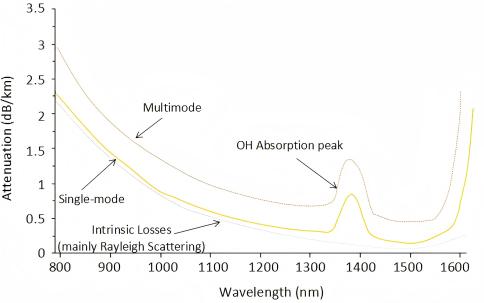
- 1550nm: The standard wavelength per 802.3ae-2002 (CL49/52) for 10GBASE-ER, originally chosen due to lower attenuation in early singlemode fibers.
- 1310nm: Enabled by advanced fiber technology reducing attenuation at this wavelength, now viable for some 40km deployments. Key Advantage of 1310nm is typically lower laser cost compared to 1550nm.
7.Differences Between 10G ZR SFP+ and 10G ZRC SFP+
Neither 10G ZR nor 10G ZRC is standardized by IEEE, they are proprietary protocol products.
- 10G ZR SFP+: Operates at 1550nm wavelength with a maximum transmission distance of approximately 80km. Multiple vendors (e.g., Cisco, Arista, Dell) offer proprietary versions.
- 10G ZRC SFP+: Developed to meet transmission requirements exceeding 80km, supporting distances up to 120km.
8.Differences Between Commercial-Grade and Industrial-Grade SFP+
The primary distinction lies in the operating temperature range the optical module can withstand while maintaining standard-compliant bit error rates:
- Commercial-grade (COM): 0 to 70°C
- Industrial-grade (IND): -40 to 85°C
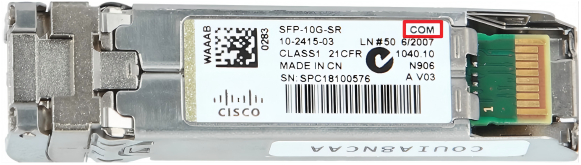
Though identical in appearance, they differ in internal components and firmware design, identifiable by the "COM" or "IND" label.