
 English
In the rapidly evolving field of optical communications, emerging challenges and growing demands—fueled primarily by the expansion of AI clusters and cloud data centers—are driving continuous advancements in cutting-edge optical module technologies. Among these challenges, power efficiency stands out as a critical constraint, alongside three core pain points shaping innovation:
Bandwidth, Form Factor & Power Pressures: As data centers—especially those supporting AI workloads—scale up, racks of compute engines (including GPUs, CPUs, and storage systems) and their accompanying network infrastructure consume massive amounts of grid power. In power-constrained environments, every watt allocated to the network is a watt unavailable for compute tasks. This makes minimizing network power consumption pivotal to maximizing the overall efficiency of AI and data center infrastructure. Compounding this, current-generation optical modules often hit bandwidth bottlenecks when transmitting large datasets, failing to keep pace with the escalating needs of modern digital infrastructure.
Long-Distance Signal Integrity: Maintaining consistent signal quality over extended distances remains a key hurdle. During transmission, optical signals degrade due to attenuation and distortion, which undermines the stability and reliability of communication networks—critical for large-scale operations like data center interconnection.
Cost & Scalability Issues: Traditional optical modules incur high manufacturing and maintenance costs, limiting their ability to scale for widespread deployment. Additionally, interoperability issues and the risk of vendor lock-in further complicate large-scale rollouts, creating barriers to efficient network expansion.
To address these challenges, five transformative technologies have emerged as game-changers in the optical module space—with a particular focus on LRO, LPO, and their synergistic relationship with silicon photonics (SiPh):
I. SiPh: Silicon Photonics Technology—The Enabler for LRO & LPO Scalability
Silicon photonics (SiPh) serves as a foundational technology for advancing modern optical modules, particularly LRO and LPO. It leverages mature CMOS semiconductor manufacturing processes to integrate optical components (for signal generation, modulation, and detection) onto silicon substrates with high precision. This integration unlocks critical advantages in power efficiency, cost reduction, and scalability—making SiPh a cornerstone for optimizing LRO and LPO performance.
Key Roles of SiPh in Optimizing LRO & LPO
Power Efficiency: By miniaturizing and combining discrete optical components onto a single silicon chip, SiPh eliminates the power waste associated with separate components in traditional modules. This is especially impactful for LPO, where power savings are a core value proposition.
Cost Reduction: SiPh leverages semiconductor fab-based production, which lowers manufacturing costs for LRO and LPO modules—directly addressing the cost scalability challenges of traditional optical solutions.
High-Density Integration: SiPh enables tighter integration of optical and electrical components, creating more compact LRO and LPO transceivers that can handle high data rates without relying on external retiming circuitry.
Improved Signal Integrity: Advancements in SiPh, such as Mach-Zehnder Modulator (MZM) technology, enhance linearity—reducing signal distortion and ensuring more reliable performance. This is critical for LPO, which demands robust link quality.
200G/Channel Availability: Vertical-Cavity Surface-Emitting Lasers (VCSELs), once widely used for Active Optical Cables (AOCs), lack a clear roadmap for 200G/channel capabilities. SiPh fills this gap, making it an ideal choice for LRO-based AOCs (which often use "book-ended" solutions to ensure reliability).
While SiPh currently faces challenges like yield rates and optical loss, its ability to complement LRO and LPO positions it as a key enabler for upgrading data center networks to 400G, 800G, and beyond.
II. LRO: Linear Receive Optics—The Balanced Transitional Solution
LRO (Linear Receive Optics) also known as Semi-Retimed Linear Optics, bridges the gap between fully retimed modules and LPO. It retains a single DSP on the transmit side but removes the DSP typically found on the receive side of traditional modules. This design shifts responsibility for receive-side signal recovery to the host system while preserving partial retiming functionality—striking a balance between efficiency and reliability.
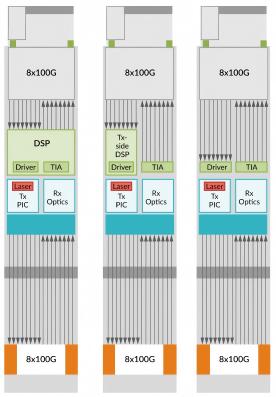
Figure 1: Architectures of fully retimed module (left), LRO module (center), LPO module (right) (Source: Juniper)
1.LRO Advantages
Moderate Power & Cost Savings: By eliminating the receive-side DSP, LRO uses less power than fully retimed modules (though roughly 50% less than LPO) and reduces BOM complexity (again, to a lesser degree than LPO).
Lower Link Risk: The transmit-side DSP acts as a mid-span stabilizer for signals, resolving many of the interoperability challenges that plague LPO. This makes LRO a lower-risk choice for enterprises hesitant to adopt LPO.
AOC Compatibility: LRO performs exceptionally well in AOCs, where the entire fiber infrastructure and transceiver ends are shipped as a single, integrated book-ended unit—ensuring reliability without excessive vendor lock-in.
2.LRO Disadvantages
Limited Efficiency Gains: LRO's compromise between fully retimed modules and LPO means it cannot match LPO's power or cost savings. This positions LRO as a transitional technology rather than a long-term replacement for other solutions.
LRO is ideal for organizations seeking incremental efficiency improvements while maintaining network stability—especially for AOC deployments.
III. LPO: Linear Pluggable Optics—Maximizing Power Savings for Short-Range Links
Linear Pluggable optics (LPO) revolutionize module design by removing the full retiming Digital Signal Processing (DSP) and Clock and Data Recovery (CDR) chips—components that are standard in 400G, 800G, and 1.6T modules. Instead, LPO retains high linear drivers and Transimpedance Amplifiers (TIAs) while integrating Continuous-Time Linear Equalization (CTLE) and equalization (EQ) functions. This shift transfers responsibility for retiming and signal conditioning to the host switch, enabling significant efficiency gains.
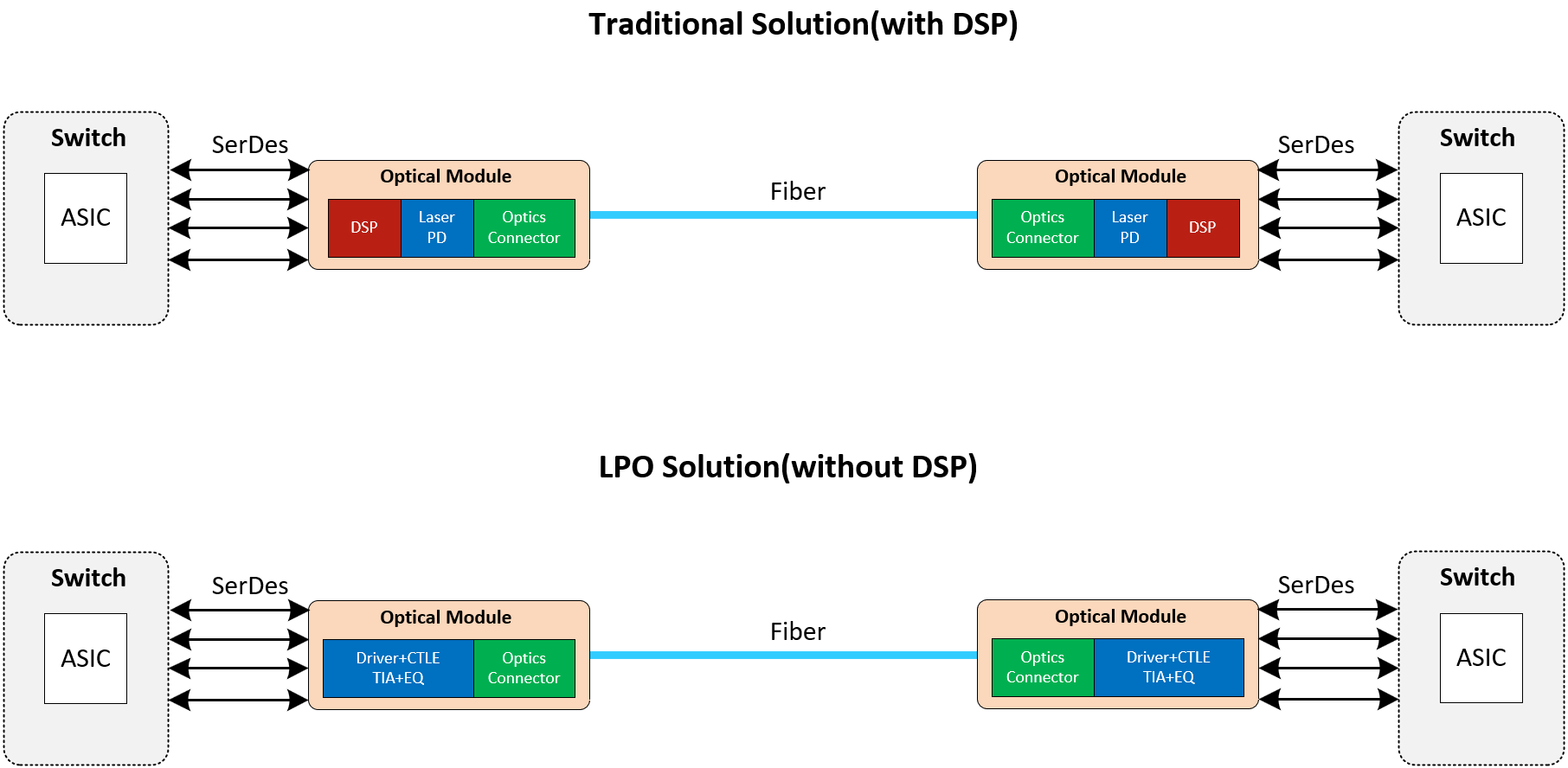
Figure 2: LPO solution vs Traditional solution
1.LPO Advantages
Dramatic Power Reduction: Eliminating energy-intensive retimers cuts power consumption substantially. For example, Arista data shows that a prototype 1.6T DR8 LPO module uses approximately 10W—far less than the ~30W consumed by fully retimed (DSP-equipped) alternatives.
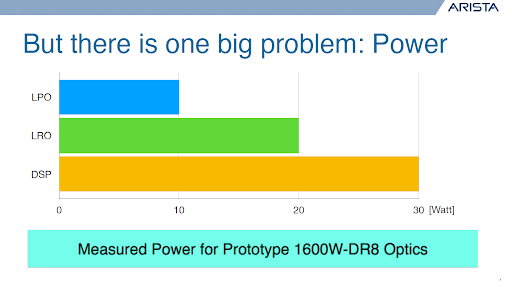
Figure 3: Optical modules power dissipation of LPO vs LRO vs retimed (DSP) (Source: Arista)
Cost Efficiency: DSPs account for over 25% of the bill-of-materials (BOM) cost of traditional modules; removing them lowers LPO's overall cost.
Low Latency: Simplified circuitry reduces signal delay, making LPO ideal for short-range links in AI data centers (e.g., server-to-switch connections within or between adjacent racks).
2.LPO Disadvantages & Mitigation Strategies
Link Integrity Challenges: LPO systems must manage approximately 16 dB of electrical loss (from host switch to module, on both transmit and receive sides) plus additional optical loss. Achieving "any-to-any" interoperability—where any LPO module can connect with any LPO switch (even from different manufacturers)—is particularly difficult, especially at 200G/channel.
Workarounds: If "any-to-any" interoperability is unachievable, deployments often rely on two solutions:
Book-ended solutions: Using hardware from a single manufacturer on both ends of the link (simpler to implement but limits flexibility and risks vendor lock-in).
Engineered links: Custom-designed connections tailored to specific setups (avoids vendor lock-in but increases complexity and costs, hindering large-scale deployment).
LPO excels in short-range scenarios where its power savings and low latency outweigh interoperability risks.
IV. Coherent Technology: The Backbone of Long-Distance DCI
Data Center Interconnection (DCI) relies on two primary detection technologies, selected based on transmission distance:
Direct detection: Best suited for short-range connections, where signal loss is minimal.
Coherent detection: Renowned for its higher capacity and superior signal-to-noise ratio, making it the top choice for long-distance DCI in metropolitan area networks (MANs).
As per-channel transmission rates increase, coherent optical technology is expanding its reach—moving beyond core backbone networks to MANs and even edge access networks. Coherent modules (such as 400G and 800G variants) have become indispensable for ensuring high-quality, reliable DCI between data centers, effectively addressing the challenge of long-distance signal integrity.
V. CPO: Co-Packaged Optics—The Future of 1.6T and Beyond
Co-Packaged Optics (CPO) redefines module architecture by integrating switch ASIC chips and silicon photonic engines onto the same high-speed circuit board. This tight integration minimizes signal attenuation, slashes power consumption, and reduces costs—all while boosting integration density.
Though CPO is still in its early stages (with industry standards not yet fully finalized), it is poised to reshape the optical module ecosystem. Silicon photonics technology supports both traditional pluggable modules and CPO solutions; as 800G adoption grows, the penetration of silicon photonic packaging is expected to rise steadily. Looking ahead, as data rates approach 1.6T, traditional pluggable modules will reach performance limits—driving a broader shift toward CPO and coherent technologies.
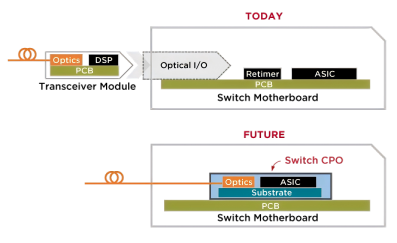
Figure 4: The diagram highlights the trend toward co-packaged optics to streamline switch design, reduce complexity, and likely improve performance and efficiency in optical networking (Source:Broadcom)
Conclusion
Optical networks face a fundamental challenge: maximizing speed and reliability while minimizing power use and cost. LRO and LPO have emerged as critical solutions for AI and cloud data centers, with silicon photonics amplifying their strengths to overcome scalability hurdles. As the industry advances toward 1.6T and beyond, the synergy between these technologies—paired with coherent optics for long-distance connectivity and CPO for future high-density needs—will define the next era of efficient, high-performance optical communications.
Recommended Reading:


