Solution
1.Immediate Response
Upon receiving the feedback at 23:00 local time, despite being off-duty, AICPLIGHT's sales representative promptly activated the emergency protocol, coordinating with the Southern Europe regional technical lead for intervention.
2.Thorough Investigation
By 23:30, AICPLIGHT's technical team held a video conference with the client. It was revealed that even Cisco and Huawei original modules retrieved from the warehouse failed to establish a connection on-site. Given that OEM technical support (Case) response cycles typically take up to 8 hours, this could not meet the on-site urgency requirements.
3.Simulated Environment Setup
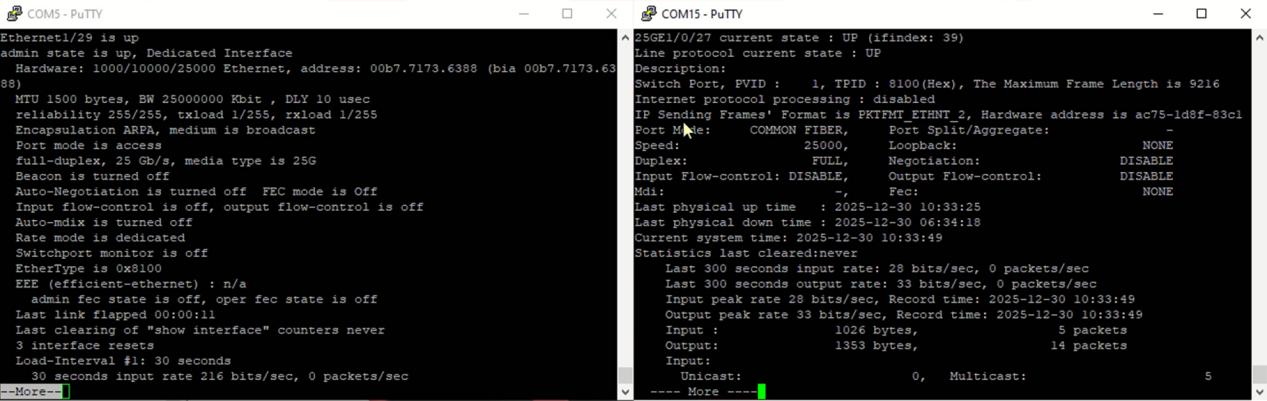
AICPLIGHT engineers quickly matched the on-site equipment models (Cisco Nexus 9000 C93240YC-FX2 running OS 10.2(4) and Huawei CE6865-48S8CQ-EI on V200R005C00*) with equivalent lab devices (Cisco N9K-C93180YC-EX and Huawei CE6860-48S8CQ-EI), synchronizing firmware versions to ensure consistency.
4.Experimental Verification
Technicians programmed test modules with the same dual-compatible coding as the ordered batch. Loopback tests confirmed the modules functioned flawlessly on both Cisco and Huawei devices, proving the issue stemmed from network configuration—not hardware quality.
5.Resolution
Further analysis identified discrepancies in default 25G SFP28 port configurations between the Cisco and Huawei switch firmware versions. With client authorization, AICPLIGHT guided remote adjustments to align port settings, successfully restoring link connectivity.

 English