Overview

A Canadian university operates three campuses within Toronto. With the continuous growth of smart devices and digital applications, the existing network infrastructure can no longer meet current academic and administrative demands. The university plans to upgrade the outdated network at its main campus while establishing seamless connectivity between Campus A and Campus B.

Over years of IT development, the university has deployed several application systems, but historical issues remain. The administration aims to systematically address these shortcomings through this network upgrade, achieving unified planning and long-term scalability.

This client has collaborated with AICPLIGHT for three years and is a university with high recognition domestically. Campus network projects typically involve multi-site deployment and significant hardware investment, but this project faces the practical constraint of a limited budget, placing higher demands on solution design flexibility and cost control capabilities.
Challenges

1.Hardware Reusability

School administrators wish to reuse existing hardware equipment as much as possible during the network upgrade, rather than replacing all network facilities entirely.

2.Future-Proof Architecture

The goal is a high-performance, scalable, maintainable, and secure network to support ongoing upgrades.

3.Data Silos & Integration

Academic, financial, and HR systems operate in isolation, hindering cross-departmental data flow and causing inefficiencies (e.g., financial risks). The university seeks AICPLIGHT's support in building an integrated campus platform alongside its IT team.

Solution

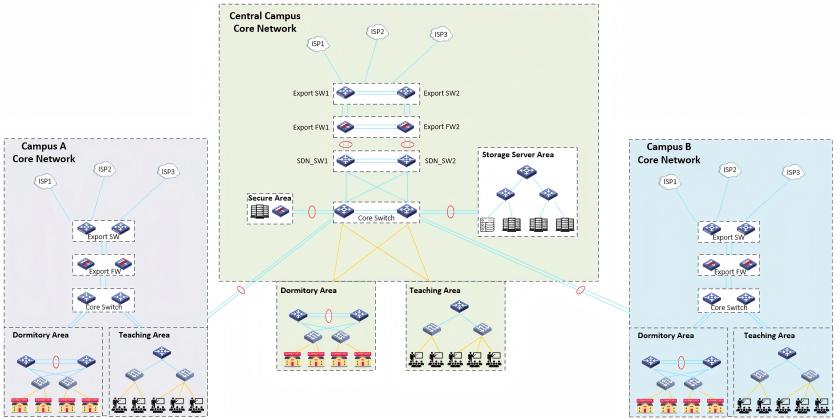
To address the client's needs, AICPLIGHT designed and recommended a Multi-Campus Network Integration Solution.
图片

Hybrid Network Architecture

  • Retained the existing 10G network while deploying a new 25G high-speed service network to enhance critical application performance.
  • Added 400GE high-speed core switches to interconnect the new and legacy networks, enabling seamless communication between Campus A and Campus B across all three campuses.

Server Infrastructure Upgrade

  • Isolated storage and service servers from low-speed networks.
  • Replaced legacy 10GE NICs with 25GE adapters, gradually migrating the entire network to 25G.
  • Centralized server traffic through core switches, ensuring low-latency, high-bandwidth access to critical resources across campuses.

Advantages

1.Cost Efficiency & Investment Protection

Preserved the existing infrastructure while integrating high-speed upgrades, minimizing capital expenditure.

2.Enhanced Reliability & Scalability

Implemented MLAG (Multi-Chassis Link Aggregation) for redundant core switching, improving fault tolerance and future-proofing the network.

3.Comprehensive Support

AICPLIGHT's technical and business teams provided end-to-end collaboration. Post-deployment, they offered free value-added services, including:

  • Strategic guidance for a unified campus teaching platform.
  • Assistance in building the platform's foundational framework.

Our Value

Through this multi-campus network integration project, AICPLIGHT not only delivered a high-performance network upgrade within budget constraints but also successfully established high-speed interconnection and resource sharing across all three campuses. The project demonstrated AICPLIGHT's expertise in complex campus network planning and seamless network convergence.

Beyond mere network deployment, AICPLIGHT took a holistic approach by actively contributing to the unified campus teaching platform—aligning with the university's long-term digital transformation goals. This proactive engagement ensured sustainable value, empowering the institution to evolve into an efficient, intelligent, and future-ready digital campus.