


800G Optical Modules: The Next Frontier in Data Transmission
1. Introduction
As digital transformation accelerates and artificial intelligence (AI) reshapes computing, optical modules, as the “core hub” of data transmission, are making a major leap from 400G to 800G. Once dominant, 400G modules can no longer handle the massive bandwidth and performance demands of AI model training and hyperscale data centers. With superior bandwidth density, energy efficiency, and architectural compatibility, 800G optical modules have become the new focal point of the industry. This shift is not merely a technical upgrade, but a necessary step toward the next generation of digital infrastructure.
2. Why 800G Has Become the Industry Focus
Optical modules perform the “electrical-optical-electrical” conversion that enables high-speed data exchange between switches, routers, and servers. While 400G modules are widely used in data centers and backbone networks, they are reaching their limits as AI workloads grow in scale and complexity.
Key bottlenecks of 400G optical modules include:
- Bandwidth limitations: Large-scale AI training involves massive parameter exchanges across GPU clusters, quickly saturating 400G ports and creating network bottlenecks.
- Latency constraints: Even microsecond-level communication delays directly reduce the efficiency of iterative model training, where real-time parameter synchronization is essential.
- Scalability challenges: Expanding capacity by adding more 400G transceiver modules increases rack space, power, and cooling demands, driving up operational costs and limiting density.
These challenges make the transition to 800G not just a logical evolution, but an urgent necessity for organizations scaling AI and data-intensive operations.
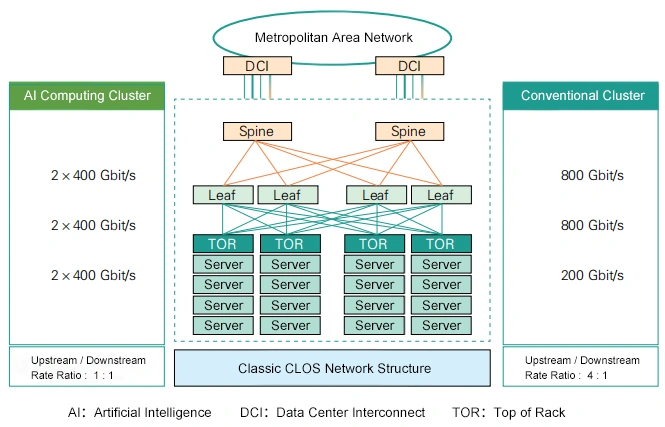
Figure 1: 800G Networking Architecture
3. Advantages of 800G
While 800G doubles the bandwidth of 400G, its true value lies in addressing current and future market needs:
- AI and large-model acceleration: AI clusters with tens of thousands of GPUs require extremely high interconnect bandwidth. 800G modules deliver higher throughput with fewer ports, easing network congestion.
- Smooth architectural transition: Most 800G modules adopt an 8×100G channel design and are compatible with the widely deployed QSFP-DD form factor. This allows phased upgrades without replacing existing switches or rack infrastructure.
- Energy efficiency: A single 800G module offers better power and space efficiency than two 400G modules, aligning with the trend toward high-density, low-power data centers.
- Mature industrial ecosystem: Breakthroughs in 112G SerDes rates, high-speed DSP chips, and silicon photonics integration have enabled reliable mass production of 800G modules.
4. Core Technologies Behind 800G
Achieving 800G performance requires innovation across several key technologies, each laying the groundwork for speed, reliability, and efficiency:
- PAM4 modulation: This 4-level pulse amplitude modulation scheme transmits 2 bits per symbol (vs. 1 bit for traditional NRZ), doubling the data rate without increasing the physical baud rate. It is the foundational technology that makes 800G feasible within existing optical fiber infrastructure.
- High-speed DSP chips: Acting as the “brain” of the module, next-gen DSPs compensate for signal distortion (e.g., chromatic dispersion, polarization mode dispersion) over long distances and support advanced forward error correction (FEC), ensuring error-free transmission even in complex network environments.
- Silicon photonics: By leveraging CMOS manufacturing processes, silicon photonics integrates optical components (lasers, modulators, detectors) onto a single chip. This reduces module size by 30%, lowers production costs by 20%, and improves scalability compared to traditional indium phosphide (InP) solutions.
- Thermal and power design: 800G modules operate at higher power densities than 400G, so manufacturers use advanced thermal interface materials (TIM), optimized heat sinks, and low-power component design to keep operating temperatures within 0–70°C, which is critical for stable performance in dense data center racks.
5. Application Scenarios
800G is not a “one-size-fits-all” upgrade but a targeted solution for high-value, high-demand use cases—with gradual expansion to broader markets:
- AI training and inference: The primary driver of 800G demand. Hyperscalers (Amazon, Microsoft, Google) and AI startups deploy 800G to connect GPU clusters, enabling faster model training and low-latency inference for real-time AI applications.
- Hyperscale data centers: Cloud providers use 800G for leaf-spine networks, reducing the number of ports and cables needed to handle exponential traffic growth. This lowers capital expenditure (CapEx) and operational expenditure (OpEx) while improving network agility.
- 5G and edge networks: As 5G advances to standalone (SA) mode and supports use cases like industrial IoT, AR/VR, and 4K/8K video streaming, 800G modules will replace 400G in high-traffic core networks and long-haul backhaul links, ensuring sufficient bandwidth reserve.
- High-performance computing (HPC): Research institutions and supercomputing centers adopt 800G to enable fast data exchange between compute nodes, accelerating scientific simulations, climate modeling, and genomic research.
6. AICPLIGHT 800G OSFP Optical Module Family
The AICPLIGHT 800G OSFP series makes a powerful debut, covering both Ethernet and InfiniBand NDR product lines. It sets a performance benchmark for AI data centers and supercomputing clusters, while also serving as a cost-effective choice for backbone network and 5G core network upgrades.
6.1 800G OSFP Ethernet Series
AICPLIGHT’s 800G OSFP optical transceivers are designed to support high-performance Ethernet networks, AI infrastructure, and large-scale GPU clusters with high bandwidth, low latency, and reliable optical performance.
Built on the latest 800G OSFP form factor, these optical modules support advanced PAM4 signaling technology and multi-lane 100G electrical interfaces, enabling seamless migration from 400G to 800G networking architectures.
The portfolio includes various 800G OSFP solutions such as 800G OSFP 2×SR4/SR8, 2×DR4/DR8, 2×FR4/FR8, providing flexible deployment options for different data center environments, from short-reach rack connections to long-distance data center interconnects.
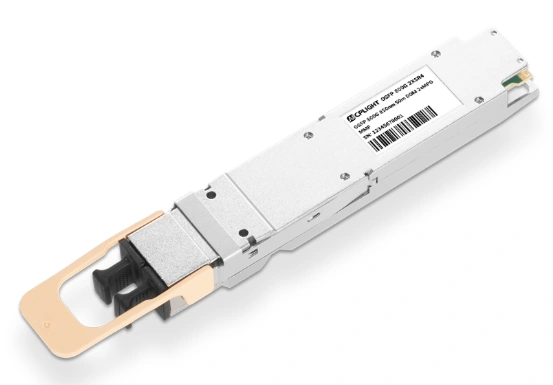
Figure 2: AICPLIGHT 800GBASE 2xSR4/SR8 OSFP Optical Transceiver
6.2 800G OSFP InfiniBand NDR Series
Built for NVIDIA InfiniBand NDR 800Gb/s networks, these OSFP NDR optical modules deliver 800Gbps aggregate throughput using 8×100G PAM4 lanes, enabling seamless communication between GPU servers, InfiniBand switches, and AI infrastructure components.
Available in multiple optical configurations, including 800G OSFP 2×SR4/SR8, 2×DR4/DR8, and 2×FR4/FR8 solutions, AICPLIGHT 800G OSFP InfiniBand NDR transceivers support different deployment requirements from short-reach rack-scale connections to longer-distance data center interconnects.
Key advantages include:
- 800Gb/s high-speed connectivity for AI and HPC workloads
- Low-latency InfiniBand NDR performance optimized for GPU clusters
- OSFP form factor with advanced thermal design for high-density switching platforms
- PAM4-based optical transmission supporting next-generation network architectures
- Reliable interoperability with NVIDIA Quantum-X800 and NDR InfiniBand ecosystems
Whether building large-scale AI training clusters, scientific computing platforms, or cloud HPC environments, AICPLIGHT’s 800G OSFP InfiniBand NDR optical transceivers provide the high-bandwidth optical foundation required for scalable AI networking.
7. Conclusion
The rise of 800G optical modules represents more than a doubling of data rates—it’s a critical step in the evolution of digital infrastructure. As AI, big data, and cloud computing continue to grow, demand for ultra-high bandwidth, low latency, and high energy efficiency will only intensify.
For data center operators, telecom providers, and enterprise IT teams, choosing the right 800G solution is critical to future-proofing networks. AICPLIGHT’s 800G OSFP family, with its seamless compatibility, superior performance, and cost-effectiveness, empowers organizations to tackle today’s most demanding connectivity challenges—serving as a trusted partner in the transition to the 800G all-scenario interconnection era.