
 English
As data centers, cloud computing, and enterprise networks demand higher bandwidth, traditional 10G networks struggle to meet high-speed interconnect requirements. The 25G SFP28 optical module has emerged as the mainstream choice for next-generation network upgrades, offering greater bandwidth density, lower power consumption, and superior transmission performance. This article provides a comprehensive overview of SFP28 modules—their definition, development background, types, and core advantages in practical applications.
1. What is an SFP28 Optical Module?
The SFP28 (Small Form-factor Pluggable 28) optical module supports a transmission rate of 25Gbps, where "28" denotes its single-channel theoretical maximum of 28Gbps. Although the theoretical rate approaches 28Gbps, the Ethernet standard specifies 25.78125Gbps, so the industry commonly refers to it as a 25G module.
Physically, SFP28 modules share the same dimensions as 10G SFP+ modules, making them nearly indistinguishable visually. However, they can be identified via label information.
2. Evolution of SFP28 Modules
Three primary methods exist to increase optical module speeds:
- Increasing channel count (e.g., QSFP's multi-channel approach).
- Boosting single-channel rates (e.g., SFP28's 25G vs. SFP+'s 10G).
- Adopting advanced modulation (e.g., PAM4 for higher spectral efficiency).
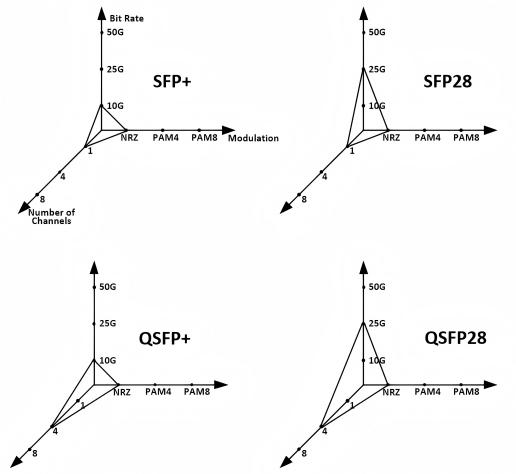
As network demands rapidly grow, traditional 10G networks struggle to handle higher bandwidth requirements. Engineers initially adopted a multi-channel approach, introducing the 40G QSFP+ optical module (4×10G). While 40G temporarily alleviated bandwidth constraints, it soon became inadequate as traffic volumes continued to rise.
Some engineers further increased channel counts, developing 100G CFP modules (10×10G), while others boosted single-channel rates, creating QSFP28 modules (4×25G).
Given the larger form factor of QSFP packaging compared to the higher port density enabled by SFP modules in the same space, engineers integrated 25G signals into SFP form factors, giving rise to SFP28 modules. Thus, the 25G SFP28 emerged later than the 40G QSFP+.
3. Types of 25G SFP28 Optical Modules
3.1 Standard 25G SFP28

Standard 25G SFP28 optical modules support transmission distances ranging from 100 meters to 40 kilometers, widely deployed in data centers, enterprise networks, and campus networks, particularly for server to access switch connections.
| Model | Type | Wavelength | Distance | Interface |
|---|---|---|---|---|
| SFP-25G-SR | MMF | 850nm | 100m | Duplex LC |
| SFP-25G-LR | SMF | 1310nm | 10km | Duplex LC |
| SFP-25G-ERL | SMF | 1310nm | 30km | Duplex LC |
| SFP-25G-ER | SMF | 1310nm | 40km | Duplex LC |
3.2 25G BIDI SFP28

The 25G BIDI SFP28 module enables bidirectional 25G data transmission over a single fiber, offering inherent fiber resource efficiency. It is primarily deployed for outdoor, inter-floor, or inter-building long-distance connections.
| Model | Type | Wavelength (Tx/Rx) | Distance | Interface |
|---|---|---|---|---|
| SFP-25G-U23-10 | SMF | 1270nm/1330nm | 10km | Simplex LC |
| SFP-25G-D32-10 | SMF | 1330nm/1270nm | 10km | Simplex LC |
| SFP-25G-U23-20 | SMF | 1270nm/1330nm | 20km | Simplex LC |
| SFP-25G-D32-20 | SMF | 1330nm/1270nm | 20km | Simplex LC |
| SFP-25G-U23-40 | SMF | 1270nm/1330nm | 40km | Simplex LC |
| SFP-25G-D32-40 | SMF | 1330nm/1270nm | 40km | Simplex LC |
3.3 25G WDM SFP28

The 25G WDM SFP28 module employs universal WDM wavelength division multiplexing technology.
- CWDM: 20nm channel spacing
- DWDM: 0.4nm channel spacing
By multiplexing multiple 25G signals onto a single fiber, they achieve high-capacity transmission while conserving fiber resources. These modules are commonly deployed in government networks requiring connections between distributed units across remote areas with long-distance transmission requirements.
| Model | Type | Wavelength Range | Distance | Interface |
|---|---|---|---|---|
| SFP-25G-CWxx-10 | CWDM | 1270~1370nm / 1470~1570nm | 10km | Duplex LC |
| SFP-25G-CWxx-20 | CWDM | 1270~1370nm | 20km | Duplex LC |
| SFP-25G-CWxx-40 | CWDM | 1270~1330nm | 40km | Duplex LC |
| SFP-25G-DWxx-10 | DWDM | 1528.77~1563.86nm | 10km | Duplex LC |
4. Advantages of 25G SFP28
- High Performance: The 25G SFP28 optical module delivers 2.5 times the input/output (I/O) performance and fiber capacity compared to 10G Ethernet.
- High Port Density: With the same compact form factor as SFP+, it enables higher port density within the same rack space.
- Cost Efficiency: Reduces total costs by minimizing ToR switch and cable requirements.
- Lower Power Consumption: Typically consumes less power than multi-channel modules achieving higher speeds.
- Seamless Upgrade Path: Offers a smoother transition to 100G QSFP28 than 40G QSFP+ (which requires 4x10G channels).


