
 English
As AI Large Language Models (LLMs) enter the trillion-parameter scale, the demands placed on interconnect networks for compute clusters have reached unprecedented heights. The network bandwidth leap from NDR (400G InfiniBand) to XDR (800G InfiniBand) is not merely a simple doubling of speed, but a profound transformation in network architecture and the selection of underlying transmission media.
In the mainstream DGX SuperPOD reference architecture, the NDR network offers flexibility, supporting 400G single-mode and multimode optical modules, as well as DAC copper cables up to 5m. However, the new generation XDR network (based on the NVIDIA Quantum-X800 platform) appears to be more selective: it only supports 800G single-mode optical transceivers, and strictly limits the usable distance of DAC copper cables to within 1.5m.
Does this shift imply that traditional multimode fiber and copper cables are becoming obsolete? What drives the XDR network, designed for hyperscale, to make such a singular choice regarding its optical transceiver selection?
NDR's Flexible Adaptability: Balancing Performance and Cost
To understand XDR's strict requirements, we first review the media strategy of the NDR (400G) era.
The core advantage of the NDR network lies in its flexible adaptability, allowing users to choose based on actual wiring distance and budget:
- Short-Distance Connection (≤5m): Uses DAC copper cables. Copper cables are low-cost and suitable for connections between servers and switches within the same rack, making them the preferred choice for short-distance scenarios.
- Medium-Distance Connection (≤100m): Uses multimode (MM) optical modules. Multimode fiber transceiver offers deployment flexibility in the data center, costs less than single-mode optical modules, and is suitable for links between adjacent racks.
- Long-Distance Connection (>100m): Uses single-mode (SM) optical modules. Single-mode fiber transceiver is preferred for its low loss, supporting long-distance connections across rows or equipment rooms.
This strategy achieved a robust balance of performance, cost, and deployment flexibility, perfectly suiting mainstream small-to-medium AI clusters (≤256 nodes).
XDR's Ultimate Singularity: A Technical Imperative Driven by Scale
The XDR network is engineered to support hyperscale AI factories (e.g., up to 2,592 nodes in a two-layer architecture) and trillion-parameter model training. In this context, performance, reliability, and scalability are non-negotiable, and the choice of transmission media must align with this core mission.
The reasons why XDR exclusively relies on the 800G single-mode optical transceiver are rooted in three technical necessities:
1.Eliminating Distance Bottlenecks, Meeting the Long-Distance Needs of Hyperscale Clusters
Hyperscale clusters inevitably involve distributed deployment, where connection distances far exceed the scope of a single equipment room.
The Uniqueness of Single-Mode Fiber Transceiver: To achieve lossless interconnection between thousands of nodes, the optical links usually need to cross multiple rows of racks or even span equipment rooms (distances often >100m). At the high data rate of 800Gb/s, only single-mode fiber can provide the required extremely low signal loss and dispersion characteristics, ensuring signal stability and integrity for a truly lossless network.
2.Physical Limits of Multimode and Copper at 800G Speed
At the 800G data rate, the physical limitations of traditional media are dramatically amplified:
- Multimode Fiber Limitation (High Modal Dispersion): Multimode fiber transmits signals through multiple light paths, which causes modal dispersion. At the ultra-high speed of 800G, modal dispersion severely degrades signal quality, making it unreliable for the medium-to-long-distance interconnection required by SuperPOD. Therefore, multimode is excluded from the core interconnect links.
- Copper Cable Limitation (High Attenuation): Signal attenuation in copper cables is proportional to the square root of the frequency. At 800G, the reliable transmission distance of even high-specification DAC cables is sharply reduced from 5m (at 400G) to 1.5m. This limits copper use exclusively to intra-cabinet connections.
3.Streamlined Selection for Zero Compromise Performance
In a highly complex network of thousands of nodes, unstable link performance at any point can lead to interruption or performance degradation of the entire training task.
XDR's mandate to use 800G single-mode optical modules (such as OSFP224 SM optical transceivers) is a strategy of design simplification and performance zero-compromise. It eliminates the complexity, troubleshooting difficulty, and inconsistent performance associated with mixing media types, ensuring that all core links operate at the highest standard.
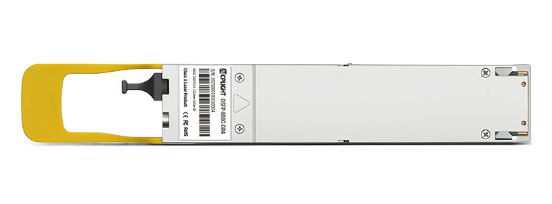
AICPLIGHT 800G DR4 OSFP224 InfiniBand XDR Optical Transceiver Module (MPO-12/APC, 1310nm, SMF, 500m)
Conclusion
The notion that "copper/multimode is obsolete" is misleading. The reality is a strategic "division of labor": they have been replaced by more specialized single-mode media in XDR's core interconnect, but they still hold value in niche applications.
| Media Type | XDR Network Positioning | Applicable Scenarios |
|---|---|---|
| 800G Single-Mode Optical Module | Absolute Core (Primary) | Inter-switch connection, cross-rack/cross-room long-distance connection (> 1.5m), ensuring lossless expansion of hyperscale clusters. |
| DAC Copper Cable | Auxiliary | Extremely short-distance connections (≤ 1.5m), such as connections between a switch and a management node within the same cabinet. |
| Multimode Optical Module | Not Applicable | Not suitable for XDR core high-speed links due to modal dispersion and distance limitations. |
In summary, the XDR network's preference for 800G single-mode optical modules is the inevitable outcome of its design goal for ultra-scale and ultra-high performance at the physical transmission layer. By using a more centralized and standardized media selection, it provides the most robust and reliable highway for AI large models.


