
 English
In today's era of explosive growth in computing power demand, data centers face unprecedented requirements for high bandwidth, low latency, and cost control. As the "cost-performance king" of short-distance interconnects, DAC (Direct Attach Copper Cables) high-speed cables are becoming critical components in AI clusters and high-performance computing environments, thanks to their core advantages of low power consumption and high stability. This article will take you on an in-depth exploration of DAC's technical details, structural composition, and application prospects in high-speed networks.
1. What is DAC?
A DAC (Direct Attach Cable) high-speed cable is a fixed-length cable assembly with connectors on both ends. While its connectors resemble optical modules in appearance, DAC is not a true optical module—it lacks internal laser components and performs no electro-optical or optical-electrical conversion. Instead, it transmits electrical signals directly over copper wires, making it incapable of optical signal transmission.
This simplicity in design gives DAC two key advantages: lower manufacturing costs and superior cost-effectiveness for short-distance applications compared to optical modules. It offers a balanced solution for high-speed interconnects, combining performance with economic efficiency.
2. How DAC Works
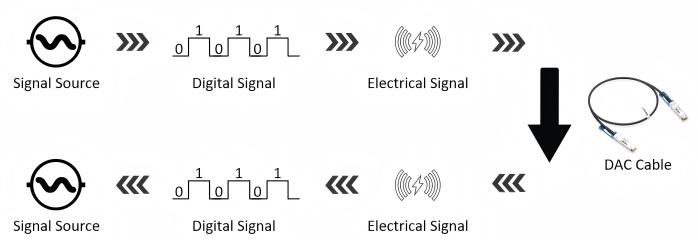
DAC is a passive cable composed of copper conductors that transmit high-speed electrical signals differentially between devices. Unlike active optical cables (AOCs), DAC contains no electronic components or signal-processing modules. Signals travel directly from one end to the other via the copper medium, featuring ultra-low latency and minimal power consumption.
3. DAC Components
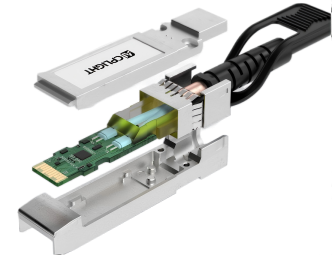
Connector Modules
Located at both ends of the DAC, these modules facilitate electrical signal transmission only and adopt industry-standard interfaces such as SFP, QSFP, QSFP-DD, and OSFP. Connectors can be designed in single-port, modular, or stacked configurations to accommodate varying equipment and port density requirements.
Cable
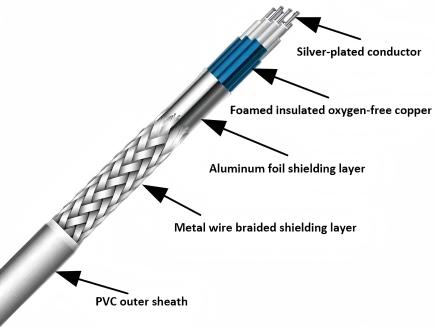
Constructed with silver-plated conductors and foamed insulation cores, the cable incorporates individual pair shielding and overall shielding to minimize crosstalk and signal attenuation, ensuring high-speed data transmission.
Outer Jacket
Typically made of PVC or LSZH (Low Smoke Zero Halogen) materials, the jacket protects the internal copper structure from mechanical stress while offering moisture resistance and fire safety. In environments with stringent fire safety requirements, such as data centers, LSZH is preferred for its low smoke emission and halogen-free composition, enhancing environmental and operational safety.
4.Internal Cable Design
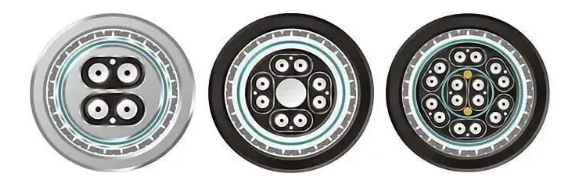
- Standard network Cables: Use copper twisted pairs for Ethernet signals, limited to ≤100 meters and prone to electromagnetic interference (EMI) in high-speed applications.
- DAC Cables: Employ high-performance differential pair structures, enabling higher transmission rates and bandwidth while offering superior resistance to electromagnetic interference. These cables maintain high-speed transmission capabilities while still supporting extended connection distances.
5.Classification of DACs
| DAC Type | Data Rate | Form Factor | Cable Gauge (AWG) | Max Distance | Power Consumption |
|---|---|---|---|---|---|
| 10G SFP+ DAC | 10 Gbps | SFP+ | 30AWG, 24AWG | 7 m | 0.01 W |
| 25G SFP28 DAC | 25 Gbps | SFP28 | 30AWG, 26AWG | 5 m | 0.01 W |
| 40G QSFP+ DAC | 40 Gbps | QSFP+ | 30AWG, 26AWG, 24AWG | 5 m | 0.01 W |
| 100G QSFP28 DAC | 100 Gbps | QSFP28 | 30AWG, 26AWG | 5 m | 0.01 W |
| 200G QSFP56 DAC | 200 Gbps | QSFP56 | 30AWG, 26AWG | 3 m | 0.01 W |
| 400G OSFP DAC | 400 Gbps | OSFP | 30AWG, 28AWG | 2.5 m | 0.01 W |
| 400G QSFP-DD DAC | 400 Gbps | QSFP-DD | 30AWG, 28AWG | 3 m | 0.01 W |
| 400G QSFP112 DAC | 400 Gbps | QSFP112 | 26AWG | 1.5 m | 0.01 W |
| 800G OSFP DAC | 800 Gbps | OSFP | 30AWG, 26AWG | 2.5 m | 0.01 W |
| 1.6T OSFP DAC | 1600 Gbps | OSFP | 27AWG | 1.5 m | 0.5 W |
6.Advantages of DAC
In scenarios requiring short-distance connections where cost sensitivity and ease of deployment/maintenance are priorities—DAC copper cables hold a distinct advantage. In real-world data center environments, both AOC and DAC solutions are often deployed simultaneously to meet diverse application needs.
Since DAC does not involve optical-electrical conversion and merely employs simple electrical connectors at both ends, its power consumption is nearly negligible. For AI clusters and large-scale computing scenarios, minimizing overall power consumption is particularly critical. Compared to active optical cables or other complex interconnect solutions, DACs deliver high performance while significantly reducing procurement and operational costs, offering enterprises superior cost-effectiveness.
7.The DAC Market
According to a report by authoritative research firm S&S Insider, the direct attach cable market size is projected to reach approximately $7.63 billion in 2024, growing to $112.17 billion by 2032. This represents a compound annual growth rate (CAGR) of 39.94% from 2025 to 2032.
This growth is primarily driven by widespread adoption across end-user sectors including data centers, telecommunications networks, and high-performance computing. These applications demand increasingly high-speed, low-latency interconnects. The gradual proliferation of 400G–800G DACs, coupled with the ongoing development of QSFP, CFP, and 800G DAC products, is fueling rapid market expansion.


