
 English
The explosive growth of AI, HPC, and cloud computing has made the 1.6T optical transceiver indispensable for next-generation, ultra-high-speed data center infrastructure. For large AI clusters, which demand lossless transport, ultra-low latency, and extreme bandwidth, 1.6T optical modules are critically deployed both within the rack (Scale-Up) and between racks (Scale-Out). Strategic selection of the optimal 1.6T transceiver and a trustworthy vendor is essential for building a resilient network.
What Is 1.6T Optical Transceiver?
The 1.6T optical transceiver represents the next evolutionary leap in high-speed optical networking, achieving a total bandwidth of 1.6 Terabits per second. This fundamental leap in capacity is driven entirely by significant increases in the electrical and optical lane rates, pushing the boundaries of signal processing and chip design.
The 1.6T optical module achieves its capacity using eight high-speed lanes, each operating at 200 Gbps (8 x 200G = 1.6T). This 200G/lane rate is achieved using PAM4 (Pulse Amplitude Modulation, 4-Level). This is a critical step up from the 100G/lane used in 800G modules, requiring significant advances in Digital Signal Processors (DSP), SerDes (Serializer/Deserializer) technology, and signal integrity.
Achieving this rate requires innovation in the electrical engine. Highly sophisticated DSPs are needed to manage signal integrity challenges (noise, dispersion) and perform complex equalization and error correction. Furthermore, next-generation networking silicon is adopting 224 Gbps SerDes lanes on the host side. This facilitates an optimized 1:1 mapping (8 x 200G: 8 electrical lanes @ 200G to 8 optical lanes @ 200G) which simplifies the module architecture.
This architectural simplification - potentially simplifying or removing the power-hungry DSP (leading to LPO designs) - delivers substantial benefits for AI clusters: reduced latency and lower power consumption, both essential for massive, synchronized computing workloads.
1.6T Optical Transceiver Form Factor: OSFP-XD vs. OSFP
When deploying 1.6T optical modules, the choice of form factor - OSFP or OSFP-XD - is a primary architectural consideration, especially for dense AI and HPC clusters where maximizing switch port density and thermal management is paramount.
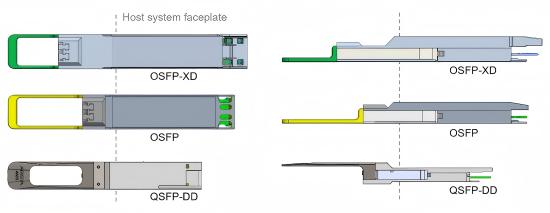
Figure 1: Host system faceplate of OSFP-XD vs OSFP vs QSFP-DD (Source: OSFP1600 and OSFP-XD MSA)
The OSFP-XD (Extra Density) form factor has rapidly become the absolute mainstream for 1.6T deployments. It features a slightly longer physical design than the standard OSFP, allowing it to accommodate more complex optical and electrical components required for 1.6T signaling.
Density and Capacity: The OSFP-XD is engineered for maximum packaging efficiency in 1.6T modules. This design allows high-performance switches to pack a remarkable 32 ports of 1.6T into just one rack unit (1RU) of space. This compact setup achieves a massive 51.2 Terabits per second (51.2T) switching capacity per 1RU, which essentially doubles the bandwidth density you could get with previous generation 800G solutions.
Thermal Management: The form factor design provides superior thermal headroom and excellent heat dissipation capability, which is essential for managing the high power demands of 1.6T DSPs and the 8 x 200G optical engines.
The OSFP (Octal Small Form-factor Pluggable), though more commonly associated with 400G and 800G, is also being adapted for 1.6T as the OSFP1600 (or OSFP 224G).
Thermal Performance: The standard OSFP is relatively larger than QSFP-DD, offering proven excellent thermal performance and supporting higher overall power consumption, which may be beneficial if the priority is extreme heat dissipation and power control rather than maximum density.
The selection between OSFP-XD and OSFP should be demand-driven:
| Criterion | OSFP-XD (Extra Density) | Standard OSFP (OSFP1600) |
|---|---|---|
| Primary Goal | Extremely high port density and panel space utilization. | Superior heat dissipation and flexible power control. |
| Typical Use | AI/HPC clusters requiring 51.2T or greater switch capacity per 1RU. | Deployments where thermal budget is critically limited. |
1.6T Optical Transceiver Solution and Deployment
The selection of the appropriate 1.6T module requires a comprehensive consideration of transmission distance, fiber type, power consumption, and thermal performance. Take AICPLIGHT 1.6T DR8 and FR8 for example:
| Part Number | OSFP-1.6T-2DR4 | OSFP-1.6T-2FR4 |
|---|---|---|
| Data Rate | 2x 800Gb/s 2x DR4 | 2x 800Gb/s 2x FR4 |
| Form Factor | Twin-port OSFP (Finned Top) | Twin-port OSFP (Finned Top) |
| Wavelength | 1310nm | 1271nm, 1291nm, 1311nm and 1331nm |
| Optical Connector | Dual MPO-12/APC | Dual Duplex LC/UPC |
| Configuration | 8x 200G-PAM4 Electrical to Dual 4x 200G-PAM4 Optical Parallel | 8x 200G-PAM4 Electrical to Dual 4x 200G-PAM4 Optical Multiplexed |
| Reach | 500m | 2km |
| Max Power Consumption | 30W | 30W |
| Matching Cables | Single-mode Fiber Cables | Dual 2-fiber LC Single-mode Cables |
The AICPLIGHT 1.6T OSFP modules share the Twin-port OSFP (Finned Top) form factor and a dual engine architecture, logically integrating two independent 800Gb/s links (2x DR4 or 2x FR4). This design enables seamless "Breakout" functionality, allowing a single 1.6T port to simultaneously connect to two separate 800G devices. By directly inheriting the established 800G standards, this structure effectively mitigates interoperability challenges and provides data centers with a smooth, phased upgrade path from 800G to 1.6T, maximizing asset utilization. The two modules primarily differ in reach and optical technology:
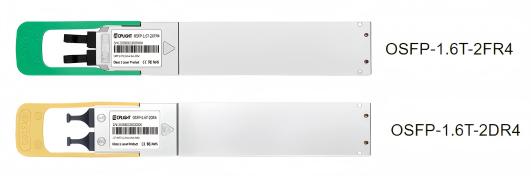
Figure 2: AICPLIGHT 1.6T OSFP modules - OSFP-1.6T-2DR4 and OSFP-1.6T-2FR4
The OSFP-1.6T-2DR4 focuses on medium-reach (500m) applications, utilizing 4x 200G-PAM4 Parallel Optics and a Dual MPO-12/APC connector. Operating at the 1310nm wavelength, it is ideal for high-density, intra-data center spine-to-leaf architectures requiring breakout capability.
The OSFP-1.6T-2FR4 is designed for long-reach (2km) applications, employing Wavelength Division Multiplexing (WDM) technology. It uses a Dual Duplex LC/UPC connector, significantly conserving fiber count, making it the optimal choice for DCI (Data Center Interconnect) or large campus backbone links.
1.6T Optical Transceiver Supplier Evaluation
Selecting an excellent 1.6T optical module supplier is as crucial as choosing the product itself. Given the extremely high demands for precision and stability in the optical and electrical components of 1.6T modules, vendor assessment must cover the following core dimensions.
Production Quality & KPIs: Thoroughly investigate the vendor's automated production lines and stringent QC systems. Demand detailed reports on Bit Error Rate (BER), aging tests, and high/low-temperature stability to measure long-term reliability.
Compatibility Validation: Prioritize vendors with proven compatibility testing reports against major network equipment (e.g., Cisco, Juniper, Arista) to ensure seamless integration.
Technical Support: An outstanding supplier must possess robust and fast-responding technical support capabilities, including deployment guidance and deep-level debugging services for emerging 1.6T technology.
Supply Chain Stability: Inquire about the vendor's stocking strategy and standard lead times to clearly understand their production elasticity and ensure an uninterrupted supply during large-scale AI infrastructure expansion. Cost evaluation should be based on Total Cost of Ownership (TCO), factoring in purchase price, power consumption costs, and warranty services.
Conclusion
The 1.6T network demands stability that goes beyond standard specifications. AICPLIGHT understands the rigorous precision required and is committed to delivering multi-validated solutions. We ensure industry-leading precision through our strict QC systems and provide comprehensive reports on BER and stability. Crucially, AICPLIGHT modules have undergone rigorous compatibility validation, guaranteeing seamless, plug-and-play integration. As your partner, we offer robust technical support and maintain an elastic supply chain strategy, providing predictable lead times to ensure your AI expansion plans are not delayed. By adopting these strategic selection and evaluation criteria, you will equip your ultra-scale network infrastructure with the highest quality and most reliable 1.6T optical transceivers, fully prepared for future data growth.


