
 English
In recent years, demand for 200G and 400G networks in data centers has continued to rise. With the rapid advancement of artificial intelligence (AI) technology, many high-performance computing (HPC) data centers have already adopted 800G or even higher-bandwidth interconnect architectures. However, in traditional enterprise data centers, 400G is still in the large-scale deployment phase, becoming the current mainstream upgrade target. Against this backdrop, the 400G optical transceiver market is dominated by two primary form factors: QSFP-DD and OSFP. A deep understanding of their design, performance, and application differences can help enterprises make more informed and forward-looking decisions in infrastructure planning.
QSFP-DD (Quad Small Form Factor Pluggable - Double Density)
The "Double Density" in its name refers to doubling the data transmission capacity compared to traditional QSFP series (e.g., QSFP+, QSFP28) by increasing the number of electrical channels.
By adopting PAM4 (4-level Pulse Amplitude Modulation) technology, each channel supports data rates up to 50 Gb/s, and with 8 electrical channels, it achieves a total 400 Gb/s high-speed optical transmission. This capability makes it widely applicable in high-density, high-throughput data center environments.
OSFP (Octal Small Form Factor Pluggable)
OSFP is a new pluggable packaging standard designed for next-generation high-speed optical communications. Based on PAM4 modulation technology, it supports 50 Gb/s per channel, aggregating to 400G total bandwidth. Furthermore, OSFP was designed with better thermal management and power efficiency, making it more suitable for future upgrades to 800G and even 1.6T technologies.
QSFP-DD vs OSFP
1. Physical Dimensions
| Parameter | QSFP-DD | OSFP |
|---|---|---|
| Width | 18.35 mm | 22.58 mm |
| Length | 89.4 mm | 107.8 mm |
| Thickness | 8.5 mm | 13.0 mm |
QSFP-DD offers higher port integration capability per unit height (1U) on rack panels, accommodating up to 40 ports due to its more compact form factor. In contrast, OSFP's larger size limits deployment to a maximum of 36 ports. Consequently, QSFP-DD is a better choice in space-constrained environments.
2. Power Consumption & Thermal Performance
Due to the compact physical dimensions, QSFP-DD modules have limited overall thermal capacity, with a typical power range of 7–12W, making them suitable for power-sensitive deployments.
In contrast, OSFP leverage larger form factor to deliver superior thermal management, supporting thermal design powers (TDP) of 12–15W. This enables integration of more complex optical engines, particularly suitable for long-haul transmission, high-order modulation, or future 800G/1.6T deployments.
3. Forward Compatibility
The key ecosystem advantage of QSFP-DD lies in its backward compatibility: it directly supports earlier QSFP family modules, including QSFP+ (10G), QSFP28 (100G), and QSFP56 (200G).
OSFP lacks native compatibility. Connecting to QSFP-series equipment requires dedicated OSFP-to-QSFP adapters, which increases deployment complexity and introduce signal integrity risks. Nevertheless, OSFP was designed not to extend legacy ecosystems but to serve as a future-proof platform for ultra-high-speed networks, justifying its "generational leap" approach.
Mainstream 400G Optical Modules (QSFP-DD & OSFP)
| Model | Distance | Fiber Type | Wavelength | Connector |
|---|---|---|---|---|
| QSFP-DD SR4 | 50m | Multimode | 850nm ×4 channels | MPO-12 |
| QSFP-DD SR8 | 100m | Multimode | 850nm ×8 channels | MPO-16 |
| QSFP-DD DR4 | 500m | Single-mode | 1310nm ×4 channels | MPO-12 |
| QSFP-DD FR4 | 2km | Single-mode | CWDM4 ×4 channels | LC Duplex |
| QSFP-DD LR4 | 10km | Single-mode | CWDM4 ×4 channels | LC Duplex |
| QSFP-DD LR8 | 10km | Single-mode | 1310nm ×8 channels | LC Duplex |
| QSFP-DD ER8 | 40km | Single-mode | 1310nm ×8 channels | LC Duplex |
| QSFP-DD ZR | 80km+ | Single-mode | Coherent technology | LC Duplex |
| OSFP SR4 | 50m | Multimode | 850nm ×4 channels | MPO-12 |
| OSFP SR8 | 100m | Multimode | 850nm ×8 channels | MPO-16 |
| OSFP DR4 | 500m | Single-mode | 1310nm ×4 channels | MPO-12 |
Analysis of 400G Interconnect Solutions for Data Centers
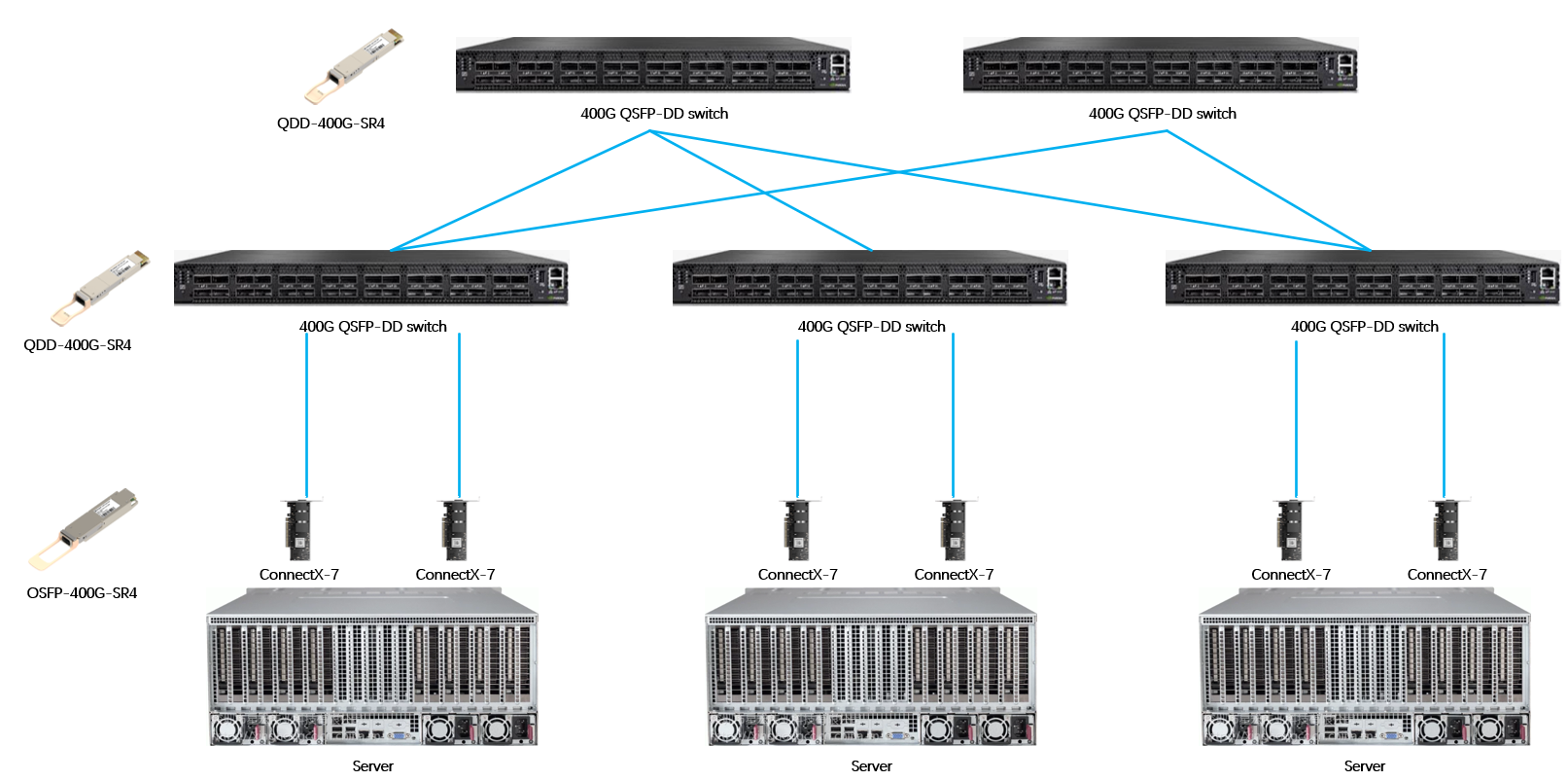
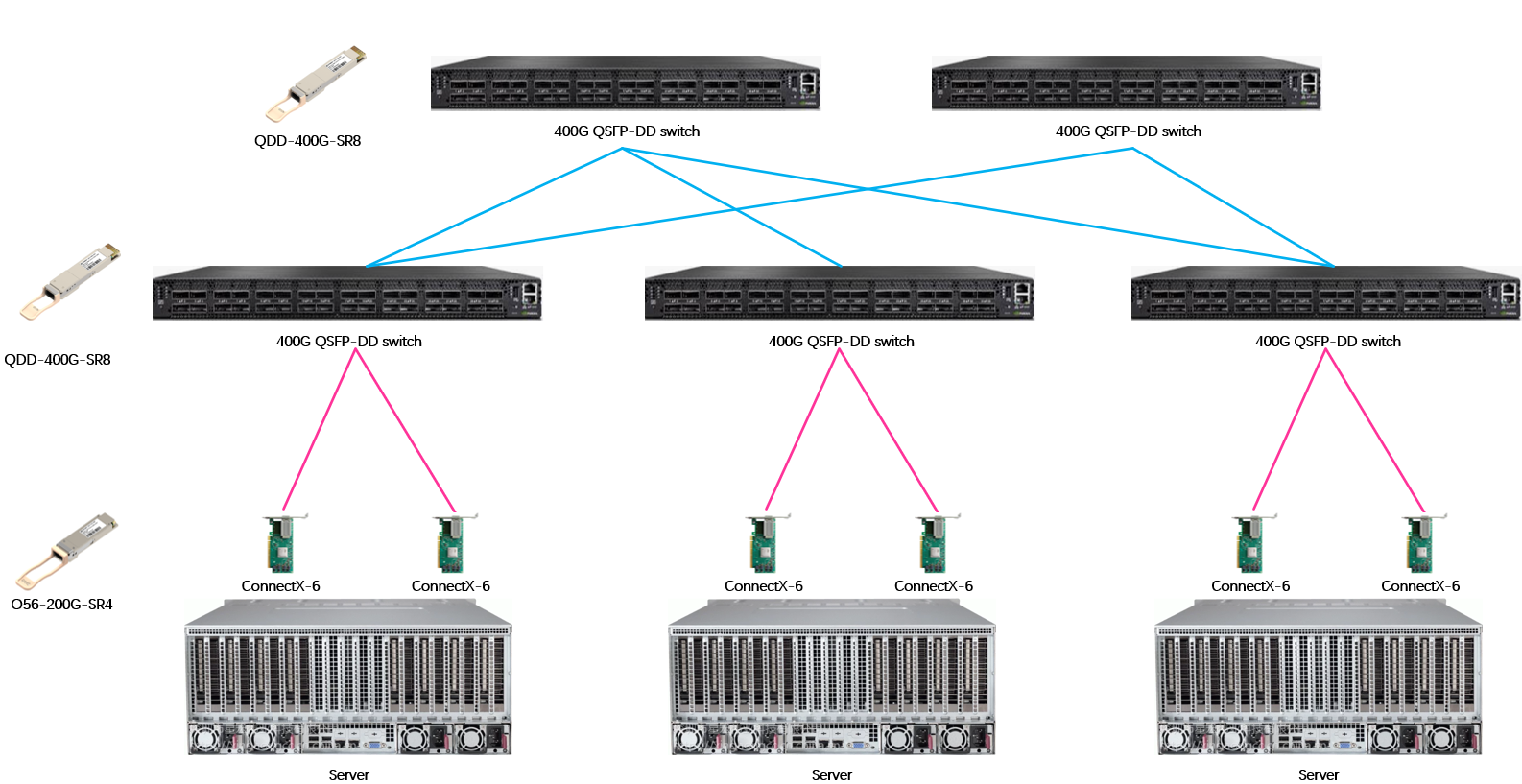
The core components of modern data centers primarily include: switches, servers (equipped with high-speed NICs), and fiber patch cord systems. With the surge in east-west traffic, the traditional three-layer network architecture (access-aggregation-core) has been replaced by a flatter, lower-latency Leaf-Spine network structure.
In the Leaf-Spine architecture, the network is divided into two critical layers:
- Server-Leaf Connections: Handle high-speed interconnects between servers and access-layer switches.
- Leaf-Spine Connections: Form a non-blocking, fully meshed backbone network, determining the overall bandwidth capacity.
The choice of high-speed NICs on the server side directly dictates the specifications and speed requirements of optical modules. Leading industry vendors currently widely adopt NVIDIA's ConnectX-6 or ConnectX-7 series smart NICs, which natively support 200/400Gbps interface outputs, driving the entire link toward comprehensive migration to 400G.
Meanwhile, switch platforms are evolving diversely, with key chip solutions including:
Broadcom Tomahawk 4 (25.6T)-based switches: 64×400G QSFP-DD configurations.
Broadcom Tomahawk 5 (51.2T)-based switches: 64×800G designs enable future-proof upgrades.
Cisco's high-end data center switches: Based on proprietary Nexus chips.
NVIDIA Spectrum series switches: Deeply integrated with DPUs and AI-optimized networking, supporting flexible 400G/800G deployments.
400G Optical Connectivity Solution Based on ConnextX-7 Network Interface Card
400G Optical Connectivity Solution Based on ConnextX-6 Network Interface Card
While 800G is being piloted by leading cloud providers and AI training facilities, 400G QSFP-DD remains the most mature and cost-effective mainstream choice for the broader market. It is particularly well-suited for mid-to-large enterprise data centers' mid-term upgrade plans.
Overview of Major 400G Optical Module Suppliers
With the explosive demand for high-speed optical modules, China's domestic supply chain has rapidly emerged, giving rise to globally competitive core suppliers:
1. Eoptolink
A key player in optical communications, Eoptolink is not only a critical partner for NVIDIA's 1.6T optical modules but also pioneered the mass production of 800G LPO (Linear-drive PAM4 Optical) modules within the industry. Its products are widely deployed in large-scale data centers and 5G infrastructure, securing significant global market share through cost-efficiency advantages.
2. Accelink
A leader in China's full-chain optical component ecosystem, possessing complete vertical integration capabilities from chips to devices and modules. The company has unveiled a 1.6T liquid-cooled optical module prototype and boasts deep expertise in high-speed optical engines, silicon photonics, and thermal management. It is a key participant in national strategic projects.
3. InnoLight
A global market leader in optical modules, InnoLight has consistently ranked among the top in worldwide market share. As NVIDIA's core supplier for 1.6T modules, it leads in silicon photonics integration and COB (Chip-on-Board) packaging technologies. Its product portfolio covers multiple speeds and packaging formats, with deep market penetration in the 800G and 1.6T high-speed segments.
4. HG Tech
Operating across laser equipment and optical communications, HG Tech excels in cutting-edge R&D. Its advancements in CPO (Co-Packaged Optics) and LPO architectures have drawn significant industry attention.
Market Trends & Strategic Shifts
Leading suppliers are now prioritizing 800G, 1.6T, and even 3.2T ultra-high-speed modules, shifting focus to high-barrier fields like AI compute clusters and next-gen silicon photonics/CPO technologies. Meanwhile, third-party manufacturers are rapidly addressing the market gap, optimizing mid-range demand for cost-effective, highly compatible solutions.
Conclusion
400G is not only a critical milestone for current data center upgrades but also a essential pathway to the 800G/1.6T/3.2T era. Whether selecting the highly compatible, high-density QSFP-DD or focusing on the long-term scalability of the OSFP platform, enterprises must evaluate their specific workloads, rack space, thermal constraints, and upgrade paths—to make informed decisions.


