
 English
With the large-scale deployment of trillion-parameter AI large models such as multimodal LLMs , and the emergence of new computing scenarios like distributed training and real-time inference, the east-west traffic inside data centers is growing at an annual rate of over 50%. Against this backdrop, traditional 800G optical modules have reached their physical performance limits. As the core carrier of next-generation interconnection technology, 1.6Tbps optical modules are rapidly moving from the technical verification phase to commercial implementation, gradually becoming a key infrastructure supporting AI computing clusters and supercomputing center networks. For data center applications, the 1.6T optical transceiver brings a notable upgrade: it introduces 224G signaling per lane, which is twice the 112G lane capacity of existing 800G transceivers.
Core Scenario Drivers for 1.6T Optical Modules
The core scenario drivers for 1.6T optical modules essentially stem from the computing and network interconnection needs for higher bandwidth, lower latency, and better energy efficiency. These drivers are particularly concentrated in fields such as AI computing clusters, ultra-large-scale data centers, next-generation communication networks, and high-end supercomputing centers. Specifically, they can be broken down into the following core scenarios:
1. AI Computing Clusters: The Data Artery Supporting Large-Model Training and Real-Time Inference
This is the most core driver scenario for 1.6T optical modules. With the large-scale deployment of trillion-parameter multimodal LLMs and generative video models (e.g., Sora), AI training requires connecting thousands or even tens of thousands of GPU/TPU chips to form computing clusters. The interconnection bandwidth between chips and between servers directly determines training efficiency. Meanwhile, large-model inference needs to respond to massive user requests in real time, imposing extremely high requirements for low-latency transmission.
Specific Requirements: Traditional 800G optical modules can only support interconnection in small to medium-scale clusters. With double the bandwidth, 1.6T optical modules can reduce the number of interconnection links, lowering cluster complexity and, through silicon photonics technology, reduce transmission latency, typically 10%-20% lower than that of 800G modules, making them suitable for new computing scenarios such as distributed training and real-time inference.
Core Value: 1.6T optical modules resolve the bandwidth bottleneck of AI computing clusters and ensure the efficiency of large-model training and the response speed of inference.
2. Ultra-Large-Scale Data Centers: The Internal Connector Addressing Explosive East-West Traffic
Inside ultra-large-scale data centers, the east-west traffic between servers, and between servers and storage devices, is growing at an annual rate of over 50%. This growth stems from the popularization of cloud computing, cloud storage, and big data analytics, as well as the demand for localized processing of AI tasks within data centers.
Specific Requirements: The single-link bandwidth of traditional 800G optical modules can no longer accommodate the surging east-west traffic. Simply increasing the number of 800G links would double the cabinet space occupancy and power consumption costs. A 1.6T optical module can achieve 1.6Tbps bandwidth on a single link, equivalent to replacing 2x 800G links with 1 link. This not only saves cabinet U-space (with a 50% increase in integration) but also reduces overall power consumption (power consumption per Gbps is 25%-30% lower than that of 800G modules).
Core Value: 1.6T optical transceivers solve the capacity expansion challenge of east-west traffic in data centers with higher integration and lower power consumption while controlling operating costs.
3. High-End Supercomputing Centers: The High-Speed Data Channel Serving Scientific Computing
High-end supercomputing centers mainly undertake large-scale scientific computing tasks such as weather forecasting, aerospace simulation, quantum computing assistance, and biopharmaceutical R&D. These tasks require connecting tens of thousands of high-performance computing chips and transmitting massive experimental data at the PB level (1PB = 1024TB), imposing strict requirements on bandwidth density and transmission stability.
Specific Requirements: Traditional supercomputing centers mostly use 100G/400G optical modules, which can no longer meet the data transmission needs of exascale supercomputing. Through wavelength division multiplexing (WDM) technology, 1.6T optical modules can achieve multi-channel 1.6T transmission in a single optical fiber, increasing the interconnection bandwidth density of supercomputing clusters. Additionally, their high stability based on silicon photonics technology with a failure rate 30% lower than that of traditional optical modules ensures the continuous and uninterrupted operation of scientific computing tasks.
Core Value: 1.6T optical transceivers break through the interconnection bottleneck of exascale supercomputing and support the efficient execution of high-end scientific computing tasks.
The core scenario drivers for 1.6T optical modules are essentially the joint impetus of four major needs - AI computing power, data traffic, network upgrades, and scientific computing. 1.6T optical transceiver is not only a carrier of next-generation interconnection technology but also a key infrastructure supporting the evolution of the digital economy toward higher computing power and denser interconnection.
Overview of AICPLIGHT 1.6T Optical Modules
The AICPLIGHT 1.6T optical modules serve as an efficiency engine for AI large models. Leveraging the super-integration advantages of silicon photonics technology, 1.6T single-link bandwidth directly delivers twice the transmission capacity of 800G modules. It can reduce the number of GPU cluster interconnection links by 50% and shorten the distributed training cycle by 15%-20%. Meanwhile, with end-to-end latency as low as the microsecond level, it easily handles massive user requests in real-time inference scenarios, turning the vision of sub-second response for 100-billion-parameter models into reality.
Designed specifically for ultra-large-scale data centers, AI clusters, and high-performance computing scenarios, the AICPLIGHT 1.6T optical modules feature high integration of replacing 2x 800G links with 1 link. It saves up to 40% of cabinet U-space and reduces power consumption per Gbps by 25%-30% compared to traditional modules, cutting energy costs for data centers by millions of kilowatt-hours annually. This strikes an optimal balance between capacity expansion and cost control. AICPLIGHT 1.6T optical modules portfolio covers short to medium-reach applications, meeting the transmission needs of different scenarios.
1.6T Optical Transceiver Model: OSFP-1.6T-2DR4
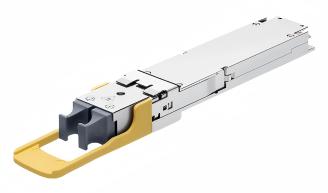
The OSFP-1.6T-2DR4 optical transceiver is a 1.6T 2x 800Gb/s Twin-port OSFP, 2xDR4/DR8 single mode, parallel, 8-channel transceiver using two, 2-fiber, 4-channel MPO-12/APC optical connectors at 800Gb/s each. The parallel single mode, short reach 8-channel (2xDR4/DR8), uses 200G-PAM4 modulation and has a maximum fiber reach of 500-meters using 8 single mode fibers. It is qualified for use in InfiniBand XDR end-to-end systems. It is the ideal solution for supercomputing and HPC industries, seamlessly integrating into computing and storage infrastructure to ensure efficient high-performance interconnectivity. The Finned top (OSFP-RHS) version is suitable for liquid-cooled switches.
1.6T Optical Transceiver Model: OSFP-1.6T-2FR4
The OSFP-1.6T-2FR4 optical transceiver is a 1.6T 2x 800Gb/s Twin-port OSFP, 2x FR4 single mode, Multiplexed, 8-channel transceiver using two, 2-fiber, LC Duplex optical connectors each carrying 4-channels of 200G-PAM4. The dual far reach 8-channel (2x FR4) design uses 200G-PAM4 electrical and optical modulation based on the CWDM4 serial, multiplexed 1310nm wavelength grid. It is qualified for use in InfiniBand XDR end-to-end systems. It is the ideal solution for supercomputing and HPC industries, seamlessly integrating into computing and storage infrastructure to ensure efficient high-performance interconnectivity. The Finned top (OSFP-RHS) version is suitable for liquid-cooled switches.

Summary
Against the backdrop of the growing contradiction between computing power demand and physical limitations, the 1.6T optical module, with its ultra-high speed, low latency, and high energy efficiency, has become a core cornerstone for building the next-generation intelligent computing network. AICPLIGHT is a leading innovator in network infrastructure solutions, specializing in optical transceivers. With 15+ years of expertise, AICPLIGHT delivers high-performance, scalable, and cost-efficient networks. From design to deployment, AICPLIGHT delivers dependable end-to-end connectivity solutions for mission-critical networks. Visit www.aicplight.com for more details.


