
 English
As generative AI models like GPT-5 push compute requirements to unprecedented levels, the interconnect technology that binds GPU clusters together is being tested against its physical limits. While the industry is currently scaling 800G and early 1.6T deployments, strategic attention has already shifted to the next critical milestone: 448G SerDes. This is not merely an incremental speed upgrade; it represents a fundamental leap in engineering complexity. By doubling the per-lane bandwidth of 224G SerDes, this technology addresses the massive interconnect bottlenecks emerging as AI clusters grow to tens of thousands of nodes.
224G vs 448G SerDes: Key Differences
| Parameter | 224G SerDes | 448G SerDes |
|---|---|---|
| Data Rate per Lane | 224Gbps | 448Gbps |
| Nyquist Frequency | ~56GHz | ~112GHz |
| Modulation | PAM4 | PAM4 / PAM6 / PAM8 |
| Copper Reach | ~1–2 meters | <0.5 meters |
| Power Consumption | Moderate | Very High |
The transition from 224G to 448G is not simply a linear upgrade in speed. Instead, it represents a fundamental shift in how electrical signals behave and how interconnect systems must be engineered. At these speeds, traditional design assumptions begin to break down, forcing a rethinking of materials, architectures, and system-level optimization.
The Physical Challenge: When Signals Hit the "Copper Wall"
At 448Gbps per lane, electrical signals approach the physical limits of copper transmission.
Extreme Insertion Loss
With PAM4 modulation, the Nyquist frequency exceeds 112GHz. At this frequency, even advanced low-loss PCB materials experience severe attenuation. As a result:
-
Passive copper cables (DAC) may be limited to less than 0.5 meters
-
Signal degradation becomes a dominant design constraint
Reflection and Crosstalk Challenges
At ultra-high frequencies, even microscopic imperfections in PCB traces, vias, and connectors can cause:
-
Significant signal reflections
-
Increased crosstalk between channels
This forces engineers to optimize signal integrity (SI) at unprecedented precision levels.
PAM4 vs PAM6 vs PAM8: The Modulation Debate
One of the biggest technical decisions in the 448G era is the choice of modulation scheme.
PAM4: Extending a Mature Ecosystem
Starting from the 56G era, PAM4 (4-Level Pulse Amplitude Modulation) has become the standard modulation scheme for high-speed SerDes. By encoding 2 bits of information per symbol period, PAM4 effectively halves the required Nyquist bandwidth. In a 224G PAM4 architecture, the symbol rate hits 112 GBaud, requiring a channel 3dB bandwidth close to 56 GHz.
As data rates scale to 448 Gbps, continuing with PAM4 would push the symbol rate to 224 GBaud, demanding a channel 3dB bandwidth exceeding 112 GHz. This presents an ultimate challenge for contemporary electrical channels, connectors, packaging, and EDA simulation tools.
PAM6 / PAM8: Lower Bandwidth, Higher Complexity
To achieve 448 Gbps without drastically increasing the symbol rate, the industry is evaluating several alternative schemes. Higher-order modulation schemes such as PAM6 and PAM8 offer an alternative path. By increasing the number of signal levels, they reduce the required symbol rate and ease bandwidth pressure on channels and components. However, this benefit comes at the cost of significantly reduced signal-to-noise ratio (SNR), increased DSP complexity, and higher power consumption. As a result, the industry has yet to reach a clear consensus, and both approaches continue to be actively explored.
| Modulation Scheme | Symbol Rate | Bits/Symbol | SNR Requirement | Complexity |
|---|---|---|---|---|
| PAM4 @ 448G | 224 GBaud | 2 | Medium | Low |
| PAM6 @ 448G | ~173 GBaud | ~2.58 | High | Medium |
| PAM8 @ 448G | ~149 GBaud | 3 | Very High | High |
| DMT/OFDM | Multi-carrier | Variable | High | Very High |
PAM8 encodes 3 bits per symbol, which reduces the symbol rate to approximately 149 GBaud. However, its Signal-to-Noise Ratio (SNR) requirement is roughly 9.5 dB higher than that of PAM4—a penalty that is almost intolerable for electrical channels. Consequently, the current industry consensus leans toward achieving 448G within the PAM4 framework by enhancing channel bandwidth and DSP capabilities, rather than prematurely jumping to higher-order modulations.
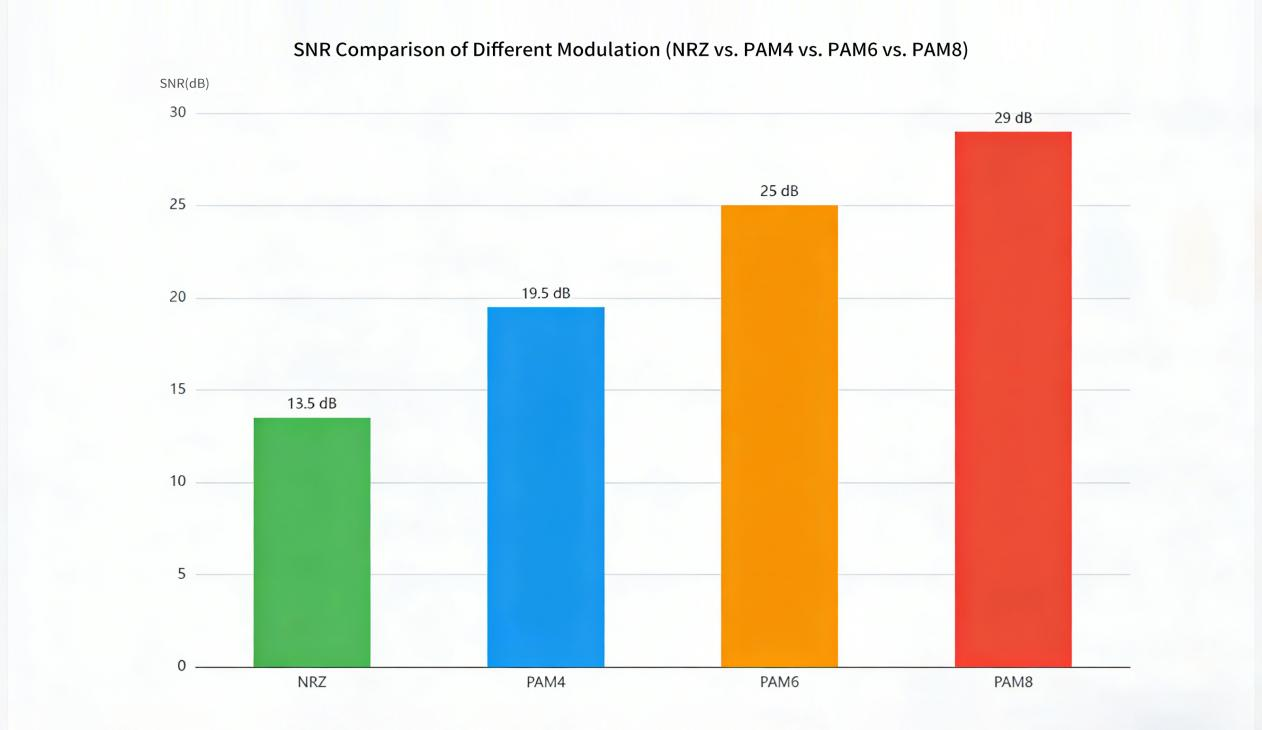
Figure 1: SNR Comparison of Different Modulation (NRZ vs. PAM4 vs. PAM6 vs. PAM8)
As illustrated above, the SNR requirement increases non-linearly with each step up in modulation order. This directly limits the feasibility of higher-order modulations in short-reach copper cables and PCB channels.
The Three Key Technologies Enabling 448G
Bringing 448G SerDes from concept to commercial deployment requires breakthroughs across several key technology domains.
Advanced DSP on 3nm Process Nodes
448G SerDes requires significantly more complex digital signal processing. Advanced semiconductor nodes (3nm and beyond) are essential to handle the exponential increase in signal processing complexity while keeping power consumption within acceptable limits. Without these advances, the thermal and energy constraints of 448G systems would be prohibitive.
LPO vs CPO: The Architecture Shift
As electrical reach on PCBs continues to shrink, solutions such as Linear-drive Pluggable Optics (LPO) and Co-Packaged Optics (CPO) are becoming increasingly important. LPO offers advantages in power efficiency and latency but is more sensitive to signal quality, while CPO minimizes electrical path length by integrating optical engines directly with switching ASICs, making it a long-term solution for 448G and beyond.
Next-Generation Testing Infrastructure
Testing and validation infrastructure must evolve to keep pace. 448G systems require oscilloscopes with bandwidths exceeding 140GHz and highly advanced bit error rate testing capabilities. This represents a substantial increase in complexity compared to previous generations and poses new challenges for both vendors and system integrators.
Reshaping the 3.2T Era with 448G
The maturity of 448G SerDes will directly usher in the era of 3.2T optical modules.
Doubling Port Density: By utilizing eight 448G lanes, a single module (in a form factor like OSFP) can achieve a massive 3.2T throughput. This means the switching capacity within the same data center rack footprint can effectively double.
The "Neurons" of GPU Clusters: Next-generation hyperscale AI clusters—likely built on 224G/448G interfaces for future GPU architectures—will rely on this extreme bandwidth to ensure seamless collaboration across tens of thousands of GPUs, eliminating communication latency as a bottleneck for collective intelligence.
From 800G to 3.2T: Where We Are Today
The industry is currently in a transition phase:
-
800G optical modules are being widely deployed
-
1.6T transceiver is entering early adoption
-
3.2T module (enabled by 448G SerDes) is under development
Forward-looking data center operators are beginning to prepare for this shift, recognizing that early adoption of enabling technologies will be critical for maintaining competitive performance.
Conclusion
448G SerDes is more than just a speed upgrade—it represents a fundamental shift in interconnect technology. As AI infrastructure continues to scale, mastering 448G will be critical for enabling the next generation of high-performance data centers.


